The AI Advantage: Empowering Young Entrepreneurs with Artificial Intelligence Tools for Business Development and Marketing
This comprehensive report examines The AI Advantage: Empowering Young Entrepreneurs with Artificial Intelligence Tools for Business Development and Marketing through extensive research and analysis.
Key Research Takeaways
- Comprehensive Analysis: This report covers all major aspects of The AI Advantage: Empowering Young Entrepreneurs with Artificial Intelligence Tools for Business Development and Marketing
1. Executive Summary
The dawn of Artificial Intelligence (AI) has heralded a transformative era across industries, profoundly reshaping the landscape for entrepreneurs, particularly the younger generations. This executive summary encapsulates the pivotal findings of extensive research into the adoption, benefits, challenges, and future outlook of AI integration among young entrepreneurs for business development and marketing. The data overwhelmingly demonstrates that AI is no longer an emerging technology but a mainstream tool for Gen Z and Millennial business owners, empowering them to achieve unprecedented levels of efficiency, cost savings, and accelerated growth, even on constrained budgets. However, the summary also highlights a generational and size-based adoption gap, alongside persistent concerns regarding complexity, cost, and ethical considerations.
The research reveals a stark reality: businesses leveraging AI are outperforming their non-AI-adopting counterparts, with significant implications for market competitiveness and long-term viability. As such, AI is rapidly becoming a fundamental pillar for startup success, democratizing advanced capabilities previously exclusive to large corporations. This section provides a high-level overview of these critical insights, setting the stage for a deeper exploration of how AI is fundamentally altering entrepreneurial workflows, marketing strategies, and pathways to profitability.
1.1 The Rapid Ascent of AI Among Young Entrepreneurs
Artificial Intelligence (AI) has swiftly transitioned from a futuristic concept to an indispensable operational component for a significant majority of young entrepreneurs. Recent data underscores a dramatic surge in AI adoption, particularly within the last one to two years, largely propelled by the accessibility of generative AI tools such as ChatGPT.
1.1.1 Mainstream Adoption and Recent Acceleration
The integration of AI into new ventures is well underway among digital-native generations. A compelling 73% of Gen Z business owners and 70% of Millennials are actively employing AI tools within their enterprises[2]. This widespread adoption is a relatively recent phenomenon, with nearly half (48%) of small businesses only commencing their AI journey within the past year[1]. This rapid uptake is indicative of an accelerated pace, particularly following the breakout year of generative AI. Less than a year after major generative AI platforms like ChatGPT were launched, approximately one-third of companies globally reported utilizing generative AI in at least one business function[8]. McKinsey research further elaborates that around 75% of the economic value generated by generative AI is concentrated in critical business areas such as marketing and sales, customer operations, software engineering, and research & development[8]. These are precisely the high-impact domains where resource-constrained young entrepreneurs seek efficient solutions to drive growth and operational excellence.
1.1.2 Generational and Size-Based Adoption Gaps
While adoption is broad among younger entrepreneurs, a significant disparity exists across different business demographics. Younger firms, defined as those operational for five years or less, exhibit a substantially higher AI adoption rate of 78% compared to their older counterparts (businesses 25+ years old), where adoption trails at 48%[4]. This gap highlights a predisposition among digital-native founders to embrace and experiment with new technological tools. Similarly, enterprise size plays a role, with larger SMEs (100+ employees) demonstrating an 86% adoption rate, notably higher than micro-businesses (fewer than five employees) at 60%[4]. This suggests that while AI tools are accessible, their full integration may still be more seamless for better-resourced, larger small and medium-sized enterprises. This differential underscores the importance of targeted outreach and education for very small and more established businesses to bridge the knowledge and resource divide.
1.1.3 Drivers of Adoption and Entrepreneurial Optimism
The motivation behind AI adoption for young entrepreneurs is multifaceted, encompassing both a drive for competitive advantage and a necessity to overcome resource limitations. A significant 29% of business owners cited the need to maintain competitiveness as a primary reason for adopting AI, while 19% pointed to skilled labor shortages[1]. Beyond external pressures, personal familiarity with technology and peer influence were cited by over half (54%) of entrepreneurs as contributors to their decision to try AI solutions[1]. Crucially, 51% were drawn to AI’s promise of efficiency gains and time/cost savings[1]. This clearly reflects AI’s role as a force-multiplier for founders who often wear multiple hats. Reflecting this positive sentiment, nearly 70% of Gen Z “side hustlers” view AI as their go-to resource for assistance and inspiration[3], and 78% anticipate AI being “game-changing” for their business[6]. This optimism translates into tangible investment plans, with 83% of small business owners intending to increase their AI investments over the next 12 months, and approximately one-third planning significant spending increases[1].
Table 1.1: AI Adoption Rates Among Entrepreneurs by Generation and Business Age
| Demographic Segment | AI Adoption Rate | Source |
|---|---|---|
| Gen Z Business Owners | 73% | Harris Poll[2] |
| Millennial Business Owners | 70% | Harris Poll[2] |
| Businesses ≤ 5 Years Old | 78% | BDC Study[4] |
| Businesses ≥ 25 Years Old | 48% | BDC Study[4] |
| SMEs with 100+ Employees | 86% | BDC Study[4] |
| Micro-businesses (< 5 employees) | 60% | BDC Study[4] |
1.2 AI’s Impact on Efficiency and Cost Savings for Startups
A primary driver for AI adoption among nascent businesses is its demonstrable ability to drastically improve operational efficiency and realize significant cost reductions. These benefits are particularly crucial for startups operating with limited capital and lean teams.
1.2.1 Driving Efficiency and Reducing Operating Costs
AI tools are fundamentally reshaping how small businesses operate by automating labor-intensive tasks, thereby enabling entrepreneurs to achieve more with fewer resources. Over 93% of small business owners assert that AI delivers cost-effective solutions that contribute to money savings and enhanced profitability[1]. Concrete evidence of this impact comes from Canada, where 27% of AI-using entrepreneurs reported reduced operating costs, and 22% managed to cut their hiring needs by automating various tasks[4]. This suggests a direct correlation between AI adoption and a leaner, more resilient operational structure, which is invaluable in an economic climate marked by inflation and labor volatility.
The efficiency gains are often dramatic. Tasks that traditionally consumed 3–4 hours can now be completed in as little as 45 minutes with AI assistance[9]. For example, a solo marketing consultant successfully increased her client roster from 5 to 10+ while reducing her working hours by 25%, primarily by offloading first-draft content creation to AI[9]. This demonstrates AI’s capacity to act as a significant force-multiplier, allowing time-constrained founders to expand their capacity and output dramatically without incurring the prohibitive costs associated with additional personnel.
1.2.2 Financial Returns and Competitive Advantage
Beyond immediate cost reductions, AI investments are showing rapid and substantial returns for small firms. A remarkable 85% of small businesses realize a positive return on investment (ROI) from AI within the first year of implementation[5]. Advanced AI implementations can even yield returns of 200–300% ROI in less than six months[5]. These speedy ROIs often translate to profits of $3–$5 for every dollar invested[5], making AI an attractive and low-risk investment for growth-focused entrepreneurs.
Moreover, AI adoption is creating a clear distinction between growth-oriented businesses and those struggling to keep pace. A global Salesforce survey revealed that an overwhelming 91% of small and medium-sized businesses (SMBs) utilizing AI reported revenue growth, with 87% citing AI’s role in scaling operations[6]. These AI-driven businesses are growing approximately three times faster than their non-AI-using peers and are also experiencing improved profit margins (86% reported higher margins)[6]. Conversely, 74% of firms not employing AI struggle to achieve meaningful growth[11]. This evidence positions AI as a critical differentiator, enabling early adopters to capture outsized market share and build a sustainable competitive advantage.
1.3 AI-Powered Marketing and Business Development
AI’s utility extends significantly into the realms of business development and marketing, offering startups cost-effective tools to punch above their weight, engage customers, and foster brand growth.
1.3.1 Revolutionizing Marketing on a Budget
Young entrepreneurs are leveraging AI to conduct sophisticated marketing activities that were traditionally the domain of large enterprises with extensive budgets. Key applications include:
- Email Marketing Automation: 32% of small businesses use AI to automate their email marketing campaigns, enabling personalized communication at scale effortlessly[1].
- Social Media Management & Branding: 28% utilize AI for managing social media presence, crafting engaging content, and strengthening their brand identity[1].
- Content Creation: AI copywriting and design tools are widely employed, with approximately 26% of small businesses using AI for content writing and creation, and 28% for image/design creation[1]. These tools significantly reduce the time and cost associated with producing marketing collateral across various platforms.
One striking example is an online boutique owner who, after implementing AI-based product recommendations and chat assistance, tripled her conversion rate from 1.2% to 3.8% and increased average order size by approximately 40%[9]. This demonstrates how AI empowers small businesses to deliver highly personalized customer experiences, rivaling those of much larger competitors without proportional investment.
1.3.2 Enhanced Customer Engagement and Service with AI
AI tools facilitate constant customer interaction and support, crucial for building brand loyalty and converting leads. Approximately 27% of small businesses utilize chatbots for customer service[1]. These AI-powered chatbots provide 24/7 instant responses, handling common inquiries and significantly reducing support costs by about 30%, while simultaneously boosting customer satisfaction[5]. Such capabilities ensure that potential customers receive immediate attention, preventing loss of interest due to delayed responses and freeing human entrepreneurs to focus on complex, high-value interactions.
1.3.3 Streamlining Business Development Workflows
Beyond marketing, AI serves as a powerful accelerator for business development. Young entrepreneurs are harnessing AI for market research, competitor analysis, lead generation, and even drafting business plans. A Harris Poll indicated that 32% of Gen Z founders use AI for business research, and around 30% leverage it for drafting portions of their business plans[2]. This drastically reduces the time spent on foundational tasks, allowing quicker iteration and validation of business models.
AI’s role in lead generation and sales enablement is equally transformative. Small businesses are increasingly outpacing larger ones in employing AI for sales and marketing automation[14]. For example, a real estate entrepreneur utilized an AI assistant to manage and nurture leads, resulting in his lead conversion rate more than doubling from 8% to 17%[9]. This showcases AI’s capacity to optimize the sales funnel, ensuring no inquiry goes unaddressed and allowing founders to concentrate on closing deals and building meaningful relationships.
1.4 Critical Challenges and the Path Forward
Despite the undeniable advantages and enthusiastic adoption by many, a segment of small businesses remains cautious or unconvinced about AI. Understanding these challenges is crucial for fostering broader and more effective AI integration.
1.4.1 Hesitation and the Perceived Threat of AI
Not all entrepreneurs are wholeheartedly embracing AI. A 2025 survey revealed a perplexing dip in active AI usage among U.S. small businesses, falling to 28% from 42% the previous year[5]. Simultaneously, over half (58%) of owners expressed no current plans for AI adoption in their businesses[5]. The primary deterrents cited often include the perceived complexity of implementation, substantial costs, and uncertainty regarding tangible ROI[5]. This indicates a gap between the widely publicized potential of AI and the practical realities and concerns of some business owners.
Intriguingly, even among the digital-native Gen Z cohort, a significant 51% agree that “AI is more of a threat than a benefit” for small businesses, a sentiment shared by 35% of Millennial founders[2]. This level of apprehension underscores the need to address concerns about job displacement, skill obsolescence, and the perceived risk of over-reliance on technology. It suggests that clear use cases, affordable and user-friendly solutions, and trust-building initiatives are essential to alleviate skepticism and drive deeper adoption.
1.4.2 The Unknowing User and the Knowledge Gap
A curious paradox in AI adoption is the number of entrepreneurs utilizing AI tools without realizing it. A Canadian study found that only 39% of entrepreneurs initially believed they were using AI, but this figure rose to 66% when examples of AI-powered tools were presented[4]. This implies that many are already benefiting from embedded AI features within their existing software (e.g., CRM platforms, accounting software, cloud applications) without consciously attributing the improvements to AI[4]. While this “invisible AI” provides benefits, it can also prevent entrepreneurs from fully leveraging these tools or proactively seeking more advanced AI solutions tailored to their needs. Bridging this knowledge gap through education is key to unlocking AI’s full potential.
1.4.3 Ethical Considerations and the Human Element
Entrepreneurs are also keenly aware of the ethical dimensions and human implications of AI. A significant 85% of small business owners believe that governments should strike a balance between AI innovation and establishing clear ethical guidelines and risk mitigation frameworks[1]. There is a strong consensus that AI serves as a powerful “tool,” not a total replacement for human judgment and creativity. Many recognize AI’s limitations concerning nuance, context, and potential biases (e.g., AI translation potentially missing legal or cultural nuances)[5]. The prevailing sentiment is that human oversight, strategic thinking, and the invaluable human touch remain critical, with AI primarily handling “grunt work.” This perspective shapes how young leaders are adopting AI responsibly, integrating it to augment human capabilities rather than diminish them.
1.5 Conclusion: A Strategic Imperative for Young Entrepreneurs
The evidence is conclusive: Artificial Intelligence has emerged as a cornerstone for empowering young entrepreneurs, offering unparalleled advantages in business development and marketing. From streamlining operations and generating substantial cost savings to revolutionizing customer engagement and accelerating revenue growth, AI tools are leveling the playing field, enabling agile startups to compete effectively with larger, more established enterprises. The remarkable ROI seen within the first year of AI implementation by a majority of small businesses underscores its immediate and tangible value.
While challenges such as understanding complex tools, managing perceived costs, and addressing ethical concerns persist, the overwhelming trend indicates that AI is becoming an essential component of the modern entrepreneurial toolkit. Young entrepreneurs, particularly Gen Z and Millennials, are not only early adopters but are also strategically integrating AI to reclaim valuable time, multiply their output, and personalize customer interactions at scale. As this technology continues to evolve, those entrepreneurs who strategically embrace AI, while judiciously leveraging their unique human touch, will be best positioned to innovate, grow, and redefine success in the dynamic global marketplace.
This executive summary provides a foundational understanding of the “AI Advantage” for young entrepreneurs. The subsequent sections of this report will delve deeper into specific applications, detailed methodologies, and granular data to further illuminate these findings.

2. The Rapid Rise of AI Among Young Entrepreneurs
The landscape of entrepreneurship is undergoing a profound transformation, driven significantly by the proliferation of Artificial Intelligence (AI) technologies. This shift is particularly evident among the younger generations of business founders – Gen Z and Millennials – who are not merely adopting AI, but are integrating it as a foundational element of their business development and marketing strategies. What was once considered a futuristic technology, largely confined to large corporations or specialized tech firms, has rapidly become an accessible and indispensable tool for nascent businesses and solopreneurs alike. The recent surge in AI adoption can be largely attributed to the breakout of user-friendly generative AI tools in the past 1-2 years. These accessible platforms have democratized AI, allowing entrepreneurs to leverage sophisticated capabilities such as content generation, personalized marketing, and automated customer service without requiring deep technical expertise. As a result, the current era marks a pivotal moment where AI is not just enhancing existing business processes, but fundamentally reshaping how young ventures are conceived, launched, and scaled. This section delves into the current rates of AI adoption by Gen Z and Millennial entrepreneurs, highlights the drivers behind this rapid integration, and explores the generational and organizational gaps that characterize AI use across the business spectrum. It further examines the tangible benefits and strategic advantages that early AI adopters are realizing, setting a new benchmark for competitive advantage in the entrepreneurial ecosystem.
2.1 AI Adoption Climbs Rapidly Among Young Entrepreneurs
The entrepreneurial landscape is witnessing an unprecedented acceleration in Artificial Intelligence (AI) adoption, with young business owners leading the charge. Gen Z and Millennial entrepreneurs are not just experimenting with AI; they are embedding it into the core of their business operations at remarkable rates. This phenomenon signals a fundamental shift in entrepreneurial strategy, where AI is increasingly viewed as a prerequisite for success rather than an optional enhancement.
2.1.1 Fast-Rising Adoption Rates and the Generational Divide
The data unequivocally illustrates a rapid and widespread integration of AI among young entrepreneurs. As of 2025, approximately **73% of Gen Z business owners and 70% of Millennials** report actively using AI tools within their ventures[1]. This represents a significant majority, underscoring AI’s mainstream acceptance within this demographic. Crucially, this widespread adoption is a recent development, catalyzed by the emergence of more accessible and user-friendly AI tools. A notable **48% of small businesses initiated their AI journey within just the past year** alone[2], marking a sharp increase in uptake following the rise of generative AI platforms like ChatGPT. This rapid acceleration suggests a transformative moment, where AI moved from the periphery to the entrepreneurial forefront in a remarkably short period. The trend of heightened AI adoption among younger entrepreneurs is also evident in broader demographic analyses. A global survey conducted by Samsung revealed that nearly **70% of Gen Z individuals engaged in “side hustles” consider AI their primary resource for assistance and inspiration**[12]. This statistic reinforces the idea that for a generation that grew up with digital technology, AI is a natural extension of their problem-solving toolkit and a critical enabler for their entrepreneurial ambitions. Moreover, a pronounced generational and size-based disparity in AI integration is emerging. Younger firms are demonstrating a far greater propensity to adopt AI compared to their more established counterparts. For instance, in Canada, **78% of businesses less than five years old have adopted AI, a stark contrast to just 48% of businesses that have been in operation for 25 years or more**[19]. Similarly, larger small and medium-sized enterprises (SMEs) with over 100 employees exhibit a higher AI adoption rate of **86%**, significantly outpacing micro-businesses with fewer than five employees, which stand at **60%**[20]. This generational gap suggests that entrepreneurs who are “digital natives” are inherently more comfortable with and quicker to leverage AI technologies. Their innate familiarity with digital interfaces and rapid technological shifts likely reduces the perceived barriers to entry for AI tool adoption. Older, more traditional businesses, on the other hand, may face greater inertia, possibly due to entrenched operational practices, a lack of awareness regarding AI’s practical applications, or a greater reluctance to invest in new, unproven (to them) technologies. This divide raises important questions about digital literacy and the future competitiveness of businesses that lag in AI integration.
2.1.2 Drivers of Rapid AI Adoption Among Young Entrepreneurs
The motivations propelling young entrepreneurs towards AI are multifaceted, encompassing both strategic opportunities and practical necessities. These drivers indicate a clear understanding among this demographic that AI is not merely a technological fad but a core component of sustainable business growth and efficiency. One primary driver is the pursuit of a **competitive edge**. As many as **29% of small business owners cited the need to stay competitive** as a key reason for adopting AI[23]. In a dynamic market, AI offers startups the ability to automate tasks, analyze data, and personalize customer interactions at a scale and speed that was previously unattainable without substantial human resources. This allows them to challenge larger, more established players. Another significant factor is the response to **skilled labor shortages**, cited by **19% of small business owners** as a motivation for AI adoption[23]. AI tools can effectively serve as virtual team members, handling routine, time-consuming, or data-intensive tasks. This capability is invaluable for young ventures often operating on lean budgets and with limited human capital, allowing them to scale operations without the immediate burden of hiring and training additional staff. Beyond competitive and resourcing pressures, personal familiarity and peer influence play a substantial role. Over half, specifically **54%, of small business owners reported that their own comfort with technology and the influence of peers guided their decision to explore AI solutions**[24]. This highlights a cultural predisposition among younger entrepreneurs to embrace new technologies, further amplified by the collaborative and information-sharing nature of their networks. Crucially, the promise of **efficiency gains and cost savings** stands out as a powerful incentive, attractive to **51% of young entrepreneurs**[25]. AI’s ability to automate repetitive tasks, optimize workflows, and reduce operational expenditures is particularly appealing to startups and small businesses where every dollar and minute counts. By offloading mundane activities to AI, founders can redirect their limited time and resources towards strategic thinking, innovation, and direct customer engagement – higher-value activities that are critical for growth.
2.1.3 Optimism for AI’s Impact and Future Investment
The prevailing sentiment among young entrepreneurs regarding AI is overwhelmingly positive, reflecting a strong belief in its transformative potential. This optimism is translated into concrete plans for continued and increased investment in AI technologies. A substantial **three-quarters (74%) of young business owners anticipate that AI will be “somewhat” or “very” critical to the future operations of their business**[26]. This widespread conviction that AI is not a fleeting trend but a foundational technology for future business success is a powerful indicator of its ingrained status within the entrepreneurial mindset. Many view AI as a true “game-changer”; a global Salesforce survey found that **78% of small and mid-sized businesses (SMBs) that have adopted AI believe it will materially alter their company’s prospects**[27]. This deep-seated optimism is directly translating into significant investment projections. A large majority, **83% of small business owners, plan to increase their AI investments over the next 12 months**[28], with nearly one-third expecting these to be major increases. Among high-growth startups, an even greater proportion of **78% are set to boost their AI budgets in the coming year**[151]. These proactive investment strategies underline the proactive and forward-thinking approach of young entrepreneurs, who recognize that sustained engagement with AI is crucial for maintaining competitiveness and achieving scalable growth. In essence, the emerging picture is one where AI is becoming an inherent part of the entrepreneurial playbook for the younger generation. As digital natives, they are not only comfortable with AI but are also strategically deploying it to overcome resource constraints, gain competitive advantages, and lay the groundwork for future scalability and success. This proactive stance contrasts sharply with the cautious approach of some older, more established businesses, creating a clear dividing line in the modern business landscape.
2.2 Automation as a Force-Multiplier in Business Development
For young entrepreneurs, often operating with lean teams and limited capital, Artificial Intelligence serves as a powerful force-multiplier, dramatically enhancing productivity and operational capacity. AI-driven automation is not just about saving time; it’s about enabling startups to achieve a level of output and efficiency that traditionally required far greater resources, effectively leveling the playing field against larger competitors.
2.2.1 Scaling Operations Without Scaling Headcount
One of AI’s most compelling benefits for startups is its ability to facilitate growth and expand operations without the proportionate increase in human resources. This is particularly critical in an environment characterized by rising labor costs and potential talent shortages. AI tools are adept at automating repetitive, time-consuming tasks, thereby freeing up valuable human capital for more strategic endeavors. For instance, a study by the Business Development Bank of Canada (BDC) revealed that **27% of entrepreneurs utilizing AI reported a reduction in their operating costs**[29]. More strikingly, **22% indicated that AI enabled them to grow their businesses without needing to hire additional staff**[29]. This demonstrates AI’s role in creating a more agile and cost-efficient operational model. The impact of AI as a “silent co-founder” is vividly illustrated by case studies. Jennifer Martinez, a solo digital marketing consultant, leveraged generative AI tools for content creation and research. This strategic deployment allowed her to scale her client base from 5 to 12 within six months, tripling her monthly revenue, all while *reducing* her working hours from 60 to approximately 45 per week[39]. Such an outcome highlights how AI can automate the grunt work, enabling entrepreneurs to focus on high-impact activities like client relationships and strategic development, which are essential for sustainable growth. The ability to accomplish more with fewer resources is profoundly transformative for bootstrapped startups.
2.2.2 Faster Research and Informed Decision-Making
Business development inherently involves extensive research, analysis, and strategic planning. These are often time-intensive processes that can bog down a small team. AI tools are now accelerating these critical functions, allowing young entrepreneurs to gain insights and make decisions with unprecedented speed and accuracy. Entrepreneurs are increasingly using AI for a range of research activities. A Harris Poll indicated that **32% of Gen Z founders employ AI to conduct market research** for their businesses, while approximately **30% even rely on AI to generate or draft components of their business plans**[30]. Instead of spending days or weeks manually gathering data, synthesizing information, or laboring over business plan drafts, they can now utilize intelligent assistants and generative AI for rapid ideation and outlining of strategies. This instant access to summarized information and structured outlines significantly condenses the initial phases of business development. The rapid insights generated by AI aid entrepreneurs in quickly iterating on business models, validating new ideas, and adapting to market signals. Decisions – ranging from new product development to budgeting and resource allocation – are increasingly being informed by AI-driven analytics. Traditionally, such sophisticated analytical capabilities were the exclusive domain of large corporations with dedicated market research departments. AI is democratizing this access, equipping agile startups with data-backed reasoning to make faster, more informed strategic pivots. This evidence-based approach to strategy provides a significant competitive advantage in rapidly evolving markets.
2.2.3 Streamlined Lead Generation and Sales Enablement
AI is revolutionizing the sales and lead generation processes for young businesses, making sophisticated sales strategies accessible even to companies without large sales teams. Affordable AI-powered Customer Relationship Management (CRM) and lead generation tools are becoming commonplace, capable of identifying prospects, personalizing outreach, and automating follow-up sequences. Interestingly, small firms are demonstrating a proactive stance here, with one study noting that **small businesses are adopting AI for sales and marketing automation at a faster pace than larger enterprises**[31]. These tools allow entrepreneurs to maintain a consistent sales pipeline, nurture leads effectively, and engage potential customers more efficiently. Consider the example of a young real estate entrepreneur who used an AI assistant to track and nurture leads. This led to a significant increase in his **lead conversion rate, jumping from 8% to 17%** due to no inquiries being missed or mishandled[32]. For a small business, such a dramatic improvement in conversion without adding sales personnel represents an extraordinary win in business development. By automating initial contacts, lead qualification, and routine follow-ups, AI frees entrepreneurs to concentrate on closing deals, building relationships, and providing the human touch discerning customers still value. This strategic deployment allows young businesses to extend their sales reach and effectiveness far beyond what would be possible with manual efforts alone.
2.2.4 Smarter Decisions with Predictive Analytics
The emergence of “AI-as-a-service” platforms has made predictive modeling and advanced data analytics accessible to even the smallest startups. These tools empower entrepreneurs to move beyond reactive decision-making by forecasting demand, identifying emerging trends, and pinpointing operational inefficiencies. AI’s predictive capabilities are being increasingly leveraged for critical business development decisions. For example, **nearly one-quarter of small businesses (23%) currently use AI for predictive analysis, including sales forecasting and market trend predictions**[33]. This allows them to proactively adjust inventory, optimize product development, and plan market entry strategies based on anticipated changes rather than historical data alone. The payoff for integrating AI into strategic decision-making is substantial: companies that harness data-driven AI insights are statistically more likely to experience robust growth. According to McKinsey & Company, the synergy between data analytics and AI facilitates faster, more informed strategic pivots[8] – a crucial advantage for young businesses striving to find and refine product-market fit. What was once a sophisticated capability primarily enjoyed by well-resourced corporations is now democratized, enabling agile startups to employ an evidence-backed approach to their strategic development.
2.2.5 Overcoming Resource Limitations Through AI Automation
In summary, AI-driven automation is proving to be a game-changer for young entrepreneurs by enabling them to transcend traditional growth barriers. The perennial startup challenges of limited time and manpower are directly addressed by AI, which accelerates workflows and undertakes labor-intensive tasks. This allows founders to iteratively develop prototypes faster, seize market opportunities more swiftly, and scale their operations efficiently without incurring immediate, significant cost increases. As one founder aptly described, AI functions as a “silent co-founder,” managing mundane tasks and allowing her to focus on crucial client relationships and creative strategy[38]. By effectively onboarding a low-cost, indefatigable “team member” in the form of algorithms, even solo entrepreneurs can achieve operational outputs and market reach comparable to larger entities. This strategic application of AI is redefining the potential of small businesses, transforming inherent resource limitations into opportunities for agile, high-impact growth.
2.3 AI-Powered Marketing & Branding on a Startup Budget
For young entrepreneurs, operating with often tight marketing budgets, AI offers a transformative advantage: the ability to execute sophisticated marketing and branding strategies that were once exclusive to large corporations. AI tools are democratizing personalized marketing, high-volume content creation, and efficient customer engagement, allowing startups to achieve outsized market impact and build strong brands cost-effectively.
2.3.1 Hyper-Personalization and Targeted Customer Engagement
AI is enabling young firms to deliver highly personalized marketing experiences, a capability that significantly boosts engagement and conversion rates. Startups are now utilizing AI recommendation engines and customer data platforms to tailor product suggestions and content, akin to the strategies employed by industry giants like Amazon or Netflix. This brings a “personal shopper” experience to every customer, even for solo entrepreneurs. Indeed, AI-driven personalization is a top priority for many small businesses. By late 2024, **45% of SMEs planned to incorporate AI for content personalization or creation by 2025**[40]. The real-world impact is compelling: Rachel Torres, an online fashion boutique owner, implemented an AI personalization tool and an AI chatbot. This resulted in her **conversion rate tripling from 1.2% to 3.8%**, and her **average order value jumping by 40% (from $67 to $94)** within months[42]. Her email marketing revenue also saw a **340% increase** thanks to AI-driven audience targeting[44]. Such an outcome demonstrates that AI effectively levels the playing field, making advanced, data-driven personalization accessible and highly impactful for even the smallest e-commerce operations. By making marketing more relevant to individual customers, AI tools offer a cost-effective pathway to enhanced engagement and sales.
2.3.2 Content Creation and Social Media at Scale
Generating a consistent flow of high-quality marketing content is a cornerstone of modern branding, yet it can be a significant drain on a small team’s resources. Generative AI has emerged as a game-changer, enabling entrepreneurs to produce diverse content rapidly and efficiently. Leveraging AI copywriting and design tools (like Jasper, Copy.ai, or Canva’s AI), young businesses can now create blog posts, marketing copy, social media updates, intricate designs, and even video snippets with unprecedented ease. Currently, **about one-quarter (26%) of small businesses deploy AI for content writing and creation**[45], and **28% use it for image and design creation**[46]. This dramatically lowers the financial and time barriers associated with launching comprehensive marketing campaigns. Kevin Park, a content creator, exemplifies this by using AI to repurpose his YouTube videos into articles, social posts, and infographics across multiple platforms. This AI-powered strategy led to a **600% increase in his LinkedIn engagement and a tenfold expansion of his content reach**, ultimately **tripling his revenue** through new sponsorships and product sales—all without increasing his personal work hours[47]. This demonstrates how AI enables solo entrepreneurs and small teams to produce multi-channel content output that rivals the efforts of a much larger, dedicated marketing department, effectively allowing them to “appear bigger” in the market.
2.3.3 Automating Digital Advertising and Customer Relationship Management
AI tools are increasingly integrated into marketing stacks to optimize digital advertising spend and enhance customer relationship management (CRM) for small businesses. AI-powered advertising platforms, such as Google’s Performance Max or Facebook’s automated ad campaigns, can dynamically allocate budgets and refine creatives in real time. Already, **26% of businesses have adopted AI-driven online advertising tools** to improve their return on investment (ROI)[48]. These systems continuously learn which demographics and creative approaches yield the best results, ensuring that limited advertising budgets are utilized with maximum effectiveness. Similarly, AI-driven email marketing, used by **32% of small firms**[49], can segment audiences and personalize email content at scale, leading to higher open and conversion rates. The synergistic effect of these AI applications is enhanced efficiency: case studies frequently show small companies achieving **50–70% increases in marketing conversion rates** following the implementation of AI optimization strategies[50]. For entrepreneurs, automating these complex technical aspects means achieving superior marketing outcomes and having more time to focus on crafting impactful messages and overarching strategy.
2.3.4 24/7 Customer Engagement with Chatbots
Providing consistent and timely customer service is crucial for marketing and lead conversion, but maintaining round-the-clock human staff is financially prohibitive for startups. AI chatbots effectively bridge this gap. Approximately **27% of small businesses now utilize AI chatbots for customer support or lead qualification**[51]. These range from website live chat agents to AI assistants embedded in messaging applications. The benefits are twofold: an improved customer experience and significant operational relief for the entrepreneur. A well-designed chatbot can instantly answer frequently asked questions, guide customers through product catalogues, or even collect preliminary information for sales inquiries, ensuring 24/7 availability. This not only prevents potential customers from disengaging due to slow responses but also **reduces support costs by approximately 30%** on average while often boosting customer satisfaction[52]. Importantly, young entrepreneurs report high customer acceptance of AI helpers, particularly when queries are straightforward, reserving human interaction for more complex issues. By integrating chatbots, startups can project a professional, responsive image that belies their size, outperforming in service quality without unsustainable resource commitments.
2.3.5 Building Brand and Community with AI Insights
Beyond direct marketing outputs, AI is empowering entrepreneurs to deeply understand and strategically cultivate their brand identities and communities. Social media analytics tools powered by AI can efficiently monitor brand mentions, analyze sentiment, and identify trending topics far faster and more comprehensively than manual human assessment. For example, AI-driven social listening can alert a founder to positive or negative feedback about a specific product feature across various online platforms, enabling agile and informed marketing responses. Additionally, AI can optimize the timing and targeting of social media posts for maximum audience reach and engagement, functionalities that typically require dedicated teams in larger organizations. The overall impact is a data-informed and adaptive marketing strategy accessible to resource-constrained startups. AI is transforming marketing technology from a luxury into a necessity; a 2025 marketing benchmark report noted that **80% of small businesses now consider the use of AI and analytics in marketing to be “critical” for success**[53]. By judiciously leveraging AI in their marketing and branding efforts, young companies are accelerating customer growth, achieving remarkable cost-efficiency, and converting modest budgets into significant market presence and influence.
2.4 ROI and Growth Acceleration through AI
The true measure of any technology’s impact in business is its return on investment (ROI) and its ability to accelerate growth. For young entrepreneurs, AI tools are delivering compelling results, manifesting in tangible boosts to revenue, significant cost savings, and a crucial leveling of the competitive playing field. AI is proving to be not just a tool for efficiency but a direct engine for business expansion.
2.4.1 Tangible Boosts to the Bottom Line
For young entrepreneurs, the ultimate validation of AI investments lies in the improvement of revenue and profitability. Recent data provides strong evidence that AI is making a substantial positive impact. A 2025 global survey by Salesforce revealed that a remarkable **91% of small and mid-sized businesses (SMBs) that utilize AI reported an increase in their revenue**[54]. This stat highlights AI’s direct contribution to top-line growth. Beyond revenue, AI adopters also attested to significant operational enhancements: **87% stated that AI helped them scale their business operations**, and **86% credited AI with improving their profit margins**[55]. These findings underscore a clear correlation between AI integration and a more favorable financial trajectory for businesses. Essentially, companies that strategically weave AI into their processes are experiencing accelerated growth. This observation is reinforced by industry reports indicating that businesses embracing AI are growing **approximately three times faster than their non-AI-adopting counterparts**[56],[57]. This revenue uplift is derived from various sources, including optimizing sales opportunities, enhancing customer retention, and accelerating product development cycles. The consistent message is clear: AI is actively driving both top-line growth and improved profitability for early and effective adopters.
2.4.2 Rapid Payback and ROI
Unlike some traditional IT initiatives that may require extended periods to demonstrate financial returns, many AI tools are providing small businesses with rapid and measurable payback. Surveys indicate that a significant **85% of small businesses achieve a positive ROI from their AI investments within 12 months** of implementation[58]. In numerous instances, even basic AI applications, such as automated chatbots or recommendation engines, can become profitable within a few months through direct cost savings or increased sales volume. For example, a restaurant owner who implemented an AI-powered inventory and demand forecasting system reduced food waste and operating costs significantly, leading to a substantial increase in profit margins from **4.2% to 7.8%**[61]. The cost savings alone can quickly justify the investment. Some advanced AI implementations are reportedly generating **200–300% ROI in under six months**[59], particularly in areas like marketing automation which can swiftly boost online sales. This rapid return on investment substantially mitigates the financial risk for entrepreneurs, making AI adoption a more attractive and feasible strategy.
2.4.3 Efficiency Fuels Growth
A core reason for AI’s robust ROI is its dual capacity for **cost reduction and capacity expansion**. By simultaneously lowering operational costs and increasing the operational bandwidth of a business, AI fundamentally alters the growth equation for startups. When a restaurant efficiently manages inventory with AI, not only does it cut waste (e.g., saving \$47,000 annually and eliminating 8 tons of waste in one case)[61], but the enhanced operational insights also enable it to serve more customers without compromising service quality or overstretching resources. Similarly, if AI automates a large percentage of customer inquiries, it reduces labor costs for support and simultaneously allows the business to handle a larger customer base more effectively, leading to higher sales retention. These efficiency gains compound further: entrepreneurs report strategically reinvesting the time and money saved by AI into growth-oriented initiatives. A survey found that **41% of small businesses stated AI allowed them to reallocate employee time to higher-value tasks** like innovation or sales, and **34% leveraged AI savings to pursue new growth opportunities**[62],[63]. AI thus initiates a virtuous cycle where improved efficiency directly facilitates business expansion, which in turn delivers even greater ROI. This capacity to do more with less transforms startups from struggling to keep pace into agile growth machines.
2.4.4 Leveling the Playing Field for Startups
The high ROI from AI extends beyond immediate financial metrics; it also profoundly impacts a startup’s competitive positioning. Young entrepreneurs armed with AI can effectively challenge larger, more established competitors in ways previously unimaginable. For instance, AI-driven analytics and forecasting allow a small retailer to optimize inventory and anticipate market trends with a level of sophistication typically associated with large big-box chains. A nascent e-commerce startup can use AI to automatically fine-tune its website and ad campaigns, competing effectively against rivals with much larger marketing departments. This “leveling” effect is widely recognized by business leaders. **80% of SMB leaders who have adopted AI believe that it is indeed leveling the playing field between small and large businesses**[64]. This perception boosts confidence among entrepreneurs, encouraging them to pursue more aggressive growth strategies, such as venturing into new markets or introducing new product lines. In essence, strong ROI for young companies is not just an internal gain but a visible shift in their market power, reflected in their ability to capture market share. For some high-growth startups, integrating AI has become a crucial factor in attracting investor funding, signaling scalability, and future potential.
2.4.5 Success Metrics: A Testament to AI’s Impact
The practical applications of AI are reflected in dramatic improvements across key business metrics, underscoring its role as a powerful growth engine. Case studies highlight startups that have **doubled or tripled key performance indicators** through AI integration:
- Lead conversions have seen increases of **up to +110%**[65].
- Customer churn rates have been reduced by as much as **40%**[66].
- Content output has surged by **3 times**[47].
- Time taken to deliver services has been **cut in half**[34].
One nonprofit organization, for example, successfully increased the number of clients served by **67% while maintaining roughly the same budget**, achieved through the automation of grant writing and administrative tasks using AI[67]. These outcomes illustrate AI’s capacity to amplify results across virtually all aspects of a business. Entrepreneurs who capitalize on these AI-driven gains early on can reinvest them, creating a snowball effect that further consolidates their competitive position. Conversely, businesses that ignore AI risk falling into an increasingly wider performance gap. As one report starkly concluded, “AI is creating two classes of companies – the winners growing faster and the rest struggling to keep up”[68]. For young business owners intent on growth, the message is unequivocal: judicious AI adoption can yield exceptionally high returns and is becoming an indispensable requirement for remaining competitive in the contemporary business landscape.
2.5 Maximizing AI’s Benefits While Managing Risks
While the widespread enthusiasm for AI among young entrepreneurs is undeniable, successful integration is not merely about adoption, but about strategic implementation and thoughtful risk management. Entrepreneurs are learning that AI is a powerful enhancer, not a magic bullet, requiring human oversight, continuous learning, and a careful balance between automation and the invaluable human touch.
2.5.1 Strategic Use Over Blind Adoption
The most successful young entrepreneurs treat AI as a robust tool that augments human capabilities rather than a complete replacement for them. They understand that AI’s effectiveness is maximized when it is guided by human judgment and domain expertise. This often means using AI for initial drafts, data aggregation, or trend identification, and then applying human creativity, critical thinking, and strategic insight to refine the output. For example, marketing consultant Jennifer Martinez used AI to generate first drafts of content and conduct data research, which she then meticulously refined with her creative strategy and client insights[69],[70]. This approach significantly increased her output speed without compromising quality, demonstrating that effective AI use is about collaboration. Without human oversight, AI is prone to “hallucinating” or producing generic, off-brand content. Entrepreneurs are, therefore, becoming skilled “AI pilots,” actively configuring AI systems, rigorously reviewing their outputs, and continuously fine-tuning them to align with their specific business needs and brand voice. This ensures quality and contextual nuance in AI-augmented workflows and addresses a critical risk of unchecked automation.
2.5.2 Addressing Skills and Knowledge Gaps
Despite their digital native status, young entrepreneurs often face a learning curve in effectively leveraging AI tools and integrating them into existing workflows. A notable challenge is a lack of awareness about AI’s pervasive presence; a BDC study revealed that **27% of business owners were unknowingly using AI features embedded within their software applications**[71],[72]. This unawareness can prevent them from fully harnessing the capabilities of these tools or from recognizing AI’s broader potential. To bridge this gap, entrepreneurs are engaging in proactive self-education through online courses, community forums, and practical experimentation. There is also a growing trend towards hiring individuals with specialized AI and data science skills or collaborating with AI-savvy freelancers. The user-friendly interfaces of many modern AI tools—often requiring no coding expertise—facilitate this learning process. Businesses that commit to developing AI literacy among their teams consistently report superior results. A Gartner survey, for instance, indicated that organizations with a defined AI strategy and well-trained users achieved higher success rates compared to those experimenting without clear guidance[73].
2.5.3 Mitigating Risks and Setting Boundaries
Young entrepreneurs are also becoming increasingly sophisticated in managing the inherent risks associated with AI adoption. Primary concerns include the **accuracy and reliability of AI outputs, potential biases, data privacy, and the impact on customer trust**. Founders understand the imperative of ensuring that AI-generated information is factually correct and free from unintentional biases, especially for client-facing content or strategic decisions. The phenomenon of AI “hallucinations” – where AI generates false information – necessitates a human in the loop for critical quality control. Ethical considerations are paramount, with **85% of small business owners asserting that governments and industry bodies should collaborate to establish clear ethical guidelines and transparency protocols for AI**[74]. Pending comprehensive regulation, many startups are implementing their own internal guidelines, such as transparently disclosing AI usage (e.g., labeling AI-generated articles) and rigorously protecting customer data when using third-party AI services. Cybersecurity is another area of focus, with advisors cautioning against feeding sensitive proprietary data into public AI tools. As businesses mature, some opt for more secure, trusted AI solutions or even develop custom AI models tailored to their private datasets to mitigate data risks.
2.5.4 Navigating Cost and Integration Challenges
While the benefits of AI are significant, practical challenges, particularly related to cost and integration, can deter some entrepreneurs. Some AI tools, especially those requiring specialized integrations or advanced functionalities, can be expensive. A 2025 survey indicated that **cost was a primary reason for some small businesses to discontinue AI tool usage, failing to perceive sufficient benefit for the expense**[75]. This highlights the importance of strategic AI adoption, commencing with high-impact, low-cost projects. For instance, an affordable chatbot addressing customer service pain points might deliver rapid, measurable ROI, justifying subsequent investments. Integration, making new AI software compatible with existing systems, also presents hurdles. Entrepreneurs often start with standalone AI tools but then encounter fragmentation as their AI stack grows. Progressive founders are increasingly seeking integrated platforms; a Salesforce survey noted that **growing SMBs were significantly more likely to use integrated tech stacks (66%) compared to struggling ones (32%)**[77]. This emphasizes the value of a unified approach, often by leveraging AI features embedded within existing cloud applications (e.g., CRM or e-commerce platforms). The guiding principle is to implement AI where it offers tangible, practical benefits and aligns seamlessly with existing business workflows, avoiding disjointed efforts.
2.5.5 The Human Touch as a Differentiator
Crucially, young entrepreneurs recognize that while AI excels at efficiency and scale, human creativity, empathy, and authenticity remain irreplaceable assets. As AI adoption becomes commonplace, the competitive advantage will shift from simply *using* AI to *how* businesses strategically combine AI’s strengths with unique human qualities. Successful applications demonstrate AI handling the heavy lifting – data analysis, routine content generation, customer support triage – while entrepreneurs double down on relationship building, community engagement, and creative innovation. This perspective implies that widespread AI adoption will elevate the importance of distinct human skills. Those who master this balance – leveraging AI for its speed, scale, and data processing capabilities, and leveraging themselves for empathy, creativity, and complex judgment – are not only realizing immediate benefits but are also building resilient, adaptive businesses for the long term. The consensus firmly holds that the “AI advantage” is real, but it reaches its zenith only when coupled with astute, human-centric leadership. Entrepreneurs who embrace this synergistic partnership are best positioned to thrive in the complex and rapidly evolving business landscape.
2.6 Conclusion and Transition
The rapid rise of AI among young entrepreneurs marks a defining characteristic of the modern business environment. Gen Z and Millennial founders are not merely early adopters; they are fundamentally reconceptualizing entrepreneurial practice through the lens of AI. This demographic’s inherent digital fluency, coupled with the accessibility of powerful generative AI tools, has fostered an environment where AI-driven efficiency, personalization, and scalability are no longer aspirations but operational realities. From dramatically increasing productivity and reducing operational costs to democratizing sophisticated marketing and sales strategies, AI acts as a potent force-multiplier, enabling young businesses to overcome traditional resource constraints and compete effectively with larger entities. The compelling ROI and accelerated growth demonstrated by AI-adopting startups are compelling evidence of this transformative impact. However, this deep dive also highlights the importance of strategic implementation, the need to bridge knowledge gaps, and the conscious effort to manage risks while preserving the invaluable human element that defines successful entrepreneurship. The next section will build upon this understanding by delving deeper into the specific AI toolkit empowering these young entrepreneurs. It will explore the diverse range of AI tools available for various business functions, analyze their practical applications in business development and marketing, and discuss how these technologies are actively being selected and customized by startups to meet their unique strategic objectives. Understanding *that* AI is being adopted is merely the first step; the subsequent exploration will focus on *how* it is being wielded as a precise instrument for entrepreneurial success. — [1] theharrispoll.com [2] sbecouncil.org [8] blog.hubspot.com [12] news.samsung.com [19] www.newswire.ca [20] www.newswire.ca [23] sbecouncil.org [24] sbecouncil.org [25] sbecouncil.org [26] theharrispoll.com [27] www.salesforce.com [28] sbecouncil.org [29] www.newswire.ca [30] theharrispoll.com [31] smallbiztrends.com [32] clicksomai.com [33] sbecouncil.org [34] clicksomai.com [38] clicksomai.com [39] clicksomai.com [40] www.statista.com [42] clicksomai.com [44] clicksomai.com [45] sbecouncil.org [46] sbecouncil.org [47] clicksomai.com [48] researchmoneyinc.com [49] sbecouncil.org [50] sales-mind.ai [51] sbecouncil.org [52] sales-mind.ai [53] blog.hubspot.com [54] www.salesforce.com [55] www.salesforce.com [56] smescale.com [57] smescale.com [58] sales-mind.ai [59] sales-mind.ai [61] clicksomai.com [62] sbecouncil.org [63] sbecouncil.org [64] www.salesforce.com [65] clicksomai.com [66] clicksomai.com [67] clicksomai.com [68] smescale.com [69] clicksomai.com [70] clicksomai.com [71] www.newswire.ca [72] www.newswire.ca [73] blog.hubspot.com [74] sbecouncil.org [75] finance.yahoo.com [77] www.salesforce.com [151] www.salesforce.com

3. AI as a Force-Multiplier for Business Development
In the dynamic landscape of modern entrepreneurship, where agility, efficiency, and resourcefulness are paramount, Artificial Intelligence (AI) has rapidly emerged as a transformative force. For young entrepreneurs and nascent businesses, AI is not merely a technological enhancement; it is a fundamental shift that redefines the parameters of business development, acting as a potent “force-multiplier.” This section delves into how AI, through its capabilities in automation, intelligent assistance, and data analysis, empowers startups to achieve disproportionate levels of productivity, operate leaner, accelerate critical business functions like research and decision-making, and significantly enhance lead generation and sales enablement. The evidence points to AI as a critical differentiator, enabling early adopters to outpace competitors and achieve growth trajectories previously unattainable for resource-constrained ventures. The surging adoption rates among Gen Z and Millennial entrepreneurs underscore AI’s pivotal role. A striking 73% of Gen Z business owners and 70% of Millennials are already integrating AI tools into their operations by 2025[2]. This rapid uptake is largely a recent phenomenon, with nearly half (48%) of small businesses commencing AI usage within just the past year[3]. This highlights a critical inflection point, largely catalyzed by the widespread accessibility of generative AI tools like ChatGPT[8]. Such tools have made advanced AI capabilities available to a broader audience, fostering an environment where innovation is no longer exclusive to large enterprises with extensive R&D budgets. As McKinsey research indicates, approximately 75% of generative AI’s economic value is concentrated in areas highly relevant to business development and growth, such as marketing and sales, customer operations, software engineering, and R&D[4]. This concentrated impact positions AI as an indispensable asset for young entrepreneurs seeking to maximize their potential in these critical functions.
Automation as a Pillar of Lean Operations and Productivity Boosts
For startups, the ability to achieve significant output with minimal resources is a core tenet of survival and growth. AI-powered automation directly addresses this imperative, serving as a virtual extension of the entrepreneurial team without the corresponding increase in headcount or operational costs. This capability allows young businesses to scale their operations efficiently, transforming traditionally labor-intensive tasks into streamlined, automated processes. Automating routine and repetitive tasks is where AI first delivers tangible benefits. Consider the spectrum of administrative duties, data entry, initial customer inquiries, and basic content generation that consume valuable time for founders. By offloading these to AI, entrepreneurs free themselves to focus on high-value activities such as strategic planning, cultivating client relationships, and innovating new products or services. Research from the Business Development Bank of Canada (BDC) revealed that 27% of Canadian entrepreneurs utilizing AI successfully reduced their operating costs, while 22% were able to decrease or entirely avoid the need for new hires by automating various processes[6]. This is a critical advantage in an economic climate often characterized by inflation and labor shortages, allowing businesses to “do more with less” and preserve precious cash flow. In the U.S., a substantial 93% of small-business owners concur that AI offers cost-effective solutions that demonstrably save money and enhance profitability[5]. The impact on individual productivity is equally profound. Tasks that previously demanded 3–4 hours of an entrepreneur’s time can now be completed in as little as 45 minutes with AI assistance[11]. A compelling example is Jennifer Martinez, a solo digital marketing consultant. Initially constrained by managing only five clients and working 60-hour weeks, she integrated generative AI tools like ChatGPT for drafting posts, Jasper for blog content, and Canva’s AI for graphic design. Within six months, her client base expanded from 5 to 12, and her monthly revenue surged from $8,000 to $24,000. Crucially, her work hours simultaneously dropped to approximately 45 per week. This case vividly illustrates how AI acted as a “silent co-founder,” handling production work and allowing Martinez to redirect her time towards strategic insights and client engagement, thereby multiplying her capacity without expanding her team[12]. This ability to scale output without linearly scaling headcount is paramount for young, bootstrapped ventures aiming for sustainable growth. Furthermore, AI’s role in creating lean operations extends to its cross-functional applicability. Small businesses are not just using AI for one or two tasks; 75% of AI-adopting small businesses utilize these tools across multiple business functions[9]. The most common applications identified include:
- Financial management (40% of small firms)[10]
- Email marketing automation (32%)[10]
- Cybersecurity (32%)[10]
- Inventory management (28%)[9]
- Social media and content creation (approx. 26%)[10]
On average, firms implement AI in about four different operational areas, including customer service chatbots (27%) and image design tools (28%)[10]. This broad utility enables comprehensive streamlining across the nascent organization, cementing AI’s role as a vital tool for maintaining a lean yet highly effective operational structure. The outcome is not merely cost reduction but a fundamental shift in how work is executed, empowering entrepreneurs to manage more complex operations and a larger client base than ever before.
Accelerated Research, Strategic Insights, and Decision-Making
Effective business development hinges on accurate market understanding, informed strategic planning, and rapid decision-making. Traditionally, these processes were resource-intensive, requiring extensive manual research, expert analysis, and significant time investment – luxuries often unavailable to young entrepreneurs. AI now democratizes access to sophisticated analytical capabilities, dramatically accelerating these critical functions. AI tools are increasingly used for comprehensive market research and competitor analysis. Instead of sifting through countless reports or conducting laborious manual data collection, entrepreneurs can leverage AI to aggregate, synthesize, and interpret vast datasets far more efficiently. For instance, 32% of Gen Z founders actively utilize AI for conducting research for their businesses, and a notable 30% even employ AI to help generate or draft sections of their business plans[14]. This ability to quickly outline market strategies, identify customer segments, and assess competitive landscapes allows founders to iterate on business models and validate ideas at an accelerated pace. The speed of insight generation facilitates faster strategic pivots, which is a crucial advantage in rapidly evolving markets. Beyond simple aggregation, AI empowers smarter decision-making through predictive analytics. Previously the domain of large corporations with dedicated data science teams, accessible “AI-as-a-service” platforms now bring capabilities like demand forecasting, trend identification, and operational inefficiency flagging within reach of startups. Approximately 23% of small businesses currently use AI for predictive analysis, including sales forecasting and market trend prediction[15]. An illustrative example is David Kim, a restaurant owner who reduced food waste from 23% to 6% and nearly doubled his profit margins (from 4.2% to 7.8%) by implementing an AI-powered inventory and demand forecasting system. This system analyzed sales patterns, weather, and local events to optimize purchasing and menu planning, turning a significant cost center into a source of efficiency and increased profitability[17]. Such data-driven insights enable young entrepreneurs to make more informed decisions about product development, resource allocation, and market entry strategies. The implications of accelerated research and decision-making for business development are profound. It allows entrepreneurs to:
- Shorten product development cycles: By quickly validating ideas and understanding market needs, companies can bring new offerings to market faster.
- Optimize resource allocation: AI-driven insights help allocate capital and human resources to the most impactful areas, minimizing wasted effort.
- Mitigate risks: Predictive analytics can identify potential challenges or shifts in consumer behavior early, allowing for proactive adjustments.
- Identify new opportunities: AI can uncover niche markets or unmet needs that might be overlooked through traditional analysis.
This evidence-backed approach to developing and refining business strategies provides a competitive advantage, enabling agile startups to respond to market signals with a speed and precision traditionally expected only from much larger, well-resourced entities.
Enhanced Lead Generation and Sales Enablement
Business development also critically involves expanding the customer base and streamlining the sales process. AI is revolutionizing lead generation and sales enablement for young entrepreneurs by automating outreach, personalizing interactions, and providing predictive insights that drive conversions. Affordable AI-driven CRM and lead generation tools are now plentiful, capable of sourcing prospects, personalizing communication, and automating follow-ups – capabilities that were once exclusive to dedicated sales teams. Interestingly, small firms are leading the charge in adopting AI for sales and marketing automation, often outpacing larger enterprises[16]. This indicates a recognition among nimble startups of AI’s direct impact on revenue growth and market penetration. Key AI applications in lead generation and sales enablement include:
- Intelligent Lead Nurturing: AI assistants can track and nurture leads, ensuring no inquiry goes unaddressed. A real estate entrepreneur achieved a remarkable increase in lead conversion from 8% to 17% by using an AI assistant to manage and respond to leads, highlighting how consistent communication driven by AI can build trust and drive sales[16].
- Personalized Outreach: AI powers highly personalized email campaigns and social media interactions, tailoring messages to individual prospect interests and pain points. This significantly increases engagement rates compared to generic mass outreach.
- Automated Follow-ups: AI tools ensure timely follow-ups, overcoming the biggest challenge for busy entrepreneurs: maintaining consistent communication with a large pool of prospects.
- Chatbots for Qualification and Support: AI chatbots are deployed on websites and social media to qualify leads, answer frequently asked questions, and provide immediate customer support 24/7. This not only improves customer satisfaction but also reduces support costs by approximately 30% while freeing up human staff for complex issues[17]. Many small businesses (27%) are now leveraging chatbots for customer support or lead qualification[10].
These developments allow entrepreneurs to manage a significantly larger sales pipeline and engage with prospects more effectively without additional headcount. The consultant Jennifer Martinez, for instance, used AI to handle 3x more output for her client work, implicitly supporting higher lead generation and sales enablement for her clients through increased content output[18]. This demonstrates AI’s indirect yet powerful contribution to sales and business development. By automating the routine aspects of sales, AI empowers entrepreneurs to concentrate their limited human interaction time on building deeper relationships and closing complex deals, which require the unique nuances of human connection and strategic thinking.
AI-Powered Marketing and Branding on a Startup Budget
Marketing and branding are critical for any business, but for young entrepreneurs with limited budgets, executing impactful campaigns can be a significant challenge. AI provides sophisticated, cost-effective solutions that enable startups to compete with larger enterprises in terms of reach, personalization, and customer engagement. A prime example is AI-driven personalization. Historically, tailoring marketing messages and product recommendations to individual customers was a resource-intensive endeavor reserved for large companies. However, AI recommendation engines and customer data platforms now allow even small boutiques to mimic the personalization strategies of industry giants like Amazon or Netflix. An online fashion boutique owner, Rachel Torres, implemented AI personalization tools, specifically product recommendation AI and a chatbot for styling advice. This resulted in a stunning tripling of her conversion rate from 1.2% to 3.8% and a 40% increase in average order value (from $67 to $94)[13]. Her email marketing revenue also jumped 3.4x due to AI-driven audience targeting. This case vividly illustrates how AI leveled the playing field, allowing a solo entrepreneur to deliver a highly personalized customer experience, drastically boosting engagement and sales on a modest budget[13]. Content creation, a cornerstone of modern marketing, is another area where AI delivers massive advantages. Generating a consistent stream of high-quality content across various platforms can overwhelm a small team. Generative AI tools, such as Jasper, Copy.ai, and Canva’s AI, empower entrepreneurs to produce blog posts, marketing copy, social media updates, and even visual assets like logos and video snippets with unprecedented speed and efficiency. Approximately 26% of small businesses use AI for content writing and creation[10], and 28% utilize it for image and design creation[10]. Kevin Park, a solo content creator, leveraged AI to repurpose his YouTube videos into articles, social posts, and infographics. This led to a 600% increase in LinkedIn engagement, a tenfold increase in content reach, and a tripling of his revenue through new sponsorships and product sales, all without increasing his personal work hours[18]. This demonstrates how AI enables small brands to achieve a multi-channel content presence that would typically require a full team. AI also optimizes digital advertising and customer relationship management (CRM). AI-powered ad platforms dynamically allocate budgets and optimize creatives, learning in real-time which campaigns yield the best results. Around 26% of businesses now employ AI-driven online advertising tools to improve their Return on Investment (ROI)[19]. Similarly, AI-driven email marketing (used by 32% of small firms) segments audiences and personalizes content at scale, leading to higher open and conversion rates[10]. These efficiencies translate into higher marketing ROI, with some small companies reporting 50–70% improvements in conversion rates after implementing AI optimization[7]. Finally, AI enables 24/7 customer engagement, crucial for brands but financially prohibitive for startups to staff manually. As mentioned, 27% of small businesses use AI chatbots for customer support or lead qualification[10]. These chatbots provide instant answers, guide customers through purchasing, and gather initial sales inquiries, reducing support costs by about 30% and significantly boosting customer satisfaction[7]. AI thus helps startups project a professional, always-available image, on par with larger competitors. The integration of AI into marketing and branding functions is no longer a luxury but a critical tool, with 80% of small businesses agreeing that AI and analytics in marketing are becoming “critical” for success by 2025[4].
ROI and Growth Acceleration through AI
The most compelling argument for AI’s role as a force-multiplier for young entrepreneurs lies in its quantifiable impact on their bottom line and overall growth trajectory. Data overwhelmingly indicates that AI adoption translates directly into increased revenue, enhanced profitability, and accelerated scaling. A global survey by Salesforce in 2025 revealed that a staggering 91% of small and mid-sized businesses (SMBs) utilizing AI reported an increase in their revenue[20]. Beyond top-line growth, 87% stated that AI helped them scale their operations, and 86% attributed improved profit margins to AI integration[21]. This is not merely anecdotal; businesses leveraging AI are growing approximately three times faster than their non-AI-adopting counterparts, with 86% experiencing higher profit margins[22]. Conversely, 74% of firms without AI struggle to achieve meaningful growth, underscoring AI’s role as a key differentiator between “winner” startups and those that lag behind[22]. The investment in AI often yields rapid and substantial returns. Unlike some traditional technology investments that require extended payback periods, many AI tools demonstrate positive ROI within a remarkably short timeframe for small businesses. A significant 85% of small firms achieve a positive return on their AI investment within 12 months[7]. Some advanced AI implementations have even reported 200–300% ROI within six months[7]. This rapid payback minimizes risk for entrepreneurs, as even modest improvements in sales or reductions in operational costs can quickly justify the subscription fees of AI software. The mechanism behind this accelerated growth lies in AI’s capacity to simultaneously reduce costs and increase capacity. By automating tasks, AI frees up human capital to focus on strategic, higher-value activities. For example, 41% of small businesses leveraging AI reported that it allowed them to redirect employee time to more impactful work, and 34% reinvested the time and money saved into new customer engagement innovations[23]. This efficiency-driven reallocation fuels a positive feedback loop: efficiency gains translate into higher profits, which can then be reinvested into further growth initiatives. A nonprofit that automated grant writing and administrative tasks using AI managed to grow the number of clients served by 67% with essentially the same budget, demonstrating AI’s ability to amplify impact dramatically without proportional cost increases[24]. AI also levels the playing field, enabling young entrepreneurs to effectively compete with larger, more established organizations. By providing access to sophisticated analytics, predictive capabilities, and automation previously exclusive to well-funded enterprises, modern AI tools democratize competitive advantages. Eighty percent of AI-adopting SMB leaders believe AI is indeed leveling the playing field between small and large businesses[25]. This newfound competitive confidence empowers startups to aggressively pursue new markets, launch innovative products, and secure investor funding, as AI integration signals scalability and a forward-thinking approach. The measurable success metrics for AI adoption are compelling:
| Metric | AI-Driven Improvement | Source |
|---|---|---|
| Conversion Rate | Tripled (1.2% to 3.8%) | Online boutique example[13] |
| Average Order Value | Increased by 40% ($67 to $94) | Online boutique example[13] |
| Email Marketing Revenue | Increased 3.4x (+240%) | Online boutique example[13] |
| Lead Conversion Rate | Jumped from 8% to 17% | Real estate entrepreneur example[16] |
| Operating Costs | Reduced by 27% | BDC study (Canadian SMBs)[6] |
| Profit Margins | Increased (e.g., 4.2% to 7.8%) | Restaurant owner example[17] |
| Content Reach | Increased 10x | Content creator example[18] |
| LinkedIn Engagement | Rose by 600% | Content creator example[18] |
| Monthly Revenue (solo consultant) | Tripled ($8,000 to $24,000) | Marketing consultant example[12] |
| Client Capacity (solo consultant) | Increased from 5 to 12 clients | Marketing consultant example[12] |
| Customer Churn | Decreased by 40% | General example from case studies[24] |
These examples and statistics unequivocally show that AI is a powerful engine for growth, amplifying results across nearly every business function. Young entrepreneurs who leverage these capabilities effectively can re-invest their gains, further accelerating their trajectory and creating a significant competitive advantage. The stark reality is that AI is creating “two classes of companies — the winners growing faster and the rest struggling to keep up”[22].
Maximizing AI’s Benefits While Managing Risks
While the advantages of AI are undeniable, successful young entrepreneurs approach its integration strategically, recognizing it as a powerful tool to augment human capabilities rather than a complete replacement. This nuanced perspective is essential for maximizing benefits while mitigating inherent risks. Central to effective AI deployment is the understanding that human oversight and domain expertise remain critical. As illustrated by Jennifer Martinez, the marketing consultant, AI excels at generating first drafts and handling data, but her creative strategy and refinement of the AI’s output were what ensured quality and relevance[12]. This “human-in-the-loop” approach is vital for maintaining brand consistency, ensuring accuracy, and preventing AI from producing generic or even erroneous content. Entrepreneurs must actively “pilot” AI systems by setting clear parameters, reviewing outputs, and continuously fine-tuning them to align with their specific business needs and values. Navigating the AI landscape also involves addressing knowledge and skills gaps. While younger entrepreneurs are generally more tech-savvy, a notable 27% of business owners reportedly use AI features within existing software without even realizing it[26]. This unawareness can hinder the full utilization of AI’s potential. To overcome this, entrepreneurs are proactively learning through online courses, community forums, and hands-on experimentation. The user-friendly design of many modern AI tools (often requiring no coding) facilitates this self-education. Investing in training or collaborating with AI-savvy freelancers can further bridge this gap, ensuring that businesses can harness AI effectively and strategically. Conscious risk management is another facet of maximizing AI benefits. Entrepreneurs are keenly aware of concerns surrounding data privacy, potential biases in AI outputs, model accuracy, and the overall reliability of AI tools. For direct-to-consumer businesses, maintaining customer trust is paramount. This necessitates careful consideration of how AI interacts with customers and handles sensitive information. Many founders advocate for responsible AI use, with 85% believing that governments and industry should provide clear ethical guidelines and ensure transparency in AI applications[27]. Practical measures include implementing human review for external-facing AI-generated content, being cautious about feeding proprietary or sensitive data into public AI models, and prioritizing trusted, secure AI solutions. The understanding that AI translation, for example, might miss cultural nuances or legal complexities, highlights the need for human judgment in areas requiring subtlety[28]. Moreover, the costs associated with AI tools and the complexities of integrating them into existing workflows can pose challenges. While many AI solutions offer attractive ROIs, some entrepreneurs have pulled back from AI due to perceived high costs or a lack of clear, tangible benefits relative to the investment[29]. This underscores the importance of a phased, strategic implementation, focusing first on high-impact, low-effort AI applications. Choosing integrated tech stacks, rather than a proliferation of standalone tools, is also proving beneficial for seamlessly incorporating AI; growing SMBs are far more likely to use integrated tech stacks (66%) compared to struggling ones (32%)[30]. Ultimately, the human element remains a critical differentiator. As AI becomes more ubiquitous, simply adopting the technology will not be enough. Young entrepreneurs understand that their unique creativity, strategic vision, and authentic human connection are invaluable assets. AI handles the heavy lifting, freeing them to focus on building relationships, fostering community, and innovatively solving complex problems. The most successful businesses will be those that skillfully blend AI’s efficiency with human empathy, judgment, and strategic insight. In this evolving landscape, the “AI advantage” is most pronounced when paired with astute human leadership, enabling entrepreneurs to build resilient, adaptable, and highly competitive businesses. The profound impact of AI on business development, from boosting productivity to accelerating growth and democratizing sophisticated capabilities, sets the stage for an examination of its specific applications in content creation. The next section will delve into how AI tools are reshaping the creation, personalization, and distribution of content, offering young entrepreneurs unprecedented opportunities to establish their brands and engage their target audiences effectively.
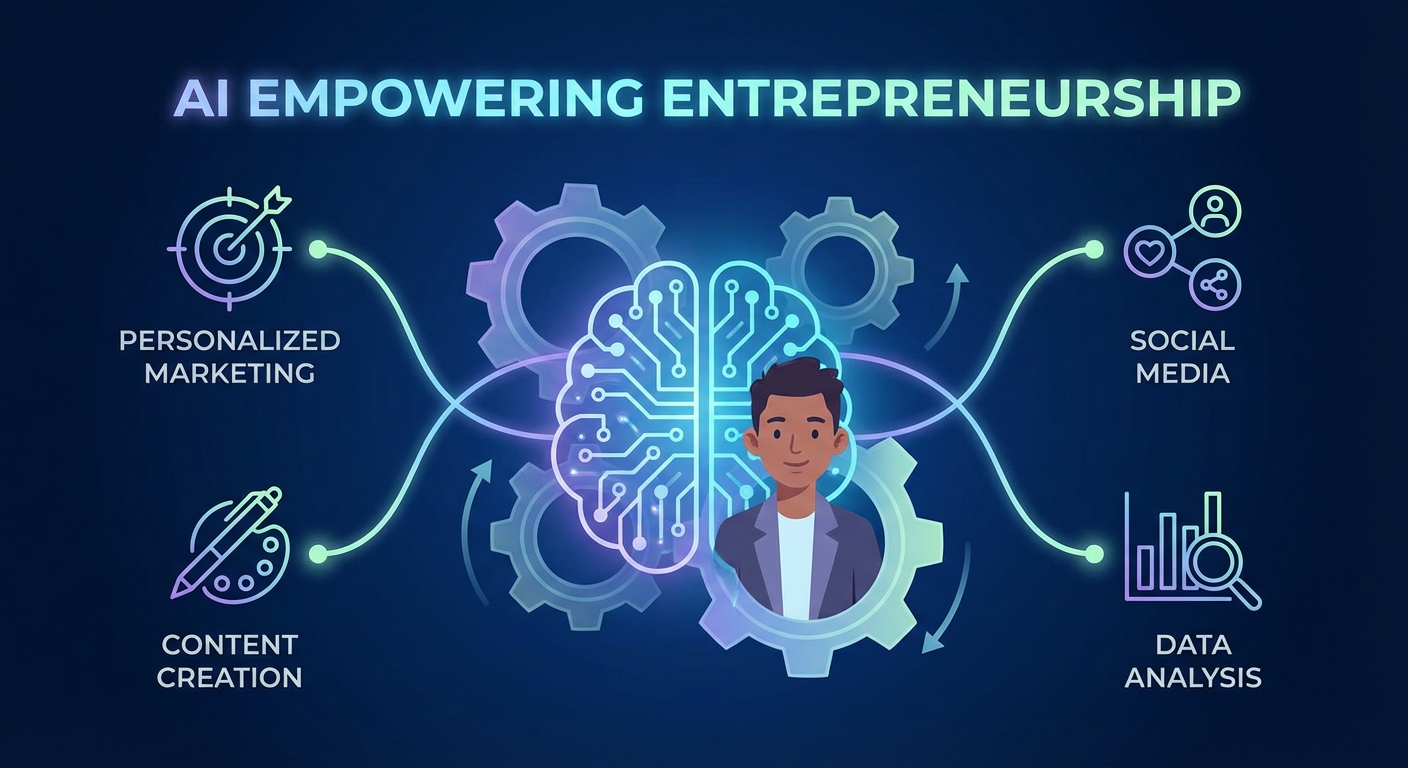
4. Transforming Marketing and Branding with AI
For young entrepreneurs navigating the competitive landscape of modern business, effective marketing and strong branding are not merely optional; they are foundational pillars for success. Historically, establishing a robust market presence required significant capital investment in advertising, comprehensive marketing teams, and sophisticated data analysis tools, placing smaller ventures at a distinct disadvantage. However, the advent and rapid evolution of Artificial Intelligence (AI) have dramatically reshaped this playing field, offering unprecedented opportunities for startups to democratize advanced marketing techniques. AI tools now enable personalized outreach, scalable content creation, efficient social media management, automated digital advertising, and 24/7 customer engagement through chatbots, all while operating within the often-constrained budgets typical of nascent businesses. This section delves into how AI is revolutionizing marketing and branding for young entrepreneurs, providing a deep dive into specific applications and quantifiable benefits even with limited financial resources.
The embrace of AI by young entrepreneurs is not a niche phenomenon but a mainstream adoption trend. Data from 2025 indicates that approximately 73% of Gen Z business owners and 70% of Millennials are already leveraging AI tools in their ventures2. This widespread adoption is relatively new, with nearly half (48%) of all small businesses having initiated AI usage within the past year alone1. This surge is largely attributed to the breakout success of generative AI tools like ChatGPT, which emerged less than a year ago. McKinsey research highlights the profound impact of generative AI, estimating that roughly 75% of its economic value is concentrated in critical areas like marketing and sales, indicating its transformative potential for business growth8.
For startups, AI offers a crucial pathway to significant efficiency gains and cost savings. Over 93% of small business owners assert that AI provides cost-effective solutions that lead to financial savings and enhanced profitability4. In the Canadian context, 27% of AI-using entrepreneurs reported reduced operating costs, and 22% managed to curtail their hiring needs by automating tasks5. This underscores AI multi-faceted value proposition for lean startups. The rapid return on investment (ROI) is another compelling factor, with 85% of small firms observing a positive ROI from their AI investments within the first year of implementation6. Many businesses are achieving impressive returns, often seeing $3–$5 in returns for every $1 invested6. This immediate and substantial financial impact makes AI an indispensable tool for young entrepreneurs aiming to make a significant market splash without the deep pockets of established corporations.
4.1 Personalized Marketing and Hyper-Targeted Engagement
One of the most potent applications of AI in marketing is its ability to facilitate highly personalized customer interactions, a capability once exclusive to large enterprises with extensive data infrastructure. Young entrepreneurs can now create bespoke marketing experiences that resonate deeply with individual customers, driving engagement and conversion. This is crucial as consumers increasingly expect tailored content and offers.
4.1.1 Leveraging AI for Individualized Customer Journeys
AI enables startups to move beyond broad demographic targeting to true one-to-one personalization. By analyzing customer data—browsing history, purchase patterns, demographic information, and even real-time behavior—AI algorithms can predict preferences and recommend products or content with remarkable accuracy. This was vividly demonstrated by an online boutique owner, Rachel Torres, who ran a one-woman fashion business. Initially, her website offered a generic shopping experience with a conversion rate of approximately 1.2%. By integrating AI personalization tools, including product recommendation AI and a chatbot for styling advice, she transformed her customer journey. The AI dynamically presented shoppers with products aligned with their browsing behavior and provided instant responses to queries, effectively creating a “personal shopper” experience for every visitor9.
- Her conversion rate tripled from 1.2% to 3.8% within months9.
- Average order value (AOV) jumped significantly from $67 to $949.
- Email marketing revenue surged by 340% due to AI-driven audience targeting9.
This case illustrates how AI levels the playing field, allowing a small business to achieve results that previously required significant resources in data analysis and customer experience design. These tools effectively boost engagement and sales by making marketing more relevant and timely for each customer, all within a startup’s limited budget.
4.1.2 Dynamic Content and Offer Generation
AI’s capacity for creating dynamic content and offers extends beyond product recommendations. It can personalize website experiences, email campaigns, and even ad creatives based on individual user profiles. For instance, AI-driven email marketing platforms are utilized by 32% of small firms11 to segment audiences and personalize email content at scale. This leads to higher open rates, increased click-through rates, and ultimately, greater conversion. A survey revealed that 45% of SMEs planned to use AI for content personalization or creation by 2025, highlighting its growing importance in marketing strategies30. This bespoke approach fosters greater customer loyalty and reduces the perceived “noise” of generic marketing messages, allowing young entrepreneurs to forge stronger connections with their audience.
4.2 Scalable Content Creation and Social Media Management
One of the perennial challenges for startups is generating a consistent volume of high-quality marketing content across various platforms without stretching already thin teams. Generative AI has emerged as a cornerstone solution, enabling young entrepreneurs to create and manage content at scale, significantly lowering the barrier to entry for robust content marketing strategies.
4.2.1 Revolutionizing Content Production with Generative AI
Generative AI tools, such as those for copywriting (e.g., Jasper, Copy.ai) and graphic design (e.g., Canva’s AI features), empower entrepreneurs to produce diverse marketing assets quickly and cost-effectively. These include blog posts, social media updates, email newsletters, ad copy, and even basic video snippets or logos. Currently, approximately 26% of small businesses utilize AI for content writing and creation31, and 28% employ it for image and design creation32.
A notable example is Kevin Park, a solo content creator focusing on educational videos. He leveraged AI to:
- Transcribe YouTube videos and convert them into blog articles.
- Utilize AI video editing for creating short, engaging social media clips.
- Employ AI scheduling tools to post content at optimal times for maximum reach33.
This strategy resulted in:
- A 600% increase in LinkedIn engagement33.
- A tenfold expansion of his overall content reach33.
- A tripling of his revenue through new sponsorships and product sales, all without increasing his work hours33.
This demonstrates how AI can empower a single individual to achieve the output and market presence typically associated with a full content marketing team. For entrepreneurs like Jennifer Martinez, a solo digital marketing consultant, generative AI tools like ChatGPT for drafting posts, Jasper for blog content, and Canva’s AI for graphics enabled her to scale her client base from 5 to 12 within six months. Crucially, her monthly revenue surged from $8,000 to $24,000, while her work hours decreased to around 45 per week, showcasing AI’s ability to drive growth through efficiency55, 56. She maintained quality by diligently editing AI outputs, underscoring the importance of human oversight.
4.2.2 Streamlined Social Media Management
Managing multiple social media channels can be time-consuming, but AI simplifies this process. AI tools can analyze engagement patterns to suggest optimal posting times, generate relevant hashtags, and even draft post captions. They can automate scheduling, cross-posting, and basic community engagement tasks, freeing up entrepreneurs to focus on strategic interactions and building authentic relationships. This allows startups to maintain a vibrant and consistent social media presence that appears “bigger” than their actual operational size, enhancing brand visibility and audience connection.
4.3 Automated Digital Advertising and Enhanced Campaign Performance
Digital advertising is a critical component of modern marketing, but its complexity and the potential for budget wastage can be daunting for startups. AI-powered advertising solutions provide sophisticated optimization capabilities, ensuring ad spend is maximized and campaigns achieve superior performance.
4.3.1 AI-Driven Ad Optimization and Budget Allocation
AI tools integrated into advertising platforms (such as Google’s Performance Max or automated Facebook ads) can learn from campaign data, identify high-performing ad creatives and targeting parameters, and dynamically adjust bids and budget allocation in real time. This adaptive optimization ensures that ads reach the most receptive audiences at the lowest possible cost, improving overall campaign ROI. As a result, 26% of businesses have adopted AI-driven online advertising tools to enhance their ROI34. These systems continuously refine campaigns based on performance metrics, allowing startups to compete effectively against larger organizations with more extensive marketing budgets and teams. This capability helps young entrepreneurs achieve better results from their marketing spend and allows them to focus on crafting compelling messages rather than getting bogged down in multivariate testing and manual optimizations.
4.3.2 Predictive Analytics for Smarter Ad Targeting
Beyond live campaign optimization, AI contributes to more intelligent ad strategies through predictive analytics. By analyzing historical data and market trends, AI can forecast which customer segments are most likely to convert, refine audience targeting, and even predict the best channels and times for ad delivery. This pre-emptive intelligence minimizes guesswork and enhances the precision of advertising efforts, ensuring that every dollar spent is directed towards the most promising opportunities. The impact of AI-driven marketing campaigns can be substantial, with reported reductions in customer acquisition costs and increases in conversion rates by up to 77%35.
4.4 24/7 Customer Engagement with AI Chatbots
Delivering prompt and effective customer service is paramount for building trust and retaining customers, but managing inquiries around the clock is a significant operational challenge for resource-constrained startups. AI-powered chatbots offer a scalable and cost-effective solution, providing instant support and engagement at any time.
4.4.1 Instant Support and Lead Qualification
AI chatbots can be deployed on websites, social media platforms, and messaging apps to answer common customer questions, guide users through product selections, provide technical support, and even qualify leads. Approximately 27% of small businesses currently use AI chatbots for customer support or lead qualification36. These chatbots prevent potential customers from disengaging due to delayed responses and free up human staff (often the entrepreneur themselves) to handle more complex inquiries or strategic tasks. The efficiency gains are significant: AI chatbots can cut support costs by roughly 30% on average, while simultaneously boosting customer satisfaction through instant, consistent responses37. Customers generally appreciate the speed and availability of AI helpers, reserving direct human interaction for nuanced or critical issues.
The online boutique owner Rachel Torres, previously mentioned, integrated a chatbot for styling advice, which contributed to her tripling conversion rates and increasing average order value. This AI assistant ensured that every website visitor received immediate, personalized attention, simulating a level of customer service that would be impossible for a solo entrepreneur to provide manually. It transformed her business operations from a reactive service model to a proactive engagement strategy, available 24/7.
4.4.2 Enhancing the Customer Experience and Brand Image
Beyond practical support, chatbots contribute significantly to a professional brand image. A startup can project an always-available, responsive presence, which builds customer confidence and loyalty. AI chatbots can gather valuable customer data and feedback, which can then be analyzed to improve products, services, and overall marketing strategies. This continuous feedback loop ensures that customer interactions are not just efficient but also informative, helping the business adapt and grow. The ability to engage customers consistently, regardless of time zones or staffing limitations, offers a considerable competitive advantage to young entrepreneurs.
4.5 Building Brand and Community with AI Insights
Beyond the direct execution of marketing tasks, AI provides powerful analytical capabilities that help young entrepreneurs deeply understand their brand’s perception, engage with their community, and adapt their strategies dynamically.
4.5.1 Social Listening and Sentiment Analysis
AI-driven social media analytics tools can monitor vast amounts of online conversations, identifying brand mentions, analyzing sentiment (positive, negative, neutral), and tracking trending topics relevant to the business. This “social listening” capability allows entrepreneurs to quickly gauge public opinion, identify emerging customer needs or concerns, and respond in a timely manner. For example, AI might alert a founder to positive feedback about a specific product feature, enabling them to capitalize on that insight in future marketing campaigns. Conversely, it can flag negative comments or potential crises, allowing for proactive damage control. This real-time understanding of market perception is invaluable for brand management, enabling young businesses to build and protect their reputation effectively.
4.5.2 Data-Driven Strategic Planning
AI’s ability to process and analyze complex datasets provides startups with insights that inform overarching brand strategy and community building efforts. These tools can help identify key influencers, optimize content delivery for maximum engagement, and even predict community dynamics. The integration of AI and analytics in marketing is becoming indispensable; a 2025 marketing benchmark report indicated that 80% of small businesses agreed that using these technologies was “critical” for success38. By leveraging AI, young entrepreneurs can transform raw data into actionable intelligence, making their branding efforts more precise, impactful, and aligned with market demands.
4.6 ROI and Growth Acceleration through AI-Powered Marketing
The true measure of AI’s impact is its ability to accelerate growth and deliver a tangible Return on Investment (ROI). For young entrepreneurs, AI-powered marketing is proving to be a catalyst for both top-line revenue growth and improved profitability. Small and mid-sized businesses leveraging AI are experiencing profound positive shifts in their financial and operational metrics, clearly demonstrating AI’s capability to drive rapid and sustainable expansion.
4.6.1 Quantifiable Revenue and Profit Growth
The evidence overwhelmingly suggests that AI adopters are outperforming their peers. A 2025 global survey by Salesforce revealed that a remarkable 91% of small and mid-sized businesses utilizing AI reported an increase in their revenue39. Beyond revenue, AI also contributes to operational excellence: 87% of these AI adopters confirmed that the technology aided in scaling their business operations, and 86% attributed improved profit margins to AI integration40. This indicates that AI is not merely a cost-cutting tool but a powerful vehicle for generating new income streams and enhancing financial health.
Studies show that AI-driven businesses are growing approximately three times faster than their non-AI-using counterparts41, 42. This accelerated growth stems from AI’s multifaceted contributions, including its capacity to identify more sales opportunities, optimize customer retention strategies, and expedite product launches, all critical factors for fledgling enterprises. The consistent message across these findings is that AI is an active driver of top-line growth, not just an efficiency enhancer.
4.6.2 Rapid Payback and High ROI on Marketing Investments
One of the most compelling aspects of AI for startups is the speed and magnitude of its ROI. Unlike traditional IT investments that might take years to yield dividends, many AI tools demonstrate rapid payback periods. Surveys indicate that 85% of small businesses achieve a positive ROI from their AI investments within 12 months of implementation43. In many instances, even simple AI applications, such as a specialized marketing chatbot or a recommendation engine, can pay for themselves within a few months through direct cost savings or incremental sales. Case studies highlight that advanced AI implementations can generate an impressive 200–300% ROI within six months44, particularly in areas like marketing automation that significantly boost online sales in short periods. This swift return mitigates risk for entrepreneurs, as even a modest increase in monthly sales or a slight reduction in expenses can quickly justify the recurring investment in AI software subscriptions.
4.6.3 Efficiency as a Growth Multiplier
AI’s ability to drive ROI is deeply intertwined with its capacity to simultaneously lower operational costs and increase business capacity. This dual benefit fundamentally redefines the growth equation for startups. Consider a restaurant owner, David Kim, who utilized an AI-powered inventory and demand forecasting system. This system analyzed sales patterns, weather data, and local events to predict demand, leading to dynamic adjustments in purchasing and menu planning. The results were dramatic:
- Food waste plummeted from 23% to just 6%45.
- Annual cost savings amounted to approximately $47,00045.
- Profit margins nearly doubled, rising from 4.2% to 7.8%45.
Beyond these immediate financial gains, the AI insights allowed the restaurant to serve more customers without encountering stock shortages or overburdening the kitchen staff, thereby enabling revenue growth. Similarly, when AI automates a significant portion of customer inquiries, it not only reduces labor costs for support but also expands the business’s capacity to handle a larger customer base without compromising service quality, directly contributing to higher sales retention. These cascading efficiency gains empower entrepreneurs to reinvest saved time and capital into further growth initiatives. One survey found that 41% of small businesses credited AI with reallocating staff time to higher-value activities like innovation or sales, and 34% were able to pursue new growth opportunities as a direct consequence46, 47. AI thus fosters a virtuous cycle where enhanced efficiency fuels business expansion, which in turn delivers robust ROI.
4.6.4 Leveling the Competitive Playing Field
The high ROI from AI extends beyond mere financial metrics; it significantly impacts a startup’s competitive standing. Young entrepreneurs armed with AI can challenge larger, more established competitors in unprecedented ways. For example, a small e-commerce startup can leverage AI to automate website optimization and ad campaigns, allowing it to compete effectively with larger rivals. This “leveling” effect is widely recognized: 80% of AI-adopting SMB leaders believe AI is creating a more equitable playing field between small and large businesses48. This boosted confidence encourages further strategic moves, such as entering new markets or launching innovative products. AI integration is also becoming a key factor in securing investor funding for high-growth startups, as it signals scalability and a forward-thinking business model.
4.6.5 Illustrative Success Metrics
The transformative power of AI is evident in the dramatic improvements reported across key business metrics:
- Lead conversions increasing by over 110%49.
- Customer churn rates decreasing by 40%50.
- Content output escalating threefold49.
- Time taken to deliver services halved49.
In one instance, a nonprofit organization utilized AI to automate grant writing and administrative tasks, resulting in a 67% increase in the number of clients served, essentially within the same budget51. These outcomes unequivocally demonstrate AI’s role as a potent engine for growth, amplifying results across various business functions. Entrepreneurs who capitalize on these early gains can reinvest them strategically, further solidifying their market position. Conversely, businesses that neglect AI risk falling into a widening performance gap. As one report starkly concluded, AI is creating “two classes of companies — the winners growing faster and the rest struggling to keep up”52. For young business owners focused on growth, strategic AI adoption is not merely advantageous, but increasingly imperative for remaining competitive and achieving remarkable returns in the contemporary business landscape.
4.7 Maximizing AI’s Benefits While Managing Risks
While the advantages of AI in marketing and branding for young entrepreneurs are substantial, successful integration requires a strategic approach that maximizes benefits while mitigating inherent risks. Entrepreneurs are learning that AI is a powerful tool best used to augment human capabilities rather than replace them entirely.
4.7.1 Strategic Integration and Human Oversight
The most effective AI implementations occur when entrepreneurs employ AI strategically, understanding its strengths and limitations. This involves treating AI as a collaborative partner that handles repetitive or data-intensive tasks, thereby freeing human talent for creative, strategic, and nuanced work. For instance, marketing consultant Jennifer Martinez effectively leveraged AI for generating first drafts of content and conducting research. Her critical role then involved applying her strategic expertise to refine the AI-generated outputs, ensuring they aligned with client goals and brand voice53, 54. This approach not only enhanced the quality of her deliverables but also significantly increased her efficiency and capacity. The core lesson is that AI necessitates human oversight and domain-specific knowledge to realize its full potential, preventing the production of generic or inaccurate content. Entrepreneurs must actively “pilot” AI systems, configuring them, reviewing their outcomes, and continuously refining prompts to align with their specific business needs.
4.7.2 Addressing Skills and Knowledge Gaps
Although young entrepreneurs are often digital natives, a learning curve exists in effectively deploying and integrating AI tools. A Business Development Bank of Canada (BDC) study highlighted this, finding that 27% of business owners were unknowingly using AI features embedded in software they already utilized10, 10. This lack of awareness can hinder optimal utilization of AI’s full capabilities and may foster undue skepticism or apprehension. To bridge this gap, entrepreneurs are engaging in self-education through online resources, industry communities, and practical experimentation. There is also a growing trend towards hiring individuals with AI and data science skills or collaborating with AI-savvy freelancers. Fortunately, many modern AI tools are designed for user-friendliness, often requiring no coding and featuring intuitive interfaces. Businesses that dedicate resources to AI education and training for their teams generally report higher success rates, underscoring the importance of a well-informed implementation strategy27.
4.7.3 Mitigating Ethical and Operational Risks
Entrepreneurs are also becoming increasingly aware of and actively managing the risks associated with AI, including concerns about accuracy, bias, data privacy, and ethical implications. Hallucinations (AI generating false information) and biased outputs are real challenges that require vigilant human review. Best practices include maintaining a “human-in-the-loop” for quality control, particularly for public-facing content. Many young founders agree on the necessity of responsible AI use, with 85% believing that government and industry should establish clear ethical guidelines and transparency for AI12. In the interim, startups are establishing internal protocols, such as transparently disclosing AI-generated content and safeguarding customer data when using third-party AI services. Security concerns also dictate careful consideration of sensitive data input into public AI tools, with some businesses opting for secure, bespoke AI solutions or in-house private models.
4.7.4 Navigating Cost and Integration Challenges
Not all AI implementations are seamless. Entrepreneurs frequently cite costs and integration complexities as barriers. A 2025 survey indicated that cost was a primary reason some small businesses ceased using AI tools due to a perceived lack of sufficient benefit for the price11, 11. To circumvent this, a pragmatic approach involves initiating with high-impact, low-cost projects. For instance, a relatively inexpensive chatbot can yield quick, visible ROI in customer service, justifying further investments. Integration with existing systems can also be intricate, making unified platforms more appealing. Growing SMBs are significantly more likely to utilize integrated tech stacks (66%) compared to struggling ones (32%)29, highlighting the value of a cohesive AI strategy rather than a fragmented approach. The principle here is to deploy AI where it provides tangible, practical value and seamlessly integrates into existing workflows, avoiding “AI for AI’s sake.”
4.7.5 The Enduring Value of the Human Touch
Ultimately, young entrepreneurs recognize that their unique human creativity and authenticity remain invaluable assets. As AI adoption becomes more ubiquitous, merely using the technology will not constitute a unique advantage; rather, how it is used will be the differentiator. Successful AI implementations invariably combine AI efficiency with the distinctive personal brand or service quality that only human ingenuity can provide. AI excels at handling routine, scalable tasks, while entrepreneurs can then dedicate their time to building relationships, fostering community, and driving creative innovation. This synergistic approach allows startups to leverage AI for its unparalleled speed, scale, and data-crunching capabilities, while simultaneously amplifying human strengths such as empathy, strategic judgment, and creativity. Those who master this balance are not only achieving immediate benefits but also building resilient businesses capable of thriving long-term in an increasingly AI-driven marketplace. The “AI advantage,” therefore, is most pronounced when complemented by astute human leadership.
The transformative potential of AI in marketing and branding has made it an indispensable tool for young entrepreneurs. Its capacity to personalize interactions, scale content creation, automate advertising, and provide 24/7 customer engagement, all within budget constraints, directly contributes to enhanced ROI and accelerated growth. This foundation positions young entrepreneurs to strategically integrate AI into their broader business development and operational frameworks, a topic that will be further explored in the subsequent section on AI’s impact on operational efficiency and productivity.
5. Tangible ROI and Accelerated Growth with AI
The burgeoning landscape of artificial intelligence is rapidly transforming the entrepreneurial sphere, moving beyond mere technological novelty to become a critical driver of business success. For young entrepreneurs, the adoption of AI tools is not just about staying current; it represents a strategic imperative for achieving tangible returns on investment (ROI) and accelerating growth in an increasingly competitive market. This section delves into the profound impact of AI on revenue generation, profit enhancement, and operational scalability, highlighting how these innovative tools are democratizing capabilities, allowing small businesses to effectively compete with larger, more established entities. Far from being a futuristic aspiration, AI is demonstrably delivering immediate, measurable benefits that translate into significant financial and operational advantages for those who embrace it.
The immediate and widespread adoption of AI by young entrepreneurs underscores its perceived value. As of 2025, approximately 73% of Gen Z business owners and 70% of Millennials are already leveraging AI in their ventures[2]. This rapid integration is a recent phenomenon, with nearly half (48%) of small businesses commencing AI usage within the last year alone[1], propelled largely by the advent of accessible generative AI tools such as ChatGPT[8]. Such tools have made sophisticated AI capabilities available to a broader audience, demonstrating that the barriers to entry for AI adoption are significantly lower than previously imagined. McKinsey research further clarifies the economic impact, estimating that roughly 75% of generative AI’s economic value is concentrated in high-impact areas critical for entrepreneurs, including marketing and sales, customer operations, software engineering, and research and development (R&D)[8]. This concentration directly aligns with areas where young entrepreneurs require the most leverage to scale efficiently and cost-effectively.
The conversation around AI in business has shifted from a question of ‘if’ to ‘when’ and ‘how quickly.’ For startups and small and medium-sized businesses (SMBs), AI represents a potent force for leveling the playing field. Traditionally, larger enterprises benefited from economies of scale and extensive resources that allowed for sophisticated marketing campaigns, advanced data analytics, and comprehensive customer service operations. AI is now democratizing these capabilities, providing small businesses with access to tools that can mimic, and in some cases surpass, the effectiveness of much larger teams and budgets. This section meticulously analyzes the various facets through which AI confers a significant advantage, backed by robust data and compelling case studies, to elucidate the critical role AI now plays in the success metrics of young entrepreneurial ventures.
ROI and Revenue Generation: The Bottom-Line Impact of AI
The most compelling argument for AI adoption among young entrepreneurs is its demonstrated capacity to deliver a rapid and significant return on investment. AI is not merely an expense; it is a strategic investment that directly contributes to increased revenue and improved profit margins. The evidence for this is unequivocal and widespread across various sectors and business sizes.
Direct Revenue Boosts and Profit Margin Improvement
A global Salesforce survey conducted in 2025 revealed that an overwhelming 91% of SMBs utilizing AI reported an increase in revenue[6]. This statistic alone underscores the immediate financial upside of integrating AI into business operations. Beyond just top-line growth, AI also contributes significantly to profitability. The same survey indicated that 86% of AI-powered SMBs saw improved profit margins[6]. This dual impact on increasing income and optimizing costs positions AI as a powerful tool for financial health and sustainable growth.
The mechanism behind these gains is multi-faceted. AI tools enhance efficiency, automate routine tasks, personalize customer experiences, and provide data-driven insights that empower better decision-making. For instance, AI in marketing can lead to higher conversion rates through targeted campaigns, directly translating into increased sales. In operations, AI can identify inefficiencies and suggest optimizations, leading to cost reductions that boost profit margins. In customer service, AI-powered chatbots can handle a high volume of inquiries 24/7, improving customer satisfaction and freeing human agents to address more complex issues, thereby indirectly supporting sales and customer retention.
Rapid Return on Investment
One of the most attractive aspects of AI for resource-conscious young entrepreneurs is the speed at which their investments pay off. Unlike some legacy IT infrastructure projects that require years to demonstrate value, many AI solutions offer a remarkably rapid return. Research indicates that a substantial 85% of small firms achieve a positive ROI from their AI investments within the first year of implementation[7]. This swift payback period significantly de-risks AI adoption, making it a more accessible and appealing option for startups and small businesses operating with tighter budgets and shorter planning horizons.
Moreover, the magnitude of these returns can be impressive. Some advanced AI implementations have demonstrated ROIs ranging from 200% to 300% within just six months[7]. This means for every dollar invested, businesses are seeing returns of three to four dollars in a very short timeframe. Such dramatic and quick returns empower young entrepreneurs to reinvest profits back into their businesses, fuel further scaling, or introduce new products and services, creating a virtuous cycle of growth.
Consider the case of David Kim, a restaurant owner who adopted an AI-powered inventory and demand forecasting system. By optimizing purchasing and menu planning, David reduced food waste from 23% to a mere 6%[41]. This reduction saved approximately $47,000 annually and nearly doubled his profit margins from 4.2% to 7.8%[41]. This example vividly illustrates how AI can pinpoint and eliminate significant cost drains in traditional businesses, directly translating into substantial financial gains.
Cost Savings and Operational Efficiency
Beyond increasing revenue, AI is a powerful mechanism for achieving significant cost savings and enhancing operational efficiency, which are crucial for lean startups. Over 93% of small business owners agree that AI provides cost-effective solutions that save money and improve profitability[1]. These savings come from various avenues, primarily through automation and optimized resource allocation:
- Reduced Operating Costs: In Canada, a 2024 study showed that 27% of entrepreneurs using AI experienced a decrease in operating costs[4]. This can be attributed to AI streamlining various administrative tasks, optimizing logistics, or reducing energy consumption in certain operations.
- Labor Cost Avoidance: A remarkable 22% of Canadian businesses using AI were able to cut their hiring needs by automating tasks, effectively growing their businesses without adding to their payroll[4]. This is a critical advantage for young entrepreneurs facing skilled labor shortages and high labor costs.
- Efficiency Gains in Core Functions: AI dramatically speeds up routine tasks. Examples show that tasks previously taking 3-4 hours can now be completed in as little as 45 minutes with AI assistance[9]. This enables entrepreneurs and their small teams to achieve more in less time, effectively multiplying their productivity without increasing human capital costs.
The table below summarizes key ROI metrics reported by small businesses adopting AI:
| Metric | Impact per Salesforce Survey (2025)[6] | Additional Data Points |
|---|---|---|
| Revenue Growth | 91% of AI-adopting SMBs report increased revenue | AI-driven businesses grow approximately 3× faster than peers[11] |
| Profit Margin Improvement | 86% of AI-adopting SMBs report improved profit margins | Online boutique saw email revenue grow 3.4×; restaurant profit margins rose from 4.2% to 7.8%[9] |
| Positive ROI Timeframe | Not specified, but global SMBs see rapid payback. | 85% of small firms see positive ROI within the first year[7]; some see 200-300% ROI in under 6 months[7] |
| Cost Reduction (Operating) | AI helps reduce costs across various functions. | 27% of Canadian entrepreneurs reduced operating costs; AI chatbots cut support costs ~30%[4] |
| Reduced Hiring Needs | AI aids in scaling operations for 87% of SMBs. | 22% of Canadian businesses cut hiring needs by automating tasks[4] |
Accelerated Growth: Leveling the Playing Field Against Larger Competitors
AI’s impact extends beyond direct financial gains; it also empowers young entrepreneurs to accelerate growth and compete more effectively against larger, entrenched competitors. By democratizing access to advanced capabilities, AI levels the playing field, enabling startups to achieve scale and sophisticated operations that were once exclusive to big businesses.
Scaling Operations Without Scaling Headcount
One of the most significant advantages AI offers is the ability to scale operations efficiently without a proportional increase in headcount or overhead. This is particularly vital for startups that need to maximize their output and reach with limited human resources. AI acts as a “force-multiplier” for entrepreneurs, effectively providing a virtual team that handles routine and labor-intensive tasks.
- Firms using AI are able to handle 3× more leads or content output without adding new employees[9]. This allows a small team to manage a much larger volume of work, thus supporting rapid growth.
- A solo marketing consultant, Jennifer Martinez, dramatically increased her capacity. By leveraging generative AI for content drafting and research, she scaled her client base from 5 to 12 and tripled her monthly revenue from $8,000 to $24,000. Crucially, she achieved this while *cutting her work hours by 25%*[9]. This exemplifies how AI allows entrepreneurs to expand output and revenue without sacrificing personal time or incurring significant hiring costs.
This capacity to do more with less means that growth is no longer solely dictated by the availability of capital for recruitment, but by strategic AI integration. Entrepreneurs can redirect the time and money saved by AI towards strategic initiatives such as innovation, market expansion, and deeper customer engagement, further accelerating their growth trajectory[12].
AI-Powered Marketing and Branding on a Startup Budget
Marketing and branding are critical for any business, but they can be particularly challenging for startups with limited budgets. AI provides sophisticated tools that enable young entrepreneurs to execute highly effective marketing strategies at a fraction of the cost previously required. This capability is pivotal in leveling the playing field with larger competitors who traditionally dominate marketing spends.
- Personalized Marketing: AI enables hyper-personalization, allowing small businesses to tailor product recommendations and content to individual customer preferences. This leads to significantly higher engagement and conversion rates. An online boutique, for instance, tripled its conversion rate from 1.2% to 3.8% and increased average order value by 40% after implementing AI-based product recommendations and chat assistance[9]. This level of personalization was once exclusive to e-commerce giants.
- Content Creation and Social Media Management: Generative AI tools empower entrepreneurs to produce high-quality marketing content rapidly and affordably. Approximately 26% of small businesses use AI for content writing and creation, and 28% for image and design creation[32][33]. For content creator Kevin Park, using AI to repurpose videos into articles, social posts, and infographics led to a 600% increase in LinkedIn engagement and a tripling of revenue through new sponsorships, all without increasing his work hours[9]. AI allows small teams to achieve a multi-channel presence that rivals that of much larger marketing departments.
- Automated Digital Advertising and CRM: AI optimizes digital ad spending by analyzing performance data and adjusting campaigns in real-time. This ensures that every marketing dollar is spent more effectively, a crucial factor for budget-constrained startups. 32% of small businesses automate email marketing campaigns, enhancing targeting and personalization[10].
- 24/7 Customer Engagement: AI chatbots provide instant customer support and lead qualification around the clock, improving customer satisfaction and significantly reducing support costs (by about 30%)[13]. This allows startups to offer a level of customer service that typically requires extensive human resources. 27% of small businesses now use AI chatbots for customer service[10].
By leveraging AI for these functions, young entrepreneurs can craft highly targeted, efficient, and engaging marketing campaigns that generate impressive results, making their limited budgets stretch further and compete directly with the vast resources of corporate rivals.
Data-Driven Decision Making at Scale
AI democratizes access to sophisticated analytical capabilities, allowing young entrepreneurs to make data-driven decisions that were previously only feasible for large corporations with dedicated data science teams. AI tools can analyze vast datasets, identify trends, predict outcomes, and provide actionable insights, empowering entrepreneurs to make smarter strategic choices.
- Predictive Analytics: Nearly a quarter (23%) of small businesses now use AI for predictive analysis, including sales forecasting and market trend prediction[30]. This allows entrepreneurs to anticipate market shifts, optimize inventory, and make informed decisions about product development and market entry.
- Market Research and Business Planning: AI assists in rapid market research and even aids in drafting business plans. 32% of Gen Z founders use AI for business research, and approximately 30% leverage it for generating parts of their business plans[27]. This accelerates the initial business development phase, allowing for quicker validation and iteration of ideas.
This ability to derive deep insights from data provides young entrepreneurs with a distinct competitive edge, allowing them to respond to market dynamics with agility and precision, optimizing their strategies based on evidence rather than intuition.
Bridging the Generational and Size Gap
The adoption of AI is not uniform across all businesses. A noticeable generational and size gap exists, indicating that younger, more agile firms are at the forefront of leveraging AI’s advantages. Younger businesses (≤5 years old) have a significantly higher AI adoption rate (78%) compared to older businesses (25+ years old, 48%)[4]. Similarly, larger SMEs (100+ employees) show higher adoption (86%) than micro-businesses (1-4 employees, 60%)[4]. This disparity suggests that young entrepreneurs, being digital natives, are more comfortable integrating new technologies, while smaller and older firms may face greater challenges or inertia.
This gap highlights a critical opportunity for young entrepreneurs: by being early and effective adopters of AI, they can solidify their competitive position against less agile, older competitors. AI becomes a tool for accelerating past incumbents who are slower to adapt, capturing market share and establishing leadership in new niches.
Managing Risks and Maximizing Benefits: A Balanced Approach
While the advantages of AI are undeniable, successful implementation requires a strategic approach that maximizes benefits while mitigating inherent risks. Young entrepreneurs are demonstrating a savvy understanding of AI’s capabilities and limitations, adopting a balanced perspective that prioritizes strategic use over blind adoption.
Strategic Integration and Human Oversight
The most effective AI implementations are those where the technology augments human capabilities rather than attempting to replace them entirely. Entrepreneurs recognize that AI is a powerful tool, but it requires human oversight to ensure quality, maintain brand voice, and navigate nuanced situations. For instance, while AI can generate first drafts of content, human creativity and strategic thinking are essential for refining those outputs to resonate with target audiences and align with specific business goals[45].
This approach involves:
- Active Piloting: Entrepreneurs actively configure, review, and fine-tune AI systems for their specific business contexts, ensuring outputs are accurate and appropriate.
- Maintaining Trust and Nuance: Especially in customer-facing roles like chatbots, businesses must balance AI efficiency with the need for human empathy and understanding where complex or sensitive issues arise. As some small business owners note, AI translation might miss tone or legal nuance, necessitating human review[15].
Addressing Knowledge Gaps and Building Competency
Despite their digital fluency, many entrepreneurs initially lack a full understanding of AI’s pervasive applications. A significant finding reveals that 27% of small business owners use AI features in their software without even realizing it[10]. This “unconscious AI adoption” highlights a need for greater awareness and education to fully leverage the capabilities embedded within existing tools. Entrepreneurs are actively bridging this gap by:
- Self-Education: Utilizing online courses, tutorials, and community forums relevant to AI application in business.
- Strategic Investment in Skills: Hiring individuals with AI expertise or upskilling existing staff to manage and optimize AI tools.
Businesses that invest in learning and strategic AI implementation achieve higher success rates, underscoring the importance of informed adoption over ad-hoc usage[18].
Mitigating Risks: Ethics, Bias, and Data Privacy
Entrepreneurs are also mindful of the potential risks associated with AI, including concerns about accuracy, bias, data privacy, and ethical implications. A strong majority (85%) of small business owners believe government and industry should provide clear ethical guidelines for AI usage[16]. While awaiting such guidelines, entrepreneurs are adopting best practices such as:
- Quality Control: Implementing human review processes for AI-generated content to catch errors, “hallucinations,” or biases.
- Data Security: Prioritizing secure and trusted AI solutions, and being cautious about feeding sensitive proprietary data into public AI models.
- Transparency: Being transparent with customers about the use of AI (e.g., indicating when an interaction is with a chatbot or when content is AI-generated).
These proactive measures ensure that AI drives growth responsibly and maintains customer trust.
Overcoming Cost and Integration Challenges
Initial cost and integration complexity can be barriers to AI adoption, with some businesses scaling back AI use due to these factors[15]. To navigate this, entrepreneurs are advised to start with targeted, high-impact AI projects that demonstrate clear ROI quickly. Furthermore, prioritizing integrated tech stacks (as 66% of growing SMBs do, compared to 32% of struggling ones[14]) can simplify AI adoption by leveraging AI features within existing platforms (CRM, e-commerce, etc.), thereby reducing fragmentation and enhancing overall efficiency.
In conclusion, the tangible ROI and accelerated growth enabled by AI are compelling young entrepreneurs to embrace this technology with increasing enthusiasm. The ability to increase revenue, improve profit margins, and gain a competitive edge against larger players underscores AI’s transformative power. However, maximizing these benefits requires a thoughtful, strategic approach that balances innovation with responsible implementation and continuous learning. For those who strike this balance, AI is proving to be an indispensable ally in building and scaling successful ventures in the modern economy.
The next section will delve deeper into specific AI tools and applications, providing a practical guide for young entrepreneurs looking to integrate AI into their various business functions and further solidify their competitive advantage.
6. Strategic Implementation and Risk Management of AI
The rapid integration of Artificial Intelligence (AI) into the entrepreneurial landscape presents both unprecedented opportunities and significant challenges. While AI adoption is becoming mainstream among young entrepreneurs – with roughly 73% of Gen Z business owners and 70% of Millennials already leveraging AI tools in their ventures[2] – merely adopting AI is insufficient for sustained success. This section delves into the strategic imperative of maximizing AI’s benefits through thoughtful integration and human oversight, concurrently addressing the critical aspects of skills development, knowledge gaps, and proactive risk mitigation. The insights derived from various studies underscore that while AI can drive significant efficiency, cost savings, and revenue growth, its true potential is unlocked only when strategically deployed and responsibly managed. Neglecting these strategic and risk-management considerations can lead to suboptimal outcomes, potentially undermining the very advantages AI promises.
The recent surge in AI adoption, particularly within the last 1-2 years, with 48% of small businesses initiating AI use within the past year alone, signals a crucial inflection point[1]. Tools like generative AI have accelerated this uptake, with one-third of companies globally reporting its use in at least one business function less than a year after debut[8]. However, this swift integration necessitates a deeper understanding of how to harness AI effectively while safeguarding against its inherent risks. The economic value of generative AI is heavily concentrated in areas critical to young entrepreneurs, such as marketing and sales, customer operations, software engineering, and R&D, making strategic implementation paramount[8].
Despite the widespread enthusiasm and projected “game-changing” impact for 78% of business owners[6], a segment of small businesses remains cautious or unconvinced. A 2025 survey indicated that active AI usage among U.S. small businesses actually fell to 28% from 42% the previous year, with over half (58%) stating no plans to use AI at all[5]. Reasons cited include complexity, cost, and uncertainty regarding ROI. Moreover, 51% of Gen Z founders and 35% of Millennial founders perceive AI as a potential threat rather than a clear benefit[2]. These findings highlight the pressing need for comprehensive strategies that not only champion AI’s advantages but also systematically tackle the concerns that impede broader, more confident adoption. This section will elaborate on these strategic best practices, human oversight requirements, and the crucial elements of risk management including accuracy, bias, and data privacy.
6.1 Strategic Implementation: Maximizing AI’s Benefits Through Deliberate Integration
The success of AI adoption for young entrepreneurs hinges not just on having access to tools, but on a strategic and deliberate approach to their integration. Rather than a haphazard application, leveraging AI effectively requires careful planning, a clear understanding of its capacities and limitations, and an ongoing commitment to human-AI collaboration. This strategic framework empowers entrepreneurs to maximize benefits such as efficiency, cost savings, and market responsiveness, transforming AI from a mere technology into a core competitive advantage.
6.1.1 Augmenting Human Capabilities with AI
A core tenet of strategic AI implementation is viewing AI as an augmentation tool rather than a wholesale replacement for human intelligence or creativity. Case studies consistently demonstrate that AI yields the greatest returns when it complements human strengths, taking over repetitive, data-intensive tasks and freeing human talent for higher-order thinking. For instance, Jennifer Martinez, a solo digital marketing consultant, effectively scaled her business by leveraging generative AI tools like ChatGPT for content drafting and research[9]. This allowed her to offload the initial production work and dedicate her time to refining AI-generated outputs with her strategic insights and creativity. The result was a dramatic increase in her client base from 5 to 12 within six months, tripling her monthly revenue from $8,000 to $24,000, all while reducing her workweek from 60 to approximately 45 hours[9]. This example underscores the importance of human oversight; Martinez ensured quality by editing AI outputs, highlighting that AI works best as a powerful assistant rather than an autonomous decision-maker.
This principle is further supported by the general entrepreneurial consensus that AI is a tool, not a total replacement. While AI excels at handling “grunt work” and routine operations, human creativity, strategic thinking, and trust remain critical[12]. By allowing AI to manage tasks like automated email marketing (32% of small firms), social media management (28%), or customer service chatbots (27%)[1], entrepreneurs can reallocate their time to activities that truly drive innovation, build customer relationships, and develop long-term vision. Indeed, 41% of small businesses report that AI enables them to redirect employee time to higher-value tasks, and 39% reinvest saved time/money into customer engagement innovations[1].
6.1.2 Phased Adoption and Scalability
Strategic implementation often involves a phased approach, starting with high-impact, low-effort AI solutions that demonstrate rapid ROI. This allows entrepreneurs to gain experience, build confidence, and justify further investment. Rather than attempting a massive, complex AI overhaul, small businesses can begin with readily available, user-friendly AI applications. For example, implementing an AI-powered personalized recommendation engine, as done by Rachel Torres for her online fashion boutique, can yield immediate and measurable results. Her conversion rate tripled from 1.2% to 3.8%, and average order value increased from $67 to $94[9]. Such tangible successes provide the momentum and financial justification for expanding AI use into other areas.
Scalability is also a key consideration. Young entrepreneurs should choose AI tools and platforms that can grow with their business. Integrated tech stacks are proving to be more effective than a collection of standalone applications; a Salesforce survey noted that growing SMBs were far more likely to use integrated tech stacks (66%) compared to struggling ones (32%)[6]. This suggests that a cohesive AI strategy, where various tools communicate and share data, leads to more robust and sustainable growth. Entrepreneurs should evaluate how readily new AI solutions can be integrated with existing CRM, marketing automation, or e-commerce platforms, helping to avoid data silos and workflow fragmentation.
6.1.3 Continuous Learning and Skill Development
The dynamic nature of AI demands perpetual learning and adaptation from entrepreneurs and their teams. Even tech-native young founders may initially lack explicit AI expertise. A Canadian study revealed that 27% of business owners were already using AI features embedded in software without recognizing it[4]. While this highlights passive adoption, it also indicates a knowledge gap that can prevent full utilization of AI’s potential. Strategic implementation requires actively bridging this gap through self-education, online courses, and community engagement. Entrepreneurs who dedicate time to learning about AI consistently report better results. As AI tools become increasingly user-friendly, the barrier to entry for learning ‘how to prompt’ or ‘how to integrate’ is significantly lowered. Furthermore, some entrepreneurs are investing in hiring individuals with specialized data and AI skills or collaborating with AI-savvy freelancers. This proactive approach to skill development ensures that the business can effectively leverage new AI advancements and adapt its strategies as the technology evolves.
The table below summarizes key strategic considerations for AI implementation:
| Strategic Pillar | Description | Key Benefits for Entrepreneurs |
|---|---|---|
| Human-in-the-Loop | AI augments human roles, not replaces them. Entrepreneurs guide AI, review outputs, and apply creative judgment. | Ensures quality, maintains brand voice, leverages unique human insights, and fosters trust. |
| Phased & Iterative Adoption | Start with high-impact, low-complexity AI tools; scale proven solutions incrementally across functions. | Minimizes initial risk, demonstrates quick ROI, builds internal expertise, and allows for agile adjustments. |
| Integrated Tech Stack | Prioritize AI solutions that seamlessly integrate with existing business software (CRM, ERP, marketing platforms). | Reduces data silos, streamlines workflows, improves data consistency, and enhances overall efficiency. |
| Continuous Learning | Entrepreneurs and teams actively develop AI literacy, understanding capabilities, best practices, and limitations. | Maximizes tool utilization, fosters innovation, allows informed decision-making, and adapts to AI evolution. |
| Defined Use Cases | Clearly identify specific business problems AI can solve (e.g., content generation, customer support, data analysis). | Ensures AI investment aligns with strategic goals, measures ROI effectively, and prevents aimless experimentation. |
6.2 Human Oversight and Ethical Considerations
While AI offers immense scalability and efficiency, its effective and responsible deployment fundamentally relies on robust human oversight and a strong ethical framework. Young entrepreneurs must navigate the complexities of AI not just from a technical standpoint, but also from a moral and practical perspective, recognizing the limits of AI and valuing the irreplaceable contributions of human judgment and empathy. Without this balance, AI’s promised benefits can be undermined by issues of accuracy, bias, privacy, and ultimately, a loss of customer trust.
6.2.1 The Indispensable Role of Human Oversight
The concept of “human-in-the-loop” is paramount in leveraging AI. Entrepreneurial success stories often involve AI handling the heavy lifting of data processing, content generation, or customer interaction, with a human providing critical review, refinement, and strategic direction. As emphasized by many entrepreneurs, AI remains a tool, not a complete replacement for human capabilities[12]. For example, AI-generated marketing copy or client reports, while efficient, require a human editor to ensure accuracy, maintain brand voice, and add nuanced context that AI might miss. One marketing consultant, Jennifer Martinez, attributed her success in scaling her business to her strategy of using AI for first drafts and tedious tasks, combined with her human expertise to refine and strategize[9]. This enabled her to dramatically increase her client load without compromising quality, demonstrating AI’s power when guided by human creativity and strategic thinking.
Human oversight is particularly crucial in areas requiring complex judgment, emotional intelligence, or highly contextual understanding. AI translation, for instance, may miss tone or legal nuance, necessitating human review for critical communications[12]. Similarly, while AI chatbots can handle a significant portion of customer service inquiries (used by 27% of small businesses)[1], difficult or sensitive customer issues often require escalation to a human agent who can provide empathy and creative problem-solving. Maintaining this balance ensures that the business retains its authentic human connection with customers, preventing potential frustration arising from AI limitations.
6.2.2 Addressing Accuracy and Reliability of AI Outputs
A significant risk associated with AI, especially generative models, is the potential for “hallucinations”—the generation of false or misleading information[12]. For young entrepreneurs, whose businesses often rely heavily on reputation and trust, disseminating inaccurate AI-generated content can be highly damaging. Therefore, a critical aspect of human oversight involves rigorously fact-checking and verifying all AI outputs before they are published or acted upon. This is particularly important for content used in marketing, product descriptions, legal disclaimers, or any customer-facing information. Entrepreneurs must implement quality control mechanisms, whether through internal review processes or external expert consultation, to ensure the reliability of AI-assisted work.
Additionally, entrepreneurs should understand that the accuracy of AI models is heavily dependent on the quality and relevance of their training data. Using AI for tasks where data sources are unreliable or incomplete can lead to flawed insights and decisions. Investing in robust data governance and ensuring that AI tools are trained on high-quality, relevant datasets are essential steps towards improving output reliability.
6.2.3 Mitigating Bias in AI
AI models are trained on historical data, and if this data contains biases (e.g., gender, racial, or socio-economic disparities), the AI will inevitably learn and perpetuate these biases. For young entrepreneurs striving for equitable and inclusive business practices, unconsciously embedding AI bias can have serious repercussions, leading to discriminatory outcomes in areas such as hiring, marketing targeting, loan applications, or content generation. For example, if an AI is used to screen resumes and was trained on historical hiring data dominated by a particular demographic, it might inadvertently disadvantage candidates from underrepresented groups.
Mitigating AI bias requires proactive strategies:
- Awareness: Entrepreneurs must be educated about the potential for bias in AI and its implications for their business operations.
- Diverse Data: Wherever possible, ensure AI models are trained on diverse and representative datasets.
- Regular Audits: Periodically audit AI systems for biased outcomes and adjust models or parameters as needed.
- Human Review: Implement human review processes for critical decisions or outputs influenced by AI, especially those impacting individuals or groups. This allows human judgment to override or correct potentially biased AI recommendations.
- Transparency: Be transparent with customers and stakeholders about the use of AI and the steps taken to address bias.
6.2.4 Data Privacy and Security Concerns
Data privacy is a paramount concern in the age of AI. AI systems often require access to vast amounts of data, including sensitive customer information, proprietary business data, and personal employee details. Entrepreneurs must be acutely aware of who owns the data, where it is stored, and how it is used by third-party AI service providers. Feeding sensitive data into public AI tools, for example, can pose significant security and privacy risks. Adherence to data protection regulations (like GDPR or CCPA) is not just a legal requirement but a fundamental aspect of building customer trust. Key actions include:
- Due Diligence: Thoroughly vet AI service providers to understand their data handling practices, security protocols, and compliance certifications.
- Data Minimization: Only provide AI systems with the minimum amount of data necessary for them to perform their function.
- Anonymization/Pseudonymization: Where possible, anonymize or pseudonymize sensitive data before feeding it into AI models.
- Consent: Obtain explicit consent from customers for the collection and use of their data, especially when AI is involved in processing it.
- Secure Infrastructure: Utilize secure, private AI solutions or build custom models on private data where data sensitivity is extremely high.
Moreover, ethical considerations extend to the broader impact of AI. 85% of small business owners believe that government should balance AI innovation with ethical guidelines and risk mitigation[12]. As entrepreneurs, setting internal ethical guidelines for AI use, such as transparency about AI-generated content (e.g., flagging AI-written articles) or avoiding manipulative AI-driven marketing tactics, becomes crucial for long-term credibility.
In essence, human oversight transforms AI from a potential liability into a strategic asset. By actively steering AI’s implementation, verifying its outputs, challenging its biases, and protecting data, young entrepreneurs can harness AI’s power responsibly, fostering innovation while preserving integrity and trust.
6.3 Addressing Skills and Knowledge Gaps
Despite the high adoption rates among young entrepreneurs, a critical challenge remains in fully leveraging AI: the pervasive skills and knowledge gaps. Many entrepreneurs, while technologically proficient, may not yet possess the specific expertise required to strategically implement, manage, and optimize AI tools. This gap can lead to underutilization of AI capabilities, increased operational risks, and a failure to realize the full potential ROI.
6.3.1 Recognizing Unconscious AI Use
A significant portion of the knowledge gap stems from a lack of awareness about what constitutes AI. A study by the Business Development Bank of Canada (BDC) highlighted that while only 39% of entrepreneurs initially believed they were using AI, this number jumped to 66% when they were shown examples of AI-powered tools[10]. Over a quarter of small business owners (27%) were effectively leveraging AI features embedded in software they already used, such as CRM systems or cloud applications, without actively realizing it[10]. This “unconscious AI use” can be a double-edged sword: while it indicates a seamless integration of AI into everyday tools, it also means entrepreneurs might not be actively exploring or utilizing the full capabilities offered by these AI-powered features. They might be missing out on advanced functionalities that could further enhance efficiency or generate deeper insights.
Implications:
- Limited Exploration: Unaware users are less likely to seek out complementary AI tools or integrate AI more deeply into their workflows.
- Missed Opportunities: Basic use prevents tapping into advanced AI features that could provide significant competitive advantages.
- Suboptimal ROI: Without a clear understanding of AI’s potential, investments in AI-infused software might not yield maximum returns.
6.3.2 Bridging the Educational Divide
To overcome this, a conscious effort towards AI education and literacy is essential. This is not about training every entrepreneur to be an AI developer, but rather equipping them with the knowledge to:
- Identify AI Opportunities: Recognize where AI can add value across different business functions. McKinsey research highlights that ~75% of generative AI’s economic value is concentrated in marketing and sales, customer operations, software engineering, and R&D[8], areas young entrepreneurs often handle.
- Evaluate AI Tools: Understand the types of AI available (e.g., generative AI, predictive analytics, machine learning) and how to select suitable tools for specific business needs, considering factors like cost, complexity, and integration capabilities.
- Effective Interaction: Learn how to interact with AI tools effectively, particularly in the context of generative AI (e.g., prompt engineering for better content generation).
- Interpret Outputs: Critically assess AI-generated data, insights, or content for accuracy, bias, and relevance.
- Manage Risks: Understand the ethical, privacy, and security implications of AI use.
Entrepreneurs are addressing these gaps through:
- Self-Directed Learning: Leveraging abundant online resources, tutorials, and communities.
- Workshops and Training: Participating in specialized workshops or courses focused on AI for business.
- Peer Learning: Engaging with other entrepreneurs to share best practices and common pitfalls.
Providing clear use cases and affordable solutions with demonstrable benefits can further encourage education and deeper adoption. The fact that 83% of small-business owners intend to increase AI investments in the next 12 months, with about one-third expecting significant spending, suggests a growing willingness to invest in AI literacy alongside technology[1].
6.3.3 The Generational and Size Gap in Adoption
The noted generational and firm-size gaps in AI adoption underscore the knowledge challenge. Younger firms (≤5 years old) have an AI adoption rate of 78%, significantly higher than businesses 25+ years old (48%)[4]. Similarly, larger SMEs (100+ employees) show 86% adoption, while micro-businesses (under 5 employees) lag at 60%[4]. This pattern suggests that digital-native entrepreneurs and better-resourced companies are more comfortable and informed about integrating AI. The smaller, often older, businesses face larger knowledge and resource barriers, pointing to a need for targeted outreach and educational support tailored to their specific contexts.
This gap also implies differential access to, and understanding of, AI. While younger entrepreneurs are more likely to see AI as a “game-changer” (78% in one survey)[6], a significant percentage (51%) of Gen Z founders also express concern that AI might be more of a threat than a benefit[2]. This dual perspective highlights not just a skills gap, but also a potential lack of nuanced understanding of AI’s capabilities, limitations, and responsible deployment strategies. Closing this informational divide is crucial for fostering informed and confident AI integration.
Ultimately, addressing skills and knowledge gaps is not merely about technical proficiency; it’s about fostering an AI-literate entrepreneurial ecosystem where founders can confidently make informed decisions, leverage AI effectively, and mitigate its risks, thereby ensuring sustainable business growth and competitiveness.
6.4 Risk Management: Navigating Accuracy, Bias, and Data Privacy
The transformative potential of AI for young entrepreneurs comes with a corresponding set of risks that, if not proactively managed, can negate its benefits and even harm a burgeoning business. Key concerns revolve around the accuracy and reliability of AI-generated content, the presence of inherent biases, and critical issues of data privacy and security. Effective risk management is not an afterthought but an integral component of strategic AI implementation, ensuring that technologies are used responsibly and contribute positively to business objectives and ethical standards.
6.4.1 Managing AI Accuracy and Reliability
One of the most immediate and tangible risks associated with AI, particularly generative AI, is its propensity to produce inaccurate, irrelevant, or entirely fabricated information, often referred to as “hallucinations”[12]. For a small business, relying on such erroneous outputs can lead to significant problems:
- Reputational Damage: Disseminating false information in marketing, customer communications, or public statements can severely damage credibility and customer trust.
- Poor Decision-Making: Basing strategic decisions on flawed AI analysis, market predictions, or inventory forecasts can lead to inefficient resource allocation and missed opportunities, directly impacting the bottom line.
- Legal Liabilities: Inaccurate advice or content, especially in regulated industries, could expose the business to legal repercussions.
To mitigate this, young entrepreneurs must enforce rigorous human oversight and quality control. This means treating AI outputs as raw material that requires validation rather than definitive truth. Best practices include:
- “Human in the Loop” Validation: Every piece of critical AI-generated content, from a blog post to a customer service script, should undergo human review for factual accuracy, tonal consistency, and brand alignment. As seen in Jennifer Martinez’s case, her success came from editing AI outputs, not blindly trusting them[9].
- Cross-Referencing: Verify AI-generated information against multiple reputable sources.
- Domain Expertise: Apply expert knowledge to evaluate AI suggestions, especially in nuanced or highly specialized fields where AI might struggle with context. This acknowledges that AI may “miss tone or legal nuance”[12].
- Iterative Refinement: Provide feedback to AI models to improve their performance over time, and adjust prompts or parameters based on observed inaccuracies.
The success of AI is often measured by its ROI, and an inaccurate AI output can quickly erode financial gains, transforming potential profit into costly correction or lost customer confidence.
6.4.2 Addressing AI Bias
AI models learn from the data they are trained on. If this training data reflects societal biases, historical inequalities, or cultural stereotypes, the AI will inevitably perpetuate and even amplify these biases in its outputs. This can manifest in several problematic ways for young entrepreneurs:
- Discriminatory Outcomes: Bias in AI algorithms can lead to unfair or discriminatory treatment in customer segmentation, targeted advertising, hiring processes, or credit assessments. For example, an AI marketing tool might inadvertently exclude certain demographics from promotional campaigns if its training data contained historical biases against those groups.
- Reinforcing Stereotypes: Generative AI can produce content that reflects and reinforces harmful stereotypes, alienating potential customers and damaging brand image.
- Limited Innovation: Biased AI outputs can restrict creativity and innovation by narrowing the scope of ideas or solutions presented.
Mitigating AI bias requires a multi-faceted approach:
- Bias Audits: Regularly audit AI systems and their outputs for signs of bias. This involves testing with diverse inputs and analyzing outputs across different demographic groups.
- Diverse Training Data: Actively seek and utilize diverse and inclusive datasets for AI training to reduce the likelihood of inherited biases. Where proprietary data is used, ensure it is thoroughly cleaned and representative.
- Fairness Metrics: Employ technical fairness metrics to evaluate the performance of AI models across different groups.
- Ethical Guidelines: Establish internal ethical guidelines for AI use, ensuring that all AI applications align with the business’s values and commitment to fairness and inclusivity. The fact that 85% of small business owners believe in the need for ethical guidelines for AI innovation highlights this shared concern[12].
- Human Review for Sensitive Applications: For critical applications like hiring or loan approvals, human review of AI recommendations is non-negotiable to prevent biased decisions.
6.4.3 Ensuring Data Privacy and Security
Data is the lifeblood of AI, and virtually all AI solutions require access to some form of data. This brings forth paramount concerns regarding data privacy and cybersecurity, especially for small businesses often lacking sophisticated IT security infrastructure. The risks include:
- Data Breaches: Mismanagement of data by AI service providers or vulnerabilities in AI systems can lead to unauthorized access to sensitive customer or proprietary business information.
- Non-Compliance: Failure to adhere to data protection regulations (e.g., GDPR, CCPA, HIPAA) can result in hefty fines, legal action, and significant reputational damage.
- Vendor Risk: Using third-party AI tools means entrusting sensitive data to external entities, necessitating thorough vetting of their security and privacy practices.
- Intellectual Property Theft: Feeding proprietary business data (e.g., design sketches, marketing strategies) into public generative AI models can inadvertently expose confidential information.
Entrepreneurs must implement robust data privacy and security measures:
- Due Diligence on Vendors: Thoroughly research and select AI providers with strong security certifications, clear data handling policies, and a proven track record of protecting client data. Understand their data residency policies and encryption methods.
- Data Minimization and Anonymization: Only provide AI systems with the minimum amount of data required for their function. Anonymize or pseudonymize sensitive data whenever feasible before inputting it into AI models.
- Access Controls: Implement strict access controls, allowing only authorized personnel access to AI systems and the data they process.
- Regular Security Audits: Conduct periodic security audits and penetration testing on internal AI deployment frameworks and connected systems.
- User Training: Educate all team members on best practices for data privacy and security when interacting with AI tools, including warnings against inputting confidential information into public-facing AI.
- Legal and Contractual Protections: Ensure strong data processing agreements and confidentiality clauses with AI vendors.
In conclusion, while the competitive landscape necessitates AI adoption, successful integration for young entrepreneurs requires a proactive and comprehensive risk management strategy. By prioritizing accuracy checks, actively mitigating bias, and rigorously safeguarding data privacy, entrepreneurs can build trust, enhance their reputation, and ensure AI serves as a powerful, ethical engine for growth rather than a source of unforeseen problems. The “AI advantage” is strongest when coupled with a deep understanding of its challenges and a commitment to responsible, human-centric deployment.
The subsequent section will explore the future outlook for AI in entrepreneurship, examining emerging trends, anticipated technological advancements, and strategic recommendations for sustained competitive advantage in an AI-driven economy.
7. Challenges and Hesitations in AI Adoption
While the preceding sections have meticulously detailed the burgeoning embrace of artificial intelligence among young entrepreneurs and the remarkable benefits it confers, a complete understanding necessitates an examination of the counter-narrative: the hesitations, challenges, and reasons for non-adoption that persist among a significant segment of small businesses. Despite the compelling statistics indicating rapid AI uptake by digital-native founders, particularly Gen Z and Millennials, a notable proportion of small business owners remain cautious, unconvinced, or actively resistant to integrating AI into their operations. This section delves deeply into these underlying factors, exploring the complexities, perceived costs, uncertainties regarding return on investment (ROI), and fundamental concerns that AI might pose more of a threat than a benefit. Understanding these barriers is critical for developing strategies that can bridge the existing adoption gaps and ensure that the transformative potential of AI is accessible to all entrepreneurial ventures, regardless of their age, size, or technological proficiency. The current landscape of AI adoption reveals a nuanced picture. On one hand, young entrepreneurs are rapidly integrating AI, with roughly 73% of Gen Z business owners and 70% of Millennials already utilizing AI tools in their ventures[2]. This surge in adoption is particularly recent, with 48% of small businesses initiating AI use within the past year alone, largely driven by the emergence of accessible generative AI tools like ChatGPT[2]. These early adopters are reporting significant efficiencies, cost savings, and revenue growth, often growing three times faster than their non-AI-using peers[6]. However, a stark contrast exists. A 2025 survey by Next Insurance, for instance, found that only 28% of small businesses actively use AI, representing a decline from 42% just one year prior[5]. More alarmingly, over half (58%) of small business owners surveyed stated they have no plans to use AI at all[5]. This significant level of hesitation underscores that the “AI advantage” is not universally acknowledged or pursued. The reasons cited for this caution are multifaceted, encompassing issues of complexity, perceived cost, uncertainty about tangible ROI, and even a profound concern that AI could represent a threat rather than a beneficial tool for their businesses. This section aims to dissect these barriers, providing a comprehensive analysis of why a considerable portion of the small business ecosystem is not yet fully embracing the AI revolution.
7.1. Perceived Complexity and Lack of Understanding
One of the primary deterrents for small businesses, particularly older or micro-businesses, is the intimidating perception of AI complexity. For many, AI conjures images of highly technical, sophisticated systems requiring specialized knowledge and extensive technical infrastructure. This perceived complexity often translates into a reluctance to explore AI solutions, as entrepreneurs assume they lack the necessary technical skills or resources to implement and manage such tools. Data from the Business Development Bank of Canada (BDC) highlights a significant knowledge gap. Their 2024 study revealed that while 66% of Canadian entrepreneurs were using AI features, only 39% initially thought they were doing so[4]. When shown examples of AI-powered tools, a remarkable 66% realized they were, in fact, already leveraging AI[4]. Furthermore, over a quarter (27%) of small business owners were using AI unknowingly through features embedded in software they already possessed, such as cloud applications or CRM systems[4]. This phenomenon of “unconscious AI adoption” is critical:
- It indicates a fundamental lack of awareness regarding what constitutes AI and its various, often user-friendly, applications.
- It suggests that many businesses may be missing out on fully leveraging AI’s capabilities because they don’t recognize the AI components within their existing tools.
- It points to a significant educational challenge, where the benefits of AI are not being framed in ways that resonate with or are comprehensible to non-technical entrepreneurs.
Small business owners often operate with limited time and resources, making the prospect of learning complex new technologies daunting. The narrative around AI often focuses on advanced models and highly technical applications, overshadowing the simpler, more accessible AI features integrated into everyday business software. This disconnect between the perceived complexity of “AI” and the practical, user-friendly realities of many AI tools creates a barrier to initial engagement and deeper exploration. For an entrepreneur already stretched thin, the thought of grappling with algorithms, data science, or machine learning can be an immediate turn-off, leading to non-adoption by default.
7.2. Cost and Uncertain Return on Investment (ROI)
The financial implications of AI adoption represent another significant hurdle. Small businesses typically operate on tighter budgets and require clear, rapid returns on any investment. The perception that AI solutions are prohibitively expensive, both in terms of initial setup and ongoing subscription fees, can deter entrepreneurs from even considering them. While many AI tools are increasingly affordable and subscription-based, the aggregate cost of multiple AI subscriptions, combined with potential training or integration expenses, can appear substantial to a lean startup. The Next Insurance survey from 2025 indicated that “cost” was a primary concern for small businesses that had pulled back from AI usage or had no plans to adopt it[5]. Some early adopters found that the financial outlay did not justify the perceived benefits, leading them to discontinue usage[5]. This hesitation is compounded by uncertainty regarding ROI. Despite compelling data showing that 85% of small firms achieve positive ROI from AI within the first year[7], and many seeing returns of $3 to $5 for every $1 invested, this positive outlook is not universal. For many small business owners, the reported benefits—such as “efficiency gains” or “improved profitability”—lack the concrete, predictable nature needed to justify upfront investment. They question whether these benefits will materialize specifically for their unique business context and whether they will be significant enough to offset the costs. The table below illustrates the contrasting perspectives on AI’s financial impact: | Aspect | Pro-AI Adoption Stance | Hesitant/Non-Adopter Stance | |—|—|—| | **Cost** | “AI provides cost-effective solutions that save money and improve profitability.”[3] | “AI solutions are too expensive, and ongoing subscription fees add up.”[5] | | **ROI** | “85% of small firms see positive ROI from AI within the first year.”[7] “Often achieving $3–$5 in returns per $1 invested.”[7] | “Uncertainty about tangible benefits and whether ROI will justify the investment.”[5] | | **Efficiency** | “27% of entrepreneurs reduced operating costs; 22% cut hiring needs.”[4] | “Don’t see enough benefit for the price charged.”[5] | The perceived lack of immediate, guaranteed financial returns, combined with the real or imagined cost barrier, forms a significant psychological and practical impediment. Small businesses prioritize short-term cash flow and demonstrable value, and if AI solutions fail to clearly communicate these aspects, they will struggle to gain widespread traction.
7.3. Integration Challenges and Resource Constraints
Beyond the initial cost and complexity, the practical challenges of integrating new AI tools into existing business workflows can be substantial for small businesses. Unlike larger corporations with dedicated IT departments and substantial change management resources, small firms often lack the human capital and technical expertise needed for seamless integration.
- Technical Integration: New AI software may not easily communicate with legacy systems or disparate tools already in use. When evaluating AI solutions, small business owners often encounter an ecosystem of standalone tools (e.g., an AI copywriting tool, an AI image generator, a social media scheduler). Making these tools work together cohesively, or integrating them with existing CRM, accounting, or e-commerce platforms, can be a daunting, time-consuming, and potentially costly endeavor. The research indicates that growing SMBs are far more likely to use integrated tech stacks (66%) compared to struggling ones (32%)[6], highlighting the importance of a unified approach, which is often difficult for resource-constrained startups to achieve.
- Training and Adoption: Even user-friendly AI tools require some level of training for the entrepreneur and any small team members. This involves not only learning how to operate the software but also understanding how to best leverage its features for specific business goals. Taking time away from core business activities for training is a luxury many small business owners feel they cannot afford. This contributes to the “too busy” syndrome, where urgent day-to-day tasks overshadow strategic longer-term investments in technology.
- Internal Expertise: Small businesses rarely have in-house AI specialists or data scientists. Relying on external consultants can be expensive, and without internal expertise, evaluating AI solutions, troubleshooting issues, or optimizing AI usage becomes challenging. This reliance on external support adds another layer of cost and complexity.
These integration challenges can lead to frustration, underutilization of purchased tools, and ultimately, the abandonment of AI initiatives, reinforcing the perception that AI is “too complicated” for small enterprises.
7.4. AI as a Threat: Job Displacement, Loss of Authenticity, and Ethical Concerns
Perhaps the most profound hesitation among some small business owners stems from a deeper, philosophical concern: the notion that AI could be more of a threat than a benefit. This sentiment is surprisingly prevalent, even among younger generations who generally embrace technology. The Harris Poll data reveals that a significant 51% of Gen Z founders agree that “AI is more of a threat than a benefit” for small businesses, a concern also shared by 35% of Millennial founders[2]. This perception of threat can manifest in several ways:
7.4.1. Fear of Job Displacement and Dehumanization
While AI is lauded for automating mundane tasks and saving costs, some entrepreneurs worry about its impact on human employment within their small teams. For businesses that pride themselves on personalized service or artisanal products, there’s a concern that over-reliance on AI could diminish the human touch, leading to a dehumanization of customer interactions or a loss of unique craft. This is particularly relevant in sectors where personal relationships and human creativity are paramount. The balance between AI efficiency and maintaining a human-centric approach is a delicate one, and many entrepreneurs are wary of crossing a line that could alienate their customer base or demoralize their employees.
7.4.2. Loss of Authenticity and Brand Voice
Especially for creative entrepreneurs, there’s a legitimate concern that AI-generated content—whether it’s marketing copy, social media posts, or even design elements—could compromise their unique brand voice and authenticity. While AI can certainly produce content quickly, entrepreneurs often worry about the potential for generic, uninspired, or even inaccurate output that doesn’t truly reflect their brand’s ethos. As one small business owner noted, AI translation might miss tone or legal nuance, necessitating human oversight for critical communications[5]. The effort required to edit and refine AI output to maintain authentic messaging can sometimes negate the initial time-saving benefits, especially for businesses built on strong personal brands.
7.4.3. Ethical Dilemmas and Trust Deficit
A broader societal concern about the ethical implications of AI also filters down to small business owners. Questions around data privacy, algorithmic bias, transparency, and accountability weigh on entrepreneurs, especially those in customer-facing roles. There’s a recognition that AI systems, if not carefully managed, can perpetuate biases or misuse customer data, leading to reputational damage and legal risks. In fact, 85% of small business owners believe that government and industry should play a role in balancing AI innovation with ethical guidelines and risk mitigation[1]. This concern suggests a desire for clear frameworks and trusted guardrails before fully committing to AI. Without clear assurances on ethical use and data security, entrepreneurs may choose to avoid AI rather than risk their customers’ trust or privacy.
7.4.4. Over-reliance and Loss of Critical Skills
Some entrepreneurs harbor a fear of becoming overly reliant on AI, potentially leading to a degradation of critical human skills within their business. If AI handles all content creation, will marketing teams lose their copywriting flair? If AI manages customer service, will human empathy decline? This perspective posits that while AI can augment capabilities, unchecked dependence could lead to a ‘use it or lose it’ scenario for human intelligence and creativity. Maintaining human judgment and strategic thinking alongside AI tools is stressed even by avid users of AI, suggesting a conscious effort to prevent AI from becoming a total replacement rather than an enhancement[5].
7.5. Generational and Size Gaps in Adoption
The disparity in AI adoption is not uniform across the small business landscape; significant generational and size gaps exist. These disparities reveal underlying hesitations rooted in familiarity, resources, and perceived relevance.
7.5.1. Generational Divide
The research consistently points to a clear generational divide in AI adoption. Younger firms and digital-native entrepreneurs are far more eager to embrace AI:
- Businesses founded in the last five years show a 78% AI adoption rate[4].
- In stark contrast, businesses that are 25 years or older report an adoption rate of just 48%[4].
This 30-percentage-point difference highlights that older, often more established businesses, are less likely to integrate AI. This could be attributed to several factors:
- Technological Comfort: Older entrepreneurs may be less comfortable with rapidly evolving technologies, preferring proven methods.
- Resistance to Change: Established businesses might have entrenched processes and a culture less amenable to disruptive innovations.
- Lack of Awareness: Veteran business owners might be less exposed to accessible AI applications or may underestimate AI’s relevance to their long-standing business models.
7.5.2. Size Disparity (Micro-businesses vs. Larger SMEs)
A similar gap is observed based on business size:
- Larger small and medium-sized enterprises (SMEs) with 100+ employees have an 86% AI adoption rate[4].
- Micro-businesses, defined as those with under 5 employees, have a lower, though still significant, adoption rate of 60%[4].
While 60% is a majority, it implies that 40% of the smallest businesses are still not utilizing AI. The reasons for this may include:
- Resource Constraints: Micro-businesses often have the tightest budgets and the most limited human resources, making the perceived cost and complexity of AI particularly daunting.
- Lack of Dedicated Roles: Without specialized marketing, IT, or operations staff, the responsibility of researching, implementing, and managing AI falls solely on the entrepreneur, who is often wearing many hats.
- Scalability Perception: Entrepreneurs of micro-businesses might not immediately see how AI, often presented as a scaling tool, applies to their very small-scale operations, especially if they are not actively seeking rapid growth.
These gaps underscore the need for targeted education and accessible solutions tailored to the specific needs and limitations of different segments of the small business community. Without addressing these disparities, the AI advantage risks widening the divide between well-resourced, digitally savvy firms and those struggling to adapt.
7.6. The Need for Education and Clearer Value Proposition
A recurring theme underlying many of these challenges is the need for improved education and a clearer value proposition for AI tools targeted at small businesses. The “unconscious AI adoption” finding[4] is a powerful indicator that the industry has not always effectively communicated what AI is and how it implicitly or explicitly benefits users. For instance, if small business owners understood that the spell-check in their word processor, the personalized recommendations on their e-commerce platform, or the fraud detection within their banking app are all forms of AI, it might demystify the technology and make them more open to exploring more advanced applications. The focus needs to shift from technical jargon to tangible, relatable benefits and use cases that directly address small business pain points. The following table outlines key areas where improved communication and education could mitigate current hesitations:
| Challenge Area | Current Perception (Hesitation) | Proposed Educational/Communication Focus | Potential Outcome |
|---|---|---|---|
| Complexity | “AI is too technical; I don’t have the skills.” | Highlight user-friendly, no-code AI tools and integrated AI features in common software. Focus on “AI-as-a-service.” | Demystify AI; increase initial experimentation. |
| Cost & ROI | “AI is too expensive; ROI is uncertain.” | Showcase clear case studies with rapid ROI (e.g., specific cost savings, revenue increases) for micro-investments. Offer freemium models. | Build confidence in financial viability; lower perceived risk. |
| Integration | “Difficult to integrate with existing systems; too much disruption.” | Emphasize AI tools designed for seamless integration or standalone, impactful applications requiring minimal setup. | Reduce friction in implementation; accelerate time-to-value. |
| Threat Perception | “AI will replace my employees or undermine my brand.” | Frame AI as an augmentation tool, freeing up human staff for higher-value, creative, and strategic tasks. Emphasize human oversight. | Shift narrative from threat to empowerment; preserve human capital value. |
| Ethical Concerns | “Worries about data privacy, bias, and accountability.” | Provide clear guidelines on responsible AI use, data protection practices, and highlight AI tools with built-in ethical safeguards. | Build trust in AI-powered solutions; encourage responsible adoption. |
A critical aspect of this education should involve actionable guidance on how to integrate AI strategically. As successful entrepreneurs demonstrate, AI works best when it augments human strengths, with human oversight for quality control, ethical considerations, and maintaining brand authenticity[9]. By presenting AI not as a replacement but as a powerful co-pilot, the perceived threats can be mitigated, fostering a more collaborative and confident approach to adoption. The consensus among thoughtful entrepreneurs is that human creativity, strategic thinking, and trust remain critical, with AI best deployed to handle tedious, repetitive tasks[5]. This perspective needs to be disseminated widely to encourage responsible and effective adoption. In conclusion, while the statistics on AI adoption among young entrepreneurs are overwhelmingly positive, a substantial segment of the small business community harbors significant hesitations. These are rooted in genuine concerns about complexity, cost, uncertain ROI, and the perceived threat of AI. Addressing these barriers head-on, through clear communication, practical education, and the development of accessible, value-driven AI solutions, will be essential for ensuring that the transformational power of AI is realized across the entire entrepreneurial ecosystem. The goal is not just to advocate for AI, but to understand and alleviate the legitimate concerns that prevent its widespread, beneficial deployment. The next section will delve into the societal and ethical implications of AI adoption, exploring broader concerns that extend beyond individual business hesitations to impact the future of work, equity, and trust in technology.
8. The Future Outlook: Continued Investment and Evolution
The landscape of entrepreneurship is being fundamentally reshaped by artificial intelligence, with young business owners at the forefront of this transformative wave. As AI tools become increasingly sophisticated and accessible, their integration into business development and marketing strategies is not just a passing trend but a pivotal shift determining future success and competitiveness. This section delves into the forward-looking perspectives of young entrepreneurs, their explicit plans for escalating AI investment, and the critical ongoing needs for education, strategic implementation, and ethical guidelines that will govern AI’s evolution in the business world. The data consistently points towards a future where AI is not merely an optional enhancement but an indispensable asset, critical for driving efficiency, fostering growth, and enabling startups to compete effectively on a global scale.
Optimism and the Escalating Criticality of AI
Young entrepreneurs exhibit a profound and widespread optimism regarding the transformative potential of AI. This sentiment is not confined to a niche group of tech enthusiasts but is pervasive across a wide spectrum of nascent businesses. Nearly three-quarters (74%) of young business owners unequivocally state that AI will be “somewhat” or “very” critical to the operation of their businesses in the coming years[1]. This conviction underscores a recognition that AI’s capabilities extend far beyond simple automation, encompassing strategic advantages that will define market leaders. This perception of criticality is further amplified by tangible experiences. Many young founders view AI as a “game-changer” for their ventures. A global survey conducted by Salesforce among Small and Medium Business (SMB) leaders revealed that 78% of AI adopters believe AI will materially alter their company’s prospects[2]. Such a high percentage indicates that the perceived benefits of AI are not theoretical but grounded in observable improvements in performance and potential for future success. It signifies a paradigm shift from viewing AI as an experimental technology to considering it an essential strategic asset. The rapid adoption rates among this demographic serve as strong evidence for this optimism. As of 2025, approximately 73% of Gen Z business owners and 70% of Millennial entrepreneurs are already leveraging AI tools within their operations[3]. This mainstream integration is a recent phenomenon, with nearly half (48%) of small businesses having only adopted AI within the last year, primarily driven by the emergence of user-friendly generative AI tools[4]. This accelerated uptake suggests that the practical benefits of AI have become too compelling to ignore, prompting widespread integration into daily business practices. The generational gap in AI adoption further highlights this trend. Newer ventures, typically led by younger entrepreneurs, are significantly more AI-driven. For instance, businesses established for five years or less demonstrate a 78% AI adoption rate, in stark contrast to the 48% rate observed in businesses older than 25 years[5]. This discrepancy points to a comfort and readiness among digital natives to embrace new technologies, positioning them to capitalize on AI’s advantages more swiftly than their predecessors. The optimism is also fueled by the proven track record of AI in delivering concrete results. Early adopters have reaped significant growth benefits, with 91% of SMBs using AI reporting revenue growth[6]. These AI-driven businesses are growing approximately three times faster than their non-AI-using counterparts and are experiencing improved profit margins (86% reported higher margins)[7]. These impressive statistics solidify the belief among young entrepreneurs that AI is not just a tool for optimization but a powerful engine for substantial business expansion. Moreover, the nature of the benefits derived from AI—such as efficiency gains, cost savings, and enhanced market reach on a small budget—directly addresses the common challenges faced by startups. For entrepreneurs with limited resources, AI offers a competitive edge, enabling them to automate tasks, personalize marketing efforts, and gain actionable insights without the need for extensive human capital. This practical utility underpins the strong belief in AI’s future criticality. This positive outlook is not merely a passive observation but a proactive stance that translates directly into investment plans. An overwhelming majority of small business owners, specifically 83%, intend to increase their investment in AI over the next 12 months, with about one-third planning “significant” spending increases[8]. This planned escalation in investment signals a deep-seated conviction that AI will continue to be a primary driver of success and competitiveness. For young business leaders, AI is seen as a long-term strategic asset, essential for navigating the complexities of the modern market and securing future prosperity. Table 8.1 summarizes key indicators of optimism and planned investment in AI among young entrepreneurs.
| Metric | Value | Source |
|---|---|---|
| Young entrepreneurs believing AI will be critical in the future | 74% | Harris Poll[1] |
| SMB AI adopters believing AI is a “game-changer” | 78% | Salesforce[2] |
| Small business owners planning to increase AI investment in 12 months | 83% | SBE Council[8] |
| Businesses ≤5 years old using AI vs. those ≥25 years old | 78% vs. 48% | BDC[5] |
| SMBs with AI reporting revenue growth | 91% | Salesforce[6] |
| AI-driven businesses growing faster than peers | 3x | Smescale[7] |
This table illustrates the pervasive belief in AI’s foundational role for future business success, guiding significant investment decisions and drawing a clear contrast between AI-savvy ventures and those lagging in adoption.
The Persistent Need for Education and Awareness
Despite the widespread adoption and evident benefits of AI, a significant challenge remains in bridging the knowledge gap. Many entrepreneurs are utilizing AI tools without full awareness or comprehension of their underlying AI capabilities. A study by the Business Development Bank of Canada (BDC) highlighted this issue, finding that while only 39% of entrepreneurs initially believed they were using AI, this figure jumped to 66% once they were presented with examples of AI-powered tools[9]. Furthermore, over a quarter (27%) of small business owners are unknowingly using AI embedded within software they already operate[10]. This lack of explicit awareness can inadvertently limit the effective utilization of AI. If entrepreneurs do not fully grasp that a tool incorporates AI, they may not leverage its full potential, explore advanced features, or understand how to optimize its output. For example, a CRM system might have AI-driven lead scoring or prediction models, but if the user views it merely as a database, they miss opportunities for strategic advantage. This scenario underscores a critical need for education and targeted awareness campaigns. Education is paramount not just for recognizing existing AI features but also for strategically integrating new AI solutions. Young entrepreneurs, though generally tech-savvy, may require guidance on:
- Identifying relevant AI applications: Understanding which AI tools best fit their specific business needs, from marketing automation to financial management and customer service.
- Effective implementation: Learning how to integrate AI tools seamlessly into existing workflows without disrupting operations.
- Optimizing AI outputs: Developing the skills to prompt generative AI effectively, interpret analytical results, and refine AI-generated content to align with brand voice and quality standards.
- Data management: Grasping the importance of clean, relevant data for AI performance and addressing data privacy and security concerns.
Without proper education, there is a risk that entrepreneurs might either underutilize AI, leading to suboptimal returns on investment, or become disillusioned if initial attempts do not immediately yield expected results due to a lack of understanding. The BDC study revealed that while a high percentage of entrepreneurs reported benefits from AI, the percentage who were consciously aware of their AI usage was significantly lower. This indicates that benefits are accruing, but a deeper understanding could unlock even greater potential. The need for education is also crucial in addressing the hesitations and skepticism that persist among some small businesses. A 2025 survey by Next Insurance found a concerning trend: active AI usage among U.S. small businesses fell to 28%, a decline from 42% the previous year[11]. Furthermore, 58% of owners stated they have no plans to integrate AI into their businesses[12]. The primary reasons cited for this pullback were complexity, cost, and uncertainty about tangible benefits[13]. This highlights the dual challenge: educating unaware users to maximize their existing AI tools and convincing cautious or skeptical entrepreneurs of AI’s genuine ROI and ease of use. For the latter group, addressing misconceptions about AI’s complexity and providing clear, relatable case studies of success (such as the 85% of small firms seeing positive ROI within one year[14]) are vital. The fact that 51% of Gen Z founders and 35% of Millennial founders perceive AI more as a threat than a benefit underscores the importance of transparent communication and clear benefits demonstration[15]. Therefore, continuous investment in educational resources, practical workshops, and accessible training modules will be essential for fostering broader and more effective AI adoption. Governmental agencies, industry associations, and technology providers all have a role to play in demystifying AI and equipping entrepreneurs with the knowledge and skills needed to navigate this evolving landscape confidently.
The Evolving Landscape of Ethical Guidelines and Responsible AI Use
As AI becomes deeply embedded in entrepreneurial practices, the discussion around ethical guidelines and responsible AI use becomes increasingly prominent. There is a strong consensus among small business owners that the power of AI must be balanced with robust ethical considerations. A significant 85% of small business owners believe that government bodies should play a pivotal role in establishing ethical guidelines and mitigating risks associated with AI[16]. This sentiment reflects a pragmatic understanding that while AI offers immense benefits, it also presents challenges related to data privacy, bias, and accountability. Young entrepreneurs, often operating with lean teams and directly interacting with their customer base, are particularly attuned to issues of customer trust and brand reputation. They recognize that ethical missteps in AI implementation can have swift and severe consequences. Key concerns include:
- Data Privacy: Ensuring customer data used by AI tools is collected, stored, and processed responsibly, adhering to privacy regulations and maintaining trust.
- Algorithmic Bias: Recognizing and mitigating biases in AI systems that could lead to unfair or discriminatory outcomes in marketing, hiring, or customer service.
- Transparency and Explainability: Understanding how AI makes decisions and being able to explain these to customers or stakeholders, particularly in critical applications.
- Accountability: Establishing clear lines of responsibility for AI-generated errors or harms.
- Intellectual Property: Navigating the complexities of intellectual property rights when using generative AI for content creation.
For many entrepreneurs, the perspective is clear: AI is a powerful tool to augment human capabilities, not to replace human judgment entirely. Even avid AI users are careful to keep “human judgment in the loop”[17]. This involves actively reviewing AI outputs, especially for content intended for public consumption or critical decision-making. For instance, AI translation might miss nuanced cultural context or legal subtleties, necessitating human oversight to ensure accuracy and appropriateness[17]. The emphasis on human creativity, strategic thinking, and the cultivation of trust highlights a balanced approach. Entrepreneurs see AI as best suited for handling routine, data-intensive, or repetitive tasks—the “grunt work”—thereby freeing up human talent to focus on higher-value activities that require empathy, critical thinking, and relational skills. This responsible integration ensures that AI enhances rather than diminishes the human element of entrepreneurship. As industries await comprehensive government regulations, many startups are proactively establishing internal best practices. These include:
- Implementing disclosure policies for AI-generated content (e.g., clearly labelling AI-assisted articles).
- Prioritizing trusted AI service providers with strong security protocols and ethical commitments.
- Training teams to identify and correct potential AI biases or errors.
- Avoiding the input of sensitive or proprietary data into public AI models without careful consideration.
This proactive stance demonstrates a maturity among young entrepreneurs, who are not only quick to adopt innovative technologies but also mindful of their societal and ethical implications. The challenge for the future is to develop adaptable ethical frameworks that can keep pace with rapid AI advancements while fostering innovation. Collaboration between policymakers, AI developers, and the entrepreneurial community will be crucial in shaping a future where AI’s power is harnessed for business growth in a fair, transparent, and beneficial manner.
Continued Investment and the Rise of AI-First Strategies
The future outlook for AI in young entrepreneurship is characterized by a definitive commitment to continued and often significant investment. This goes beyond mere adoption; it signifies a move towards AI-first strategies where AI is embedded at the core of business operations and development. A striking 83% of small business owners are planning to increase their AI investments in the next 12 months, with 31% earmarking substantial spending increases[8]. Among high-growth startups, this figure is even higher, with 78% boosting their AI budgets in the coming year[18]. This trend points to a competitive imperative: those who invest strategically in AI are poised for accelerated growth, while those who lag risk falling behind. Several factors are driving this anticipated surge in investment:
- Proven ROI: The rapid payback period, with 85% of small firms achieving positive ROI within one year[14], makes AI a financially attractive investment. Moreover, advanced implementations can yield 200-300% ROI in under six months[19], providing compelling financial justification.
- Competitive Differentiation: AI is increasingly viewed as a key differentiator. The stark reality that businesses without AI often struggle to achieve meaningful growth (74% of firms without AI[7]) creates a strong incentive for investment to remain competitive.
- Scaling Capacity: Young entrepreneurs recognize AI’s capability to act as a force multiplier, enabling them to scale operations and output without proportionally increasing headcount. This is critical for businesses operating with limited human resources.
- Holistic Integration: Initial AI adoptions might have been fragmented, focusing on single tasks. Future investment will likely center on more integrated AI solutions that streamline multiple functions, from back-office automation to front-end customer engagement, contributing to a unified AI ecosystem within the business. Growing SMBs are far more likely to use integrated tech stacks (66%) compared to struggling ones (32%)[20], emphasizing the value of unified systems.
The nature of AI investment is also evolving. Initial investments might have focused on off-the-shelf tools like generative AI for content creation or chatbots for customer service. Future investment will likely include:
- Custom AI Solutions: As businesses mature and collect more proprietary data, they may invest in developing custom AI models tailored to their unique needs and datasets, offering a deeper competitive advantage.
- AI-powered Analytics and Insights: Moving beyond descriptive analytics, entrepreneurs will invest in predictive and prescriptive AI to anticipate market trends, optimize decision-making, and personalize customer experiences more effectively.
- AI Infrastructure: Investment in robust data infrastructure and cloud-based AI platforms to support more complex AI applications and ensure scalability and security.
- Upskilling and Training: Continuous investment in human capital—training employees to work effectively alongside AI, managing AI tools, and developing AI literacy across the organization.
This trajectory suggests that AI will move from being a helpful utility to a foundational layer of business intelligence and operational execution. The “AI advantage” will not simply be about having AI, but about intelligently integrating and evolving its use to redefine business models, optimize resource allocation, and strategically position companies for long-term growth and resilience. The commitment to continued investment by young entrepreneurs underscores their belief that this evolution is not just desirable but essential for survival and prosperity in the digital age. The table below outlines key areas of future AI investment for young entrepreneurs.
| Investment Area | Description | Driver |
|---|---|---|
| Integrated AI Platforms | Moving from standalone tools to unified platforms that connect various AI functionalities across departments (e.g., marketing, sales, operations). | Streamlined workflows, holistic insights, competitive advantage (growing SMBs use integrated tech stacks: 66%[20]) |
| Custom AI Solutions & Models | Developing or implementing AI tailored to specific business data, customer needs, or unique operational challenges. | Deeper competitive edge, proprietary insights, highly specialized automation. |
| Predictive & Prescriptive Analytics | Investing in AI to forecast market trends, predict customer behavior, and recommend optimal business strategies. | Informed decision-making, proactive strategy, reduced risk. |
| AI-driven Cybersecurity | Enhancing existing security measures with AI for threat detection, prevention, and response to protect digital assets. | Data protection, compliance, maintaining customer trust. |
| AI-Powered Customer Engagement | Advanced chatbots, virtual assistants, and sentiment analysis tools for personalized, 24/7 customer service and journey mapping. | Improved customer satisfaction, reduced support costs, enhanced brand loyalty. |
| Upskilling & AI Literacy Training | Investing in training programs for staff to manage, utilize, and adapt to AI tools effectively, fostering human-AI collaboration. | Maximizing AI tool effectiveness, human-AI synergy, talent retention. |
This comprehensive approach to investment highlights a strategic vision among young entrepreneurs to fully integrate AI as a core component of their business infrastructure and operational intelligence. In conclusion, the future outlook for AI among young entrepreneurs is overwhelmingly positive and proactive. Their optimism, reflected in strong adoption rates and significant planned investments, stems from AI’s demonstrated capacity to enhance efficiency, reduce costs, and deliver measurable revenue growth. However, realizing this potential fully requires continuous education to bridge awareness gaps and a consistent commitment to ethical guidelines that ensure responsible and trustworthy AI implementation. As AI continues to evolve, these entrepreneurs are poised not just to adapt to change but to actively shape the future of business, leveraging AI as a powerful ally in their pursuit of innovation and growth. This profound integration of AI into the entrepreneurial DNA signals a new era where technology and human ingenuity combine to unlock unprecedented possibilities. The next section will delve deeper into the specific AI tools and platforms that are currently supporting and enabling this entrepreneurial revolution, providing a practical guide for implementation.
9. Frequently Asked Questions
In the rapidly evolving landscape of modern entrepreneurship, Artificial Intelligence (AI) has emerged not merely as a technological trend but as a fundamental shift in how businesses operate, innovate, and grow. For young entrepreneurs, who are often digital natives and operate with limited resources, understanding and leveraging AI is becoming increasingly crucial. This section aims to address common queries surrounding AI for aspiring and current young business owners, offering practical insights into its implementation, benefits, challenges, and future trajectory, all underpinned by the latest research and real-world examples. From demystifying AI’s role in daily operations to pinpointing its impact on profitability and competitive dynamics, these frequently asked questions provide a deep dive into the practical realities of integrating AI into a burgeoning venture.
9.1. Is AI Adoption Really Mainstream Among Young Entrepreneurs, or Is It Still Niche?
The data unequivocally shows that AI adoption among young entrepreneurs is rapidly becoming mainstream, far from being a niche pursuit. This trend is particularly pronounced among younger generations who are comfortable with technology and quick to integrate new tools into their workflows. Studies consistently highlight AI as a pervasive and growing element in their business strategies.
9.1.1. High Adoption Rates Among Young Founders
Research from the Harris Poll, conducted in October 2025, reveals that a significant majority of young business owners are already utilizing AI tools. Specifically, **73% of Gen Z business owners and 70% of Millennials** reported using AI in their ventures[2]. This suggests a widespread embrace of AI across the demographic most likely to be founding new companies. Further underscoring this trend, a global Samsung study found that nearly **70% of Gen Z “side hustlers” identify AI as their go-to work resource** for help and inspiration, with 73% of Gen Z professionals aspiring to entrepreneurship[3]. These figures demonstrate not just current usage but a deep reliance on AI by emerging entrepreneurs.
9.1.2. Recent Surge Driven by Accessible Generative AI
What makes this adoption particularly notable is its recent acceleration. Many entrepreneurs have only integrated AI into their businesses within the last one to two years. For instance, **48% of small businesses began using AI just within the past year**[1]. This rapid uptake is largely attributable to the breakout of user-friendly generative AI tools like ChatGPT, which became widely accessible in late 2022. McKinsey & Company’s 2023 annual AI survey indicated that less than a year after the launch of such tools, **one-third of companies globally reported using generative AI in at least one business function**[8]. This highlights a clear causal link between the availability of intuitive AI solutions and heightened adoption rates.
9.1.3. Generational and Size Gaps in Adoption
While adoption is high among young entrepreneurs, there exists a notable gap when comparing different business demographics. Younger firms (those in operation for five years or less) demonstrate significantly higher AI adoption rates compared to older, more established businesses. A Canadian study by the Business Development Bank of Canada (BDC) found that **78% of businesses ≤5 years old use AI**, whereas only **48% of businesses ≥25 years old** have adopted it[4]. Similarly, larger small and medium-sized enterprises (SMEs) with 100+ employees show an **86% adoption rate**, eclipsing micro-businesses (under 5 employees) at **60%**[4]. This suggests that digital-native entrepreneurs and better-resourced companies are at the forefront of AI integration, forming a vanguard that newer (and often younger) founders are joining.
9.1.4. Optimistic Outlook and Future Investment
Young entrepreneurs overwhelmingly view AI as a “game-changer” for their businesses, fueling further investment and integration. Nearly **78% believe AI will be “game-changing”** for their enterprise[6], and three-quarters (74%) consider AI “somewhat” or “very” critical to running their business in the near future[2]. This optimism translates into concrete investment plans: **83% of small business owners intend to increase AI investments over the next 12 months**[1], with about one-third planning significant spending increases. In summary, AI adoption is not merely mainstream but is a defining characteristic of young entrepreneurship today. Fuelled by accessible generative AI tools and a strong belief in its transformative potential, these entrepreneurs are rapidly integrating AI into every facet of their businesses, often outpacing older or smaller firms. This widespread and growing utilization firmly establishes AI as a critical component of modern business development and marketing for the younger generation of founders.
9.2. What are the most practical applications of AI for a bootstrapping startup?
For a bootstrapping startup, AI’s practicality lies in its ability to automate tasks, optimize limited resources, and provide analytical insights without requiring a large team or significant capital investment. The key is to focus on applications that yield high impact for low effort and cost.
9.2.1. Marketing and Sales Automation
Marketing and sales are prime areas where AI offers substantial benefits for startups, often on a small budget.
- Content Creation and Social Media Management: Generative AI tools allow entrepreneurs to create high-quality marketing copy, blog posts, social media updates, and even visual content at a fraction of the traditional cost and time. Roughly **26% of small businesses use AI for content writing and creation**, and **28% for image/design creation**[1]. This enables consistent brand presence across platforms. For instance, a content creator, Kevin Park, used AI to repurpose his YouTube videos into articles and social posts, leading to a **600% jump in LinkedIn engagement** and a **tripling of revenue** without increasing his work hours[9].
- Email Marketing Automation: AI helps personalize email campaigns, segment audiences, and optimize send times, leading to higher open and conversion rates. **32% of small firms automate email marketing** campaigns using AI[1].
- Personalized Customer Engagement: AI-powered product recommendations and chatbots enhance the customer experience significantly. An online boutique owner tripled her conversion rate (from 1.2% to 3.8%) and grew her average order size by approximately 40% by implementing AI for product recommendations and chat assistance[9]. AI chatbots are used by **27% of small businesses for customer service**[1], offering 24/7 support and reducing support costs by about 30% while boosting customer satisfaction[7].
- Lead Generation and Nurturing: AI can identify qualified leads, personalize outreach messages, and automate follow-ups, freeing up precious time for founders to focus on closing sales. A real estate entrepreneur using an AI assistant to track and nurture leads saw his **lead conversion rate jump from 8% to 17%**[9].
9.2.2. Operational Efficiency and Cost Savings
AI acts as a force-multiplier for lean teams, automating routine tasks and significantly reducing operational overhead.
- Task Automation: AI can handle repetitive administrative tasks, scheduling, data entry, and report generation. Entrepreneurs report that routine tasks that previously took 3–4 hours can now be completed in **45 minutes** with AI assistance[9]. This efficiency saves money and improves profitability, with over **93% of small business owners** noting AI’s cost-effectiveness[1]. In Canada, **27% of AI-using entrepreneurs reduced operating costs**, and **22% cut their hiring needs** by automating tasks[4].
- Financial Management: AI can assist with budgeting, expense tracking, and even fraud detection. Financial management is a key AI application, with **40% of small firms** utilizing AI in this area[1].
- Inventory and Supply Chain Optimization: AI forecasting helps small businesses optimize inventory levels, reduce waste, and improve resource allocation. For example, a restaurant owner used an AI system to cut food waste from 23% to 6%, saving $47,000 annually and increasing profit margins from 4.2% to 7.8%[9].
9.2.3. Research and Strategic Insights
AI democratizes access to sophisticated analytical capabilities, allowing startups to make data-driven decisions that were once exclusive to larger corporations.
- Market Research and Trend Analysis: AI can process vast amounts of market data, identify trends, and analyze competitor strategies. **32% of Gen Z founders use AI to conduct research** for their business, and around 30% use it to help generate or draft parts of their business plans[2].
- Predictive Analytics: AI can forecast demand, sales, and market shifts, informing strategic planning and resource allocation. Nearly **one-quarter of small businesses (23%) use AI for predictive analysis** such as sales forecasting[1].
These practical applications collectively enable bootstrapping startups to achieve more with less, streamlining operations, enhancing customer engagement, and making smarter strategic decisions without the need for extensive upfront investment or a large team.
9.3. What are the primary benefits young entrepreneurs are seeing from AI implementation?
Young entrepreneurs implementing AI are experiencing a multitude of benefits that directly contribute to their business’s growth, efficiency, and competitiveness. These advantages span across financial gains, operational improvements, and strategic positioning.
9.3.1. Significant Cost Savings and Improved Profitability
One of the most immediate and tangible benefits is the reduction of operational costs and a subsequent boost to the bottom line.
- Cost-Effective Solutions: Over **93% of small business owners** agree that AI provides cost-effective solutions that save money and improve profitability[1].
- Reduced Operating Costs: In Canada, **27% of entrepreneurs using AI reported reduced operating costs**[4]. This is often achieved through automation of manual tasks, requiring fewer human resources.
- Avoided Hiring Needs: A notable **22% of Canadian entrepreneurs using AI cut their hiring needs** by automating previously labor-intensive tasks[4], allowing them to scale without incurring significant salary expenses.
9.3.2. Enhanced Efficiency and Productivity
AI’s ability to automate routine and time-consuming tasks drastically increases efficiency and productivity for entrepreneurs and their lean teams.
- Time Savings: AI can dramatically accelerate workflows. Routine tasks that once took 3–4 hours can now be completed in **45 minutes** with AI assistance[9].
- Increased Output with Same Resources: A solo marketing consultant was able to serve 10+ clients (up from 5) and triple her monthly revenue, while cutting her working hours by 25%, by using AI for first-draft content[9]. This exemplifies AI acting as a force-multiplier.
- Redirection to Higher-Value Tasks: **41% of small businesses report that AI enables them to redirect employee time to higher-value tasks**[1], such as strategic planning, innovation, and direct customer engagement.
9.3.3. Revenue Growth and Positive ROI
AI is not just about saving money; it’s a powerful driver of revenue growth, often showing a rapid return on investment.
- Revenue Boost: A global Salesforce survey revealed that **91% of SMBs using AI reported revenue growth**[6]. These AI-driven businesses are growing approximately **3 times faster** than their peers who do not use AI[6].
- Improved Profit Margins: **86% of AI-adopting SMBs saw higher profit margins**[6], linking AI directly to enhanced profitability.
- Rapid Payback: **85% of small firms achieve positive ROI from AI within the first year** of implementation[7]. Advanced implementations can even yield **200-300% ROI in under six months**[7], making AI an attractive investment for resource-constrained startups.
9.3.4. Enhanced Customer Experience and Marketing Effectiveness
AI-powered tools enable personalized and efficient interactions, leading to better customer satisfaction and more effective marketing campaigns.
- Personalization: AI allows for personalized marketing campaigns and product recommendations, leading to higher conversion rates. An online boutique saw its conversion rate jump from 1.2% to 3.8%, and average order value increase by 40% after implementing AI personalization tools[9].
- Improved Lead Conversion: AI-driven marketing campaigns have been shown to lower customer acquisition costs and **increase conversion rates by up to 77%**[7]. A real estate entrepreneur more than doubled his lead conversion rate from 8% to 17% with AI assistance[9].
- 24/7 Customer Support: Chatbots powered by AI provide instant, round-the-clock customer service, boosting satisfaction while reducing support costs by approximately 30%[7].
9.3.5. Leveling the Playing Field Against Larger Competitors
AI democratizes sophisticated business capabilities, allowing small startups to compete more effectively with larger, more established organizations.
- Access to Advanced Analytics: Small businesses can now leverage AI for predictive analysis (e.g., sales forecasting, market trends), which was once the domain of large enterprises[1].
- Appearing “Bigger”: Through AI-powered marketing and customer service, small businesses can project a more professional and scalable image, enabling them to punch above their weight in the market. **80% of AI-adopting SMB leaders believe AI is leveling the playing field** between small and large businesses[6].
In essence, AI equips young entrepreneurs with the tools to innovate faster, operate more efficiently, grow revenue, and deliver a superior customer experience, all while managing costs—critical factors for success in the competitive startup ecosystem.
9.4. What are the common challenges or drawbacks young entrepreneurs face when using AI, and how can they overcome them?
While AI offers immense benefits, young entrepreneurs are not immune to challenges in its implementation and adoption. These can range from practical concerns regarding cost and complexity to deeper issues around trust, ethics, and human oversight. Understanding these hurdles and developing strategies to overcome them is crucial for maximizing AI’s potential.
9.4.1. Perceived Complexity and Lack of Knowledge
A significant barrier is the perception that AI is complex and requires specialized technical expertise.
- Unrecognized AI Usage: A BDC study found that **27% of business owners were using AI features in software without even realizing it**[4]. This highlights a knowledge gap where entrepreneurs benefit from AI unknowingly, but may not fully leverage its capabilities due to a lack of conscious understanding. When shown examples of AI-powered tools, **66% of entrepreneurs realized they were actually already using AI**[4].
- Fear of the Unknown: For some, the technology feels daunting. In a 2025 survey, over half (58%) of small business owners stated they **don’t plan to use AI at all**, citing complexity as a barrier[5].
Overcoming Strategy: Entrepreneurs can start with readily available, user-friendly AI tools integrated into existing software (e.g., marketing platforms, CRM systems). Education through online courses, webinars, and peer communities can demystify AI. Focusing on clear, immediate problems AI can solve (e.g., automating email responses, generating basic content) builds confidence and demonstrates practical value. Gradually scaling up usage and experimentation is key.
9.4.2. Cost of Implementation and Uncertainty of ROI
Despite AI’s potential for cost savings, initial investment or ongoing subscription fees can be a deterrent for bootstrapping startups, especially if the ROI isn’t immediately clear.
- Financial Hesitation: Cost was cited as a primary reason by some small businesses that stopped using AI tools, feeling the benefit didn’t justify the expense[5].
Overcoming Strategy: Begin with low-cost or free AI tools to experiment and prove value before investing in more expensive solutions. Prioritize high-impact areas where AI can generate immediate, measurable returns (e.g., in customer service where a chatbot can reduce employee hours, or in marketing with increased conversion rates). Tracking key performance indicators (KPIs) relevant to AI’s impact will help demonstrate its ROI. Case studies show that **85% of small firms achieve positive ROI within one year**[7], so patience and proper measurement are vital.
9.4.3. Data Privacy and Security Concerns
Sharing proprietary business data or customer information with third-party AI services raises significant privacy and security questions.
- Sensitive Data Handling: Entrepreneurs need to be cautious about which AI tools they use for sensitive information, as feeding confidential data into public AI models could pose risks.
Overcoming Strategy: Prioritize AI tools and platforms that come with robust data privacy policies and security certifications (e.g., SOC 2 compliance). Use AI within reputable software vendors that you already trust with your data. For highly sensitive tasks, consider exploring local AI models or AI-as-a-service providers that offer enhanced data protection. Establishing clear internal guidelines on what data can and cannot be shared with AI tools is also important.
9.4.4. Ethical Considerations and Algorithmic Bias
AI systems can perpetuate or even amplify existing biases embedded in their training data, leading to unfair or unrepresentative outputs.
- Bias Risk: AI translation, for instance, may miss cultural nuances or legal context[5], leading to miscommunication or poor decision-making.
- Call for Regulation: **85% of small business owners believe government should balance AI innovation with ethical guidelines** and risk mitigation[1].
Overcoming Strategy: Maintain human oversight and judgment over AI-generated content and decisions. Always review and fact-check AI outputs, especially for external-facing communications or critical business decisions. Be transparent about AI usage (e.g., labeling AI-generated content). For critical tasks, use AI as a first draft or a decision-support tool rather than an autonomous decision-maker. Promote diversity among team members training or working with AI to catch potential biases.
9.4.5. Trust, Reliability, and “Hallucinations”
AI models, especially generative ones, can sometimes produce factually incorrect or nonsensical information, known as “hallucinations.”
- Accuracy Concerns: Some early adopters experienced AI’s limitations with nuance and context, leading to skepticism about its reliability[5].
- Skepticism Among Founders: Even among Gen Z founders, **51% agree that “AI is more of a threat than a benefit”** for small businesses[2], reflecting concerns about reliability and unintended consequences.
Overcoming Strategy: Adopt a “human-in-the-loop” approach, where AI provides assistance, but final decisions and quality control remain with a human. Establish a clear validation process for AI outputs before deployment. Understand the limitations of different AI models and use them for tasks where their strengths align, avoiding use cases where accuracy is paramount without robust human review. Start with low-stakes applications and gradually integrate AI into more critical functions as trust and familiarity grow.
9.4.6. Integration Challenges and Fragmentation
Integrating new AI tools with existing business software can be challenging, leading to fragmented workflows and data silos.
- Disjointed Systems: Growing SMBs are more likely to use integrated tech stacks (66%) compared to those struggling (32%)[6], highlighting the importance of seamless technical integration.
Overcoming Strategy: Prioritize AI tools that offer robust APIs or direct integrations with existing software (e.g., CRM, email marketing platforms). Opt for platforms that include built-in AI capabilities rather than standalone tools that might not communicate effectively with other systems. Plan for integration early in the adoption process and consider professional assistance if needed for complex setups. By proactively addressing these challenges, young entrepreneurs can harness AI’s transformative power while mitigating potential risks, ensuring a more successful and sustainable integration into their business operations.
9.5. How is AI changing the competitive landscape for young entrepreneurs?
AI is fundamentally reshaping the competitive landscape for young entrepreneurs, offering unprecedented opportunities to level the playing field against larger competitors while also introducing new challenges for those who lag in adoption. It’s creating a dichotomy: AI adopters are accelerating growth, while non-adopters risk falling behind.
9.5.1. Democratizing Access to Advanced Capabilities
Historically, sophisticated tools and extensive market research were the exclusive domain of large corporations due to their substantial resources. AI is dismantling this barrier, empowering startups with similar capabilities.
- Sophisticated Analytics: AI provides small businesses with access to predictive analytics, market trend analysis, and demand forecasting, enabling data-driven decisions that were previously out of reach. Nearly **one-quarter of small businesses (23%) use AI for predictive analysis**[1].
- World-Class Marketing: AI enables startups to execute personalized marketing campaigns, automate content creation, and provide 24/7 customer service at a scale and quality comparable to larger enterprises. The aforementioned online boutique owner who tripled her conversion rate with AI personalization is a prime example of a small business achieving significant results typically seen in larger operations[9].
This democratization means young entrepreneurs can launch with highly optimized operations and marketing strategies from day one, rather than having to build out expensive teams.
9.5.2. Acceleration of Growth and Efficiency
AI integration provides a significant growth advantage, creating a performance gap between early adopters and laggards.
- Faster Growth: A Salesforce survey found that **91% of SMBs using AI reported revenue growth**[6]. These AI-driven businesses are growing approximately **3 times faster** than their peers who haven’t adopted AI[6]. This suggests that AI adoption is not just incremental but exponential in its impact on growth trajectories.
- Operational Agility: AI automates tedious tasks, freeing up entrepreneurs to focus on innovation, strategy, and customer relationships. For instance, **41% of small businesses redirect employee time to higher-value tasks** due to AI[1]. This agility allows startups to pivot faster, respond to market changes, and launch new products or services with greater speed.
- Cost-Advantage: AI enables startups to operate far more leanly. By reducing operating costs (reported by 27% of Canadian AI users) and cutting hiring needs (22%)[4], AI allows startups to stretch their budgets further and invest more in growth areas.
9.5.3. Creating “Winners” and “Laggards”
The stark differences in performance are creating distinct classes of businesses, with AI adoption being a key differentiator.
- Performance Gap: While 91% of AI-using SMBs see revenue growth, a sobering **74% of firms without AI struggle to achieve meaningful growth**[6].
9.5.4. Shifting Landscape of Human Skills
AI is not just changing business processes but also valuing human skills differently. With AI handling routine tasks, uniquely human attributes like creativity, strategic thinking, empathy, and complex problem-solving become even more critical for entrepreneurs. The consensus suggests that AI is a tool to augment, not entirely replace, human judgment. This implies that entrepreneurs who foster these complementary skills within their teams will gain a competitive edge. In conclusion, AI is acting as a powerful equalizer for young entrepreneurs, granting them advanced capabilities and efficiency benefits previously enjoyed only by large corporations. However, this also means that non-adoption or insufficient integration of AI presents a severe competitive disadvantage. For the ambitious young founder, AI is becoming an indispensable strategic asset, critical for not just survival but for accelerating growth and carving out a dominant market position in the modern business world.
9.6. What does the future hold for AI adoption among young entrepreneurs? Are there any emerging trends?
The future of AI adoption among young entrepreneurs appears to be one of deeper integration, continued innovation, and a growing emphasis on strategic and ethical usage. Several trends indicate a maturation of AI integration, moving beyond mere experimentation to embedded operational importance.
9.6.1. Deeper and More Integrated Adoption
Current trends suggest that AI will become even more ingrained in the daily operations of young businesses.
- Increased Investment: A vast majority – **83% of small business owners – plan to increase their AI investments over the next 12 months**[1]. This signals a commitment to expanding AI’s role rather than just maintaining current usage.
- Strategic Necessity: **Three-quarters (74%) of entrepreneurs believe AI will be “somewhat” or “very” critical** to running their business in the next few years[2]. This perception solidifies AI’s position as a core strategic asset, not just a productivity hack.
- Integrated Tech Stacks: There’s a move towards more holistic systems. Growing SMBs are more likely to have integrated tech stacks (66%) compared to struggling ones (32%)[6]. This trend points to entrepreneurs seeking AI solutions that seamlessly talk to their existing CRMs, ERPs, and marketing platforms, enhancing overall operational coherence.
9.6.2. Specialization and “Autonomous Agent” Readiness
The next wave of AI adoption is likely to involve more specialized tools and the emergence of autonomous AI agents.
- Niche AI Solutions: As AI matures, more industry-specific or function-specific AI tools will emerge, catering precisely to the unique needs of various entrepreneurial ventures (e.g., AI for legal tech startups, AI for sustainable agriculture planning).
- Autonomous AI Agents: Some reports, like Salesforce’s, are already discussing how SMBs are preparing for the era of AI “autonomous agents”[6]. These agents could perform complex tasks independently, from managing entire marketing campaigns to handling customer support autonomously, requiring minimal human intervention once set up. This signifies a shift from AI as an assistant to AI as a co-pilot or even a semi-independent operator.
9.6.3. Focus on Ethical AI and Human-AI Collaboration
As AI becomes more powerful, the discussion around responsible and ethical use will intensify, shaping future adoption.
- Ethical Guidelines: The strong sentiment among **85% of small business owners that government should balance AI innovation with ethical guidelines** and risk mitigation[1] will likely drive demand for “ethical AI” solutions and better regulatory frameworks. Young entrepreneurs will be at the forefront of implementing these best practices.
- Human-in-the-Loop Optimization: The understanding that AI augments human capabilities, rather than replacing them entirely, will deepen. Future adoption will emphasize human-AI collaboration where AI handles the heavy lifting, freeing entrepreneurs to focus on strategic thinking, creativity, and empathy – areas where AI still falls short. This model cultivates the human touch as a key differentiator in an AI-powered world.
9.6.4. Bridging Knowledge and Skepticism Gaps
Despite high adoption rates, a segment of small businesses remains cautious or unconvinced. Future efforts will likely focus on educating these groups and making AI even more accessible.
- Addressing Skepticism: The fact that **51% of Gen Z founders worry AI could be more of a threat than a benefit**[2] indicates a need for clearer communication regarding AI’s safe and beneficial applications. Future trends will include more targeted educational resources and readily available, secure, and transparent AI solutions.
- Unlocking Unconscious AI Users: As more software embeds AI features, more entrepreneurs will unknowingly use AI. Future trends should focus on making these capabilities more explicit, encouraging deeper engagement and utilization of these embedded AI functionalities. This requires software providers to better highlight AI features and benefits.
In summary, the future for AI adoption among young entrepreneurs is bright and dynamic. It will be characterized by omnipresent, integrated AI solutions that grant unprecedented capabilities, moving towards autonomous functionalities. Alongside this technological evolution, there will be a parallel emphasis on fostering ethical AI practices and optimizing human-AI collaboration, ensuring that AI serves as a true partner in entrepreneurial success rather than just a tool. Entrepreneurs who stay ahead of these trends will be best positioned to thrive in the decades to come.
The preceding section provided a comprehensive overview of the Frequently Asked Questions related to AI adoption among young entrepreneurs. It clarified current statistics, practical applications, primary benefits, and anticipated future trends. The next section will delve into the challenges and opportunities presented by AI, and how young entrepreneurs can navigate this complex landscape to their advantage.
References
- Gen Z and millennial entrepreneurs are rapidly integrating AI into their businesses – Harris Poll
- Small Business & Entrepreneurship Council
- The state of AI in 2023: Generative AI’s breakout year | McKinsey
- AI for Entrepreneurs: 5 Ways AI is Transforming Business
- Small Business & Entrepreneurship Council
- New BDC study reveals 27% of Canadian entrepreneurs don’t know they’re using artificial intelligence (AI)
- AI ROI Analysis for Small Businesses
- New Research Reveals SMBs with AI Adoption See Stronger Revenue Growth – Salesforce
- New Research Reveals SMBs with AI Adoption See Stronger Revenue Growth – Salesforce
- Why 91% of Small Businesses Using AI Are Seeing Revenue Growth | Sme Scale
- Small Business & Entrepreneurship Council
- Small Business & Entrepreneurship Council
- Small Business & Entrepreneurship Council
- How Small Businesses Are Winning with AI: 10 Real Success Stories
- New Samsung Study: For Nearly 70% of Gen Z Side Hustlers, AI is Critical to Success
- New Research Reveals SMBs with AI Adoption See Stronger Revenue Growth – Salesforce
- Small Business & Entrepreneurship Council
- New BDC study reveals 27% of Canadian entrepreneurs don’t know they’re using artificial intelligence (AI)
- New BDC study reveals 27% of Canadian entrepreneurs don’t know they’re using artificial intelligence (AI)
- Small Business AI Adoption Declines to Just 28%
- Small Business AI Adoption Declines to Just 28%
- Gen Z and millennial entrepreneurs are rapidly integrating AI into their businesses – Harris Poll
- Gen Z and millennial entrepreneurs are rapidly integrating AI into their businesses – Harris Poll
- Small Business & Entrepreneurship Council
- New BDC study reveals 27% of Canadian entrepreneurs don’t know they’re using artificial intelligence (AI)
- New BDC study reveals 27% of Canadian entrepreneurs don’t know they’re using artificial intelligence (AI)
- Small Business & Entrepreneurship Council
- Small Business & Entrepreneurship Council
- Small Business & Entrepreneurship Council
- How Small Businesses Are Winning with AI: 10 Real Success Stories
- How Small Businesses Are Winning with AI: 10 Real Success Stories
- New BDC study reveals 27% of Canadian entrepreneurs don’t know they’re using artificial intelligence (AI)
- Small Business & Entrepreneurship Council
- AI ROI Analysis for Small Businesses
- How Small Businesses Are Winning with AI: 10 Real Success Stories
- AI ROI Analysis for Small Businesses
- New Research Reveals SMBs with AI Adoption See Stronger Revenue Growth – Salesforce
- New Research Reveals SMBs with AI Adoption See Stronger Revenue Growth – Salesforce
- AI ROI Analysis for Small Businesses
- AI ROI Analysis for Small Businesses
- Small Business & Entrepreneurship Council
- How Small Businesses Are Winning with AI: 10 Real Success Stories
- How Small Businesses Are Winning with AI: 10 Real Success Stories
- Gen Z and millennial entrepreneurs are rapidly integrating AI into their businesses – Harris Poll
- Small Business & Entrepreneurship Council
- New Research Reveals SMBs with AI Adoption See Stronger Revenue Growth – Salesforce
- New BDC study reveals 27% of Canadian entrepreneurs don’t know they’re using artificial intelligence (AI)
- New BDC study reveals 27% of Canadian entrepreneurs don’t know they’re using artificial intelligence (AI)
- Small Business AI Adoption Declines to Just 28%
- Small Business AI Adoption Declines to Just 28%
- Small Business AI Adoption Declines to Just 28%
- Small Business AI Adoption Declines to Just 28%
- Gen Z and millennial entrepreneurs are rapidly integrating AI into their businesses – Harris Poll
- Small Business & Entrepreneurship Council
- Small Business AI Adoption Declines to Just 28%
- Gen Z and millennial entrepreneurs are rapidly integrating AI into their businesses – Harris Poll
- Small Business & Entrepreneurship Council
- New Samsung Study: For Nearly 70% of Gen Z Side Hustlers, AI is Critical to Success
- New BDC study reveals 27% of Canadian entrepreneurs don’t know they’re using artificial intelligence (AI)
- New BDC study reveals 27% of Canadian entrepreneurs don’t know they’re using artificial intelligence (AI)
- Small Business & Entrepreneurship Council
- Small Business & Entrepreneurship Council
- Small Business & Entrepreneurship Council
- Gen Z and millennial entrepreneurs are rapidly integrating AI into their businesses – Harris Poll
- New Research Reveals SMBs with AI Adoption See Stronger Revenue Growth – Salesforce
- Small Business & Entrepreneurship Council
- New BDC study reveals 27% of Canadian entrepreneurs don’t know they’re using artificial intelligence (AI)
- How Small Businesses Are Winning with AI: 10 Real Success Stories
- Gen Z and millennial entrepreneurs are rapidly integrating AI into their businesses – Harris Poll
- Small Businesses Lead AI Adoption in Sales and Marketing
- How Small Businesses Are Winning with AI: 10 Real Success Stories
- Small Business & Entrepreneurship Council
- How Small Businesses Are Winning with AI: 10 Real Success Stories
- How SMEs planned to use AI for marketing in 2025| Statista
- How Small Businesses Are Winning with AI: 10 Real Success Stories
- How Small Businesses Are Winning with AI: 10 Real Success Stories
- Small Business & Entrepreneurship Council
- Small Business & Entrepreneurship Council
- How Small Businesses Are Winning with AI: 10 Real Success Stories
- Research Money Inc.
- Small Business & Entrepreneurship Council
- AI ROI Analysis for Small Businesses
- Small Business & Entrepreneurship Council
- AI ROI Analysis for Small Businesses
- AI for Entrepreneurs: 5 Ways AI is Transforming Business
- New Research Reveals SMBs with AI Adoption See Stronger Revenue Growth – Salesforce
- New Research Reveals SMBs with AI Adoption See Stronger Revenue Growth – Salesforce
- Why 91% of Small Businesses Using AI Are Seeing Revenue Growth | Sme Scale
- Why 91% of Small Businesses Using AI Are Seeing Revenue Growth | Sme Scale
- AI ROI Analysis for Small Businesses
- AI ROI Analysis for Small Businesses
- How Small Businesses Are Winning with AI: 10 Real Success Stories
- Small Business & Entrepreneurship Council
- Small Business & Entrepreneurship Council
- New Research Reveals SMBs with AI Adoption See Stronger Revenue Growth – Salesforce
- How Small Businesses Are Winning with AI: 10 Real Success Stories
- How Small Businesses Are Winning with AI: 10 Real Success Stories
- How Small Businesses Are Winning with AI: 10 Real Success Stories
- Why 91% of Small Businesses Using AI Are Seeing Revenue Growth | Sme Scale
- How Small Businesses Are Winning with AI: 10 Real Success Stories
- How Small Businesses Are Winning with AI: 10 Real Success Stories
- New BDC study reveals 27% of Canadian entrepreneurs don’t know they’re using artificial intelligence (AI)
- New BDC study reveals 27% of Canadian entrepreneurs don’t know they’re using artificial intelligence (AI)
- AI for Entrepreneurs: 5 Ways AI is Transforming Business
- Small Business & Entrepreneurship Council
- Small Business AI Adoption Declines to Just 28%
- Small Business AI Adoption Declines to Just 28%
- New Research Reveals SMBs with AI Adoption See Stronger Revenue Growth – Salesforce
- How Small Businesses Are Winning with AI: 10 Real Success Stories
- How Small Businesses Are Winning with AI: 10 Real Success Stories
- How Small Businesses Are Winning with AI: 10 Real Success Stories
- How Small Businesses Are Winning with AI: 10 Real Success Stories
- How Small Businesses Are Winning with AI: 10 Real Success Stories
- How Small Businesses Are Winning with AI: 10 Real Success Stories
- How Small Businesses Are Winning with AI: 10 Real Success Stories
- How Small Businesses Are Winning with AI: 10 Real Success Stories
- How Small Businesses Are Winning with AI: 10 Real Success Stories
- How Small Businesses Are Winning with AI: 10 Real Success Stories
- How Small Businesses Are Winning with AI: 10 Real Success Stories
- How Small Businesses Are Winning with AI: 10 Real Success Stories
- How Small Businesses Are Winning with AI: 10 Real Success Stories
- How Small Businesses Are Winning with AI: 10 Real Success Stories
- How Small Businesses Are Winning with AI: 10 Real Success Stories
- How Small Businesses Are Winning with AI: 10 Real Success Stories
- Small Business & Entrepreneurship Council
- Small Business & Entrepreneurship Council
- Gen Z and millennial entrepreneurs are rapidly integrating AI into their businesses – Harris Poll
- Gen Z and millennial entrepreneurs are rapidly integrating AI into their businesses – Harris Poll
- New Samsung Study: For Nearly 70% of Gen Z Side Hustlers, AI is Critical to Success
- New Samsung Study: For Nearly 70% of Gen Z Side Hustlers, AI is Critical to Success
- New BDC study reveals 27% of Canadian entrepreneurs don’t know they’re using artificial intelligence (AI)
- New BDC study reveals 27% of Canadian entrepreneurs don’t know they’re using artificial intelligence (AI)
- Small Business AI Adoption Declines to Just 28%
- Small Business AI Adoption Declines to Just 28%
- New Research Reveals SMBs with AI Adoption See Stronger Revenue Growth – Salesforce
- New Research Reveals SMBs with AI Adoption See Stronger Revenue Growth – Salesforce
- AI for Entrepreneurs: 5 Ways AI is Transforming Business
- AI for Entrepreneurs: 5 Ways AI is Transforming Business
- The state of AI in 2023: Generative AI’s breakout year | McKinsey
- AI for Entrepreneurs: 5 Ways AI is Transforming Business
- How Small Businesses Are Winning with AI: 10 Real Success Stories
- How Small Businesses Are Winning with AI: 10 Real Success Stories
- Salesforce Report: 87% of SMBs in Singapore with AI Report Growth in Revenue – Salesforce
- New Research Reveals SMBs with AI Adoption See Stronger Revenue Growth – Salesforce
- New Research Reveals SMBs with AI Adoption See Stronger Revenue Growth – Salesforce