The Gen Z Entrepreneurial Blueprint
Unpacking the Motivations and Methods of Today’s Teen Business Owners
The entrepreneurial landscape is undergoing a profound transformation, spearheaded by Generation Z (typically those born between 1997 and 2012). This dynamic cohort, having come of age amidst rapid technological advancements and unprecedented global change, is demonstrating an ambition for business ownership that significantly surpasses previous generations. Traditional career paths are increasingly being bypassed in favor of self-employment, fueled by a deep-seated desire for autonomy, flexibility, and purpose-driven work. This comprehensive report delves into Gen Z’s rising entrepreneurial ambition, elucidating their core motivations, innovative digital-first methods, and the inherent challenges they face, ultimately highlighting their potential to redefine the future of global business.
Statistics across the United States and the United Kingdom reveal a substantial surge in entrepreneurial interest among Gen Z. In the U.S., roughly half of Gen Z individuals aged 16–25 aspire to start their own business. This ambition dramatically outpaces older generations, with a 2023 UK survey reporting that 64% of Gen Z workers (16–25) have either launched or plan to launch a venture, nearly double the rate of the general population. This trend has not only been consistent but has also accelerated, particularly in the wake of the COVID-19 pandemic, suggesting an impending wave of youth-led startups poised to redefine market dynamics and drive innovation.
Key Takeaways
- Unprecedented Entrepreneurial Ambition: Roughly half of Gen Z aspire to start their own businesses, significantly outpacing older generations and indicating a dramatic shift in career aspirations.
- Preference for Self-Employment: A majority of Gen Z (54%) would rather establish a business than work for an employer, even if it means foregoing traditional benefits, highlighting a fundamental reevaluation of work.
- Side-Hustle as a Launchpad: Nearly two-thirds of young adults (18–35) are engaged in or plan a side hustle, often balancing these ventures with school or employment to gain experience and capital.
- Driven by Autonomy and Flexibility: The desire to “be their own boss” and escape the traditional 9-to-5 is a primary motivator, alongside seeking greater work-life balance and control over their careers.
- Digital Natives & Creator Economy: Approximately 80% leverage online platforms, social media, and e-commerce to launch ventures with minimal investment, blurring lines between influencer and entrepreneur.
- Mission-Driven & Purpose-Oriented: Gen Z founders are more likely to establish businesses that address social or environmental issues, integrating values and impact into their core business models.
- Challenges in Funding & Resources: Access to financing and customer acquisition remain significant hurdles, with personal savings often being the primary source of initial capital, underscoring a need for targeted support.
1. Executive Summary
The landscape of entrepreneurship is undergoing a profound transformation, driven by the emergence of Generation Z (typically defined as those born between 1997 and 2012). This dynamic cohort, having come of age in an era of rapid technological advancement and unprecedented global change, is demonstrating an ambition for business ownership that far surpasses previous generations. Conventional career paths are increasingly being eschewed in favor of self-employment, fueled by a deep-seated desire for autonomy, flexibility, and purpose-driven work. This Executive Summary provides a comprehensive overview of Gen Z’s rising entrepreneurial ambition, elucidating their core motivations and innovative methods, and highlighting their potential impact on the future of global business. It synthesizes key data points, statistics, and expert insights to present a clear picture of this evolving phenomenon.
Studies across the United States and the United Kingdom reveal a significant surge in entrepreneurial interest among Gen Z. In the U.S., roughly half of Gen Z individuals aged 16–25 aspire to start their own business1. This ambition dramatically outpaces older generations, with a 2023 UK survey reporting that 64% of Gen Z workers (16–25) have either launched or plan to launch a venture, nearly double the rate of the general population (approximately 32%)2. This trend has not only been consistent but has also accelerated, particularly in the wake of the COVID-19 pandemic. LendingTree’s 2021 research indicated that 44% of Gen Z (aged 14–24) reported increased interest in entrepreneurship since the pandemic’s onset3. Such figures suggest an impending wave of youth-led startups poised to redefine market dynamics.
This generational shift is characterized by a fundamental reevaluation of traditional employment. A 2023 GOBankingRates survey found that 54% of Gen Z (18–24) would rather establish a business than work for an employer, even if it means foregoing traditional benefits4. Critically, an overwhelming 86% of Gen Z plan to embark on their own ventures at some point in their careers, with nearly half (approximately 46%) aiming to do so within the next 12 months5. This immediacy underscores a pronounced generational pivot away from long-term corporate careers and towards self-directed professional journeys. While the aspiration is high, it is important to note that full-time entrepreneurship is still nascent; less than 5% currently freelance or run a business as their sole occupation6. This indicates that most Gen Z founders are adept at balancing entrepreneurial pursuits part-time while accumulating experience and capital.
The entrepreneurial blueprint of Gen Z is defined by a unique blend of personal motivations, technological proficiency, and adaptive strategies. Autonomy and flexibility stand as paramount drivers, with young entrepreneurs frequently citing the desire to be their own boss and to escape the conventional 9-to-5 work model7. This generation, having observed parental and societal experiences with layoffs and burnout, is acutely focused on taking direct control of their career trajectories8. Beyond personal gain, Gen Z founders are distinctly mission-driven, exhibiting a stronger propensity than prior generations to establish businesses that address pressing social or environmental concerns9. Their innate digital literacy further shapes their methods, with approximately 80% launching ventures online or via mobile platforms, leveraging social media, e-commerce, and creator platforms to foster growth with minimal initial investment10. This engagement with the “creator economy,” where half of Gen Z identifies as content creators who monetize their online presence, blurs the lines between influencer and entrepreneur11. Consequently, Gen Z is “rewriting the rules” of entrepreneurship through fast, lean, and innovative approaches, characterized by rapid iteration and agility12.
However, this nascent entrepreneurial ecosystem faces considerable challenges. The primary hurdle for young founders is access to financing and resources, with 45% relying on personal savings to initiate their businesses13. Over 60% report that a lack of capital, time, or staff constitutes a significant obstacle14. Customer acquisition is another recurrent difficulty, with nearly 50% struggling to generate leads15. These figures underscore a critical need for enhanced mentorship, financial literacy training, and targeted resource support to empower this generation. Despite these challenges, Gen Z exhibits remarkable confidence and commitment; 84% of Gen Z business owners fully anticipate operating their ventures five years into the future16. Approximately 73% already derive their primary income from their entrepreneurial activities17, signifying a serious and often self-sustaining commitment. An astounding 80% or more believe their generation will prove to be the most entrepreneurial in history18, with many preparing to launch multiple businesses as part of their long-term strategy19. This executive summary will delve deeper into each facet, providing an in-depth analysis of the Gen Z entrepreneurial blueprint.
Gen Z’s Entrepreneurial Surge: A New Generation Poised to Break Records
The entrepreneurial landscape is on the cusp of a significant realignment, driven by the unprecedented ambition and proactive methods of Generation Z. This cohort, broadly encompassing individuals aged 11 to 26 in 2023, is not merely expressing a passing interest in entrepreneurship; they are actively shaping a future where self-employment and business ownership are preferred career destinations.
Unprecedented Level of Interest
The statistical evidence overwhelmingly points to a record-high entrepreneurial ambition within Gen Z. In the United States, a substantive survey conducted by Morning Consult and Samsung revealed that approximately 50% of Gen Z (ages 16–25) intend to start their own businesses1. This figure alone represents a remarkable departure from historical trends for comparable age groups in previous generations. Further reinforcing this observation, a Morning Consult poll declared Gen Z “the most entrepreneurial generation,” based on the vast majority actively exploring startup ventures18. The trend is not isolated to the U.S.; in the United Kingdom, a compelling 64% of Gen Z indicated they have already founded a business or plan to do so2. This rate is approximately double that observed among UK adults from older demographic cohorts2. Such a significant disparity underscores the unique entrepreneurial inclination of Gen Z, suggesting a marked rise in youth entrepreneurial ambition that stands in stark contrast to the aspirations recorded for both Millennials and Generation X at similar life stages. These findings are compelling stakeholders, including educational institutions, government bodies, and startup incubators, to recognize and adapt to this substantial influx of potential new founders entering the economic sphere.
Early Starters and Proactive Engagement
A defining characteristic of Gen Z entrepreneurship is the eschewal of delayed career paths in favor of early launch initiatives. Unlike previous generations that typically waited until mid-career to embark on entrepreneurial journeys, many Gen Z individuals are initiating ventures in their teenage years or early twenties. A ZenBusiness study provided compelling evidence of this proactive stance, finding that an impressive 93% of 18–25-year-olds have already undertaken concrete steps toward entrepreneurship20. These steps encompass a diverse range of activities, from prototyping products and establishing websites to creating valuable online content. This early engagement is further corroborated by LinkedIn data, which indicates that “Founder” has become the second-fastest growing job title among recent Gen Z graduates6. This trend represents a significant deviation from historical norms, where the average U.S. entrepreneur was reported to start their first business around the age of 3521. Gen Z’s ability to gain such a considerable head start suggests that the coming decade will witness a sustained increase in startup activity as these young founders mature and expand their enterprises. The implications are profound, hinting at an accelerated pace of innovation and market disruption driven by a generation unburdened by traditional career constructs.
From Side Gigs to Primary Ventures
The ubiquity of side hustles among Gen Z and young Millennials marks a pivotal evolution in the genesis of entrepreneurial endeavors. Approximately two-thirds of individuals aged 18–35 are either currently engaged in a side hustle or plan to initiate one6. This widespread adoption of supplemental ventures is not merely a means of augmenting income but serves as a crucial proving ground for entrepreneurial aspirations. Many Gen Z entrepreneurs initially explore and test their business concepts through small online ventures or freelance gigs, often balancing these with academic pursuits or traditional employment during evenings and weekends. For instance, it is common for a high school student to manage an Etsy shop, or a college student to operate an Instagram resale business. These low-barrier side hustles function as invaluable entrepreneurial training grounds, providing practical experience in market validation, customer interaction, and operational management. Over time, a significant number of these preliminary ventures successfully transition into full-time enterprises. Surveys indicate that nearly half of Gen Z side-hustlers harbor the ambition of converting their part-time businesses into their primary career within a few short years5. This organic progression from side hustle to primary income stream exemplifies an adaptive and risk-mitigating approach to entrepreneurship, allowing young founders to develop their ventures without immediately sacrificing financial stability.
Momentum Fueled by the Pandemic
The COVID-19 pandemic served as an unexpected but potent catalyst for Gen Z’s entrepreneurial endeavors. The global crisis disrupted conventional employment pathways, fostered remote work environments, and compelled many young individuals to actively seek or create their own economic opportunities. A 2021 Ernst & Young survey highlighted this acceleration, revealing that 44% of Gen Z respondents reported increased interest in entrepreneurship directly attributable to the pandemic’s impact3. This period also coincided with a notable surge in new business applications, including a substantial increase from younger demographics, as recorded by government data. Gen Z witnessed peers successfully generating income through platforms like TikTok, e-commerce, or pandemic-inspired startups, which effectively normalized the concept of launching a business at a young age. This collective experience established a precedent and fostered an environment where entrepreneurial action was perceived as both feasible and desirable. Consequently, analysts project a sustained “startup boom” driven by Gen Z founders in the coming years, which promises to inject new dynamism and innovation into the small business sector.
Implications for the Future
This generational shift carries profound implications for various sectors. Employers will likely face heightened challenges in talent retention, as a growing number of skilled young professionals choose to depart traditional corporate roles in pursuit of their own ventures. Conversely, markets can anticipate a significant increase in youth-led startups, particularly within sectors such as technology, digital media, and creative industries, where Gen Z’s interests and aptitudes are naturally aligned. This necessitates the development of expanded support ecosystems, including enhanced mentorship programs, accessible funding avenues, and tailored training initiatives, specifically designed to empower younger founders. Educational institutions are already responding, with universities broadening their entrepreneurship programs and establishing incubators to harness this burgeoning enthusiasm22. Ultimately, Gen Z’s entrepreneurial surge promises to foster greater innovation and contribute to a more diversified business landscape. However, realizing this potential will require concerted efforts to successfully convert initial interest into sustainable, thriving enterprises as these young founders mature and navigate the complexities of long-term business growth.
Motivations: Independence, Purpose, and a Rejection of Traditional 9-to-5
The driving forces behind Gen Z’s entrepreneurial ambition are deeply rooted in their unique generational experiences and values. Unlike previous cohorts who might have prioritized corporate stability or climbing the ladder, Gen Z seeks autonomy, meaning, and a work-life dynamic that aligns with their personal ethics and well-being.
Craving Autonomy and Control
The fundamental desire for self-determination emerges as the primary motivator for Gen Z entrepreneurs, with the yearning to “be my own boss” consistently topping survey results7. This pervasive sentiment reflects a deliberate rejection of the conventional employer-employee power dynamic. Multiple studies confirm that escaping the perceived confines of traditional corporate structures is a significant influence. For instance, a UK survey indicated that 20% of Gen Z respondents were driven to start a business by the desire to “have something of my own,” while 16% specifically cited the goal of “being their own boss” as a key reason2. Gen Z’s formative years were marked by significant economic instability; they witnessed the repercussions of the 2008 financial crisis and the subsequent corporate layoffs. This exposure fostered a deep-seated belief that self-employment, paradoxically, offers a more tangible path to job security compared to relying on external employers. Chase Gallagher, a successful Gen Z entrepreneur, vividly articulated this perspective, revealing that observing his mother experience multiple layoffs during his childhood convinced him of the inherent risks of corporate employment. He stated, “I have way more potential betting on myself than going to work for someone”8. This sentiment is widespread throughout the generation, which observed Millennials grapple with stagnant wages, pervasive burnout, and frequent corporate downsizing, leading them to conclude that the traditional career promises of loyalty and stability had largely dissolved. Consequently, Gen Z explicitly prioritizes taking direct control of their income and professional destinies through entrepreneurial ventures.
Flexibility and Work-Life Balance
In stark contrast to the “workaholic” ethos often associated with preceding generations, Gen Z places a premium on work-life balance and flexibility, viewing entrepreneurship as the most viable route to achieve these values7. The ability to dictate one’s own schedule, work remotely, and circumvent the rigidities of the traditional 9-to-5 office grind holds immense appeal. Young business owners frequently cite liberation from corporate rules and the capacity to work according to their own terms as significant advantages of running a business. A compelling 73% of Gen Z declare that enjoying their work is “extremely important,” representing a notable increase from the 62% of a generation prior23. They are convinced that building businesses around their personal passions will yield greater fulfillment than adhering to the mandates of someone else’s company. Furthermore, many Gen Z founders prioritize mental health considerations, opting to cultivate sustainable work styles for themselves rather than risk burnout commonly associated with high-pressure corporate environments24. In essence, entrepreneurship for Gen Z is not solely perceived as a vehicle for wealth accumulation but as a critical means to achieving a lifestyle that is intrinsically aligned with their overall well-being and personal values. This integrated approach reflects a holistic perspective on their professional lives.
Passion and Purpose Over Profit
A distinctive and defining characteristic of Gen Z entrepreneurs is their profound commitment to purpose-driven ventures. This generation places an exceptionally strong emphasis on instilling meaning and achieving social impact through their work. Research from prominent institutions like Deloitte consistently demonstrates Gen Z’s deep engagement with issues such as climate change, social equality, and community development9. As a direct consequence, a substantial number of Gen Z-led businesses are founded upon mission-oriented models. These range from sustainable product startups and ethical fashion brands to mental health platforms and educational technology initiatives, all aiming to “do well by doing good.” For example, Siddharth Thakur, at just 19 years old, founded a robotics company with the explicit aim of assisting firefighters and reducing casualties from natural disasters25. Similarly, Brian Femminella, 23, co-founded SoundMind, an innovative platform delivering music therapy to individuals grappling with trauma26. These are not isolated examples but rather emblematic of a broader trend. Research from Stanford University describes the archetypal Gen Z entrepreneur as a self-starter who possesses a deep sense of empathy for others, is acutely dismayed by inherited societal problems, yet adopts a pragmatic approach to finding solutions27. This mindset compels Gen Z to pursue businesses that inherently align with their personal values, whether that entails crafting eco-friendly products or championing marginalized communities. Crucially, this generation does not perceive purpose and profit as mutually exclusive. Instead, Gen Z firmly believes that a robust social or environmental mission can serve as a powerful competitive advantage, resonating deeply with the values of their contemporary consumer base.
Disillusionment with Corporate Life
Gen Z exhibits widespread disillusionment with traditional corporate career paths, often perceiving them as unappealing, stagnant, or even inherently riskier than entrepreneurship. This skepticism is largely informed by their coming of age during or shortly after the 2008 financial crisis, followed by the significant economic disruptions of the pandemic, during which they witnessed mass layoffs and widespread corporate instability. Surveys consistently indicate that young people are disproportionately concerned about job stability; one poll revealed that individuals aged 18–34 were the most likely demographic to express anxiety about potential layoffs28. This apprehension, coupled with observing many Millennials experience slow career progression and burnout within demanding “hustle culture” environments, has solidified Gen Z’s skepticism towards the promise of corporate advancement. In numerous interviews, Gen Z individuals frequently articulate sentiments such as, “I’d rather work hard for my own dream than for someone else’s” or “No job is truly secure, so I might as well create my own”29. A HubSpot Gen Z trends report further noted that respondents felt they had “fewer opportunities than their parents did,” thereby necessitating the creation of their own pathways30. Furthermore, Gen Z places a high premium on authenticity and inclusivity, and is often disinclined to engage with companies that do not align with their ethical principles. All these factors collectively contribute to a generation that views entrepreneurship not merely as a career option, but in many instances, as a preferred and even necessary route to attain the career satisfaction and stability they actively seek. This profound shift suggests a fundamental reordering of career priorities and expectations for the modern workforce.
Implications for Employers and Society
The distinctive motivational profile of Gen Z conveys an unequivocal message: the conventional paradigm of a stable, decades-long corporate career no longer resonates with this cohort. Employers must critically adapt their workplace cultures to integrate greater autonomy, deeper purpose, and enhanced flexibility if they aspire to attract and retain Gen Z talent, who are increasingly predisposed to depart for self-initiated ventures. Conversely, Gen Z’s intrinsic focus on meaningful work and social impact offers a powerful impetus for innovation, particularly within sectors such as sustainable technology, education, healthcare, and social entrepreneurship. Their startup initiatives frequently pinpoint unmet needs or rectify inefficiencies that legacy players have overlooked. Local communities and astute investors may find that strategically backing Gen Z entrepreneurs yields both considerable financial returns and profound social dividends, as these young founders approach entrenched problems with unparalleled freshness of perspective and idealism. However, it is also crucial to acknowledge that a degree of idealization of entrepreneurship may exist, potentially overlooking the inherent hardships such as arduous hours and elevated stress levels. Time will be the ultimate arbiter, revealing whether their pursuit of balance and purpose can be sustained amidst the rigorous demands of managing a successful company. Mentors and entrepreneurship educators are thus pivotal in helping young founders establish realistic expectations and construct businesses that harmoniously integrate both their core values and sound economic principles. This integrated mentorship approach is essential to converting aspirations into enduring success.
Digital Natives Redefining Entrepreneurship: Tech-Savvy Methods and the Creator Economy
Gen Z’s identity as true digital natives profoundly influences their entrepreneurial strategies, enabling them to leverage technology and social platforms in unprecedented ways to launch and scale their businesses. Their methods are characterized by agility, low-cost entry, and a seamless integration of online presence with commercial activity.
Technology as an Enabler
Gen Z entrepreneurs possess an innate dexterity with digital tools, fundamentally reshaping the trajectory of their business creation and expansion. They intuitively harness a vast array of online platforms and resources that were simply unavailable to preceding generations. For instance, the establishment of a fully functional online store can now be accomplished within a single afternoon using platforms like Shopify or by setting up an Etsy shop. Customer outreach is similarly streamlined, requiring little more than engaging product videos posted on TikTok or strategic use of viral hashtags across social media. Natasha Stanley, a prominent career coach, observes that today, “there’s so much more infrastructure available for people who want to create things of their own”31, citing facile website builders, on-demand manufacturing services, and expansive gig marketplaces as key enablers. This generation takes these advanced digital utilities for granted, employing them to bootstrap businesses with remarkably minimal upfront capital. The need for a cost-effective marketing strategy is met with a well-crafted Instagram Reel or through diligent engagement with trending Twitter hashtags. Prototyping, once a costly and time-consuming endeavor, can now involve 3D printing or the seamless remote engagement of freelancers via online platforms. The net effect of this technological fluency is the capacity for rapid iteration: Gen Z can launch a beta product, garner real-time feedback from an online community, and refine their offerings within weeks, a process that would have historically consumed months or even years. This inherent comfort with accelerated, tech-driven development cycles confers a distinct competitive advantage. Venture capitalists have noted that Gen Z founders “move at breakneck speeds,” a direct consequence of their upbringing in an era defined by instant app accessibility and continuous digital updates32. Moreover, their proficiency in self-directed learning—acquiring skills such as marketing, coding, or design through online tutorials and courses—significantly lowers traditional barriers to entry in specialized fields. In essence, Gen Z is actively rewriting entrepreneurial paradigms, making them faster, leaner, and more deeply integrated with cutting-edge technology than ever before.
Social Media & the Rise of the “Creator-Preneur”
The pervasive influence of social media and the burgeoning creator economy stands as one of the most transformative forces for Gen Z entrepreneurs. Many young founders do not commence their journeys with formal business plans; rather, they initiate with the cultivation of a personal brand or content channel, which subsequently becomes a monetizable asset. Statistics underscore this trend, revealing that a staggering 50% of Gen Z identify themselves as content creators of some capacity11. These individuals manifest in diverse forms: teenage YouTubers reviewing gadgets, TikTok personalities offering fashion advice, or Instagrammers showcasing their photographic talents, all diligently building engaged follower bases. Gen Z has closely observed the trajectory of influencers successfully converting passion into profit through advertising revenue, brand sponsorships, or merchandise, thereby blurring the distinctions between an avocation and a commercial enterprise. A significant number of this generation are now emulating this model, effectively pioneering an era of “entrepreneurship via social media.” For instance, fashion influencer Khadijah Oliver, after establishing a TikTok presence boasting 64,000 followers, adeptly parlayed her digital influence into an e-commerce hair products business, employing drop-shipping strategies and leveraging her online persona to drive sales efficiently33. Oliver exemplifies a broader trend wherein the demarcation between creator and entrepreneur dissolves, with cultivated online audiences directly translating into market segments for productization. Furthermore, platforms such as Patreon, Substack, and OnlyFans provide direct avenues for content monetization and community support, empowering creators to generate revenue without needing a conventional business infrastructure. Many Gen Z entrepreneurs initiate income generation through these less formal channels, eventually formalizing their operations into LLCs or established brands. The creator-led model has democratized entrepreneurship, extending opportunities to young individuals who might have historically considered it inaccessible. The core implication is that for many Gen Z ventures, **marketing and product are intrinsically integrated**: they prioritize cultivating a compelling online presence first, subsequently layering products or services onto this foundation of digital engagement.
E-commerce and Global Reach from Day One
In stark contrast to the localized nature of brick-and-mortar small businesses of previous eras, the default market for a Gen Z entrepreneur is boundless – encompassing the entirety of the internet-connected world. Commencing a venture online means that even a teen-led micro-business can instantaneously access a global customer base through platforms such as Amazon, eBay, Etsy, or dedicated direct-to-consumer websites. Illustratively, numerous high school entrepreneurs initiated their ventures by reselling sneakers or vintage apparel on eBay, thereby engaging with buyers not merely from their immediate community but from distant corners of the globe. By the time they establish more formalized startups, Gen Z founders are already highly adept at navigating cross-border commerce. Payment processors like Stripe or PayPal, and in certain contexts, even cryptocurrency, are second nature for managing international transactions. Social networks further amplify their global reach; a viral TikTok video from a teenager in Nigeria can generate sales inquiries and orders from the United States, Europe, or Asia within an overnight timeframe. Survey data consistently supports this trend, with 80% of Gen Z entrepreneurs reporting that they initiated their businesses with an online or mobile-first model10, underscoring how e-commerce is inherently integrated into their entrepreneurial DNA. Intriguingly, while predominantly digital, many Gen Z businesses also exhibit an early inclination towards omnichannel integration. Square’s research revealed that nearly half of Gen Z businesses incorporate a physical component, such as pop-up shops, market stalls, or even nascent brick-and-mortar presences, alongside their digital channels34. This suggests Gen Z shrewdly recognizes the value of an omnichannel strategy, perhaps having observed the limitations of pure e-commerce, and demonstrates a willingness to experiment with hybrid models. For example, a Gen Z baker might sell through Instagram while also operating a local cupcake stand on weekends. The seamless integration of these diverse channels is considerably enhanced by modern technology: point-of-sale systems, online booking functionalities, and targeted social media advertising can all operate in concert. The cumulative effect is that Gen Z ventures are positioned to scale with remarkable speed and effectively compete with larger, more established businesses by maintaining a pervasive presence across both virtual and physical customer touchpoints. This adaptability is a key differentiator in the contemporary marketplace.
Innovation in Business Models
Having been immersed in an era defined by disruptive innovations like Uber and Airbnb, Gen Z entrepreneurs inherently approach business models with an inclination towards unconventional thinking. Many gravitate towards platform or marketplace concepts that effectively leverage network effects, demonstrating a sophisticated understanding of connection and aggregation. A prime illustration of this forward-thinking approach is Whop, a marketplace for digital entrepreneurs founded by Steven Schwartz and Cameron Zoub in their early twenties. Whop has facilitated over $700 million in sales for its users within a few years, a testament to Gen Z’s capability not just to participate in the gig economy but to construct new foundational platforms for it35. Subscription models, freemium applications, and direct-to-consumer (DTC) brands are also favored strategies, aligning precisely with Gen Z’s own consumption patterns. They often prioritize recurring revenue streams and community-building elements, such as Discord channels for their brands, over transactional, one-off sales. Furthermore, Gen Z exhibits a natural proclivity for exploring and adopting emerging technologies. This includes launching NFT or cryptocurrency projects as businesses, or leveraging AI tools to automate tasks that would traditionally require substantial human resources. Their comfort with technological experimentation is evident in niche areas, such as teenage AI consultants or 22-year-old Web3 startup founders, roles that were virtually non-existent until recently. While not all Gen Z ventures are high-tech—many pursue classic businesses like clothing lines or food products—even these conventional models are invariably marketed and operated with a digital-first mindset. The overarching theme is a profound creativity in method: Gen Z founders are unfettered by traditional industry norms. If an inefficiency is identified, their immediate inclination is to ask “why not do it differently?” and then rapidly prototype a solution using readily available technology. This inventive spirit has the potential to yield groundbreaking companies, though it also implies a susceptibility to fleeting trends that may not always translate into long-term viability.
Challenges of the Digital Approach
While Gen Z’s digital proficiency provides a distinct competitive edge, it also introduces a unique set of challenges. The online marketplace is characterized by intense competition and rapid evolution, necessitating that young entrepreneurs master sophisticated digital marketing techniques and effectively differentiate their offerings. Many struggle with the dynamic algorithms and the relentless demand for fresh content required to maintain visibility. A survey highlighted this, noting that 50% of Gen Z business owners cite the difficulty of generating leads and enhancing visibility as a top challenge15. The low barrier to entry in online business means there’s a crowded field, making competitive differentiation crucial. Cybersecurity risks and reputational vulnerabilities are also significant concerns; a single misstep or a negative viral incident can severely damage a nascent brand. Moreover, an over-reliance on specific platforms can be a double-edged sword, as abrupt shifts in algorithms (e.g., Instagram) or changes in platform fees (e.g., Amazon) can overnight disrupt a Gen Z entrepreneur’s revenue streams if they lack diversified channels. Consequently, strategic maturity is essential, and guidance from experienced mentors or advisors can prove invaluable in developing robust, diversified strategies. Despite these inherent obstacles, Gen Z’s digital prowess remains a preponderant strength. As they refine their approaches, perhaps by diversifying marketing channels and gaining a deeper understanding of platform dependencies, this generation is expected to continue pushing the boundaries of what constitutes and how to operate a small business in the digital age. This ongoing adaptation promises to continue expanding the scope of modern entrepreneurship.
The Side-Hustle Path: Balancing Entrepreneurship with School and Work
The conventional image of an entrepreneur often involves an all-or-nothing leap into a single venture. However, Gen Z is redefining this narrative through the widespread adoption of the “side-hustle” model, integrating entrepreneurial pursuits with ongoing educational and employment commitments. This approach reflects a blend of prudence, passion, and strategic long-term planning.
Entrepreneurship as a Portfolio, Not a Singular Role
In a marked departure from the traditional singular focus often associated with entrepreneurship, Gen Z frequently approaches business ownership as one component within a broader professional portfolio. The concept of a “portfolio career,” involving the simultaneous juggling of multiple roles or diverse income streams, holds significant appeal for this generation36. It is not uncommon to find young individuals concurrently fulfilling roles as students, employees, freelancers, and business owners, often in varied combinations. For example, a college student might operate an e-commerce drop-shipping venture in their spare time, while a full-time software developer might moonlight on freelance platforms or dedicate weekends to building a mobile game startup. This diversified approach serves to mitigate risk, allowing Gen Z to explore their passions and test business ideas without immediately jeopardizing their financial stability. Career coaches consistently observe that many Gen Z clients explicitly desire “to have it both ways”—maintaining a stable income or pursuing higher education while simultaneously testing entrepreneurial concepts part-time37. This model has been further facilitated by the expansion of flexible work arrangements, a trend significantly accelerated by the COVID-19 pandemic. Remote work and the proliferation of gig/freelance platforms empower Gen Z to fluidly transition between professional contexts throughout their day: attending classes in the morning, working a traditional job in the afternoon, and then processing Etsy orders in the evening. While this diversified approach carries the inherent risk of overextension and potential burnout, Gen Z appears largely willing to undertake the intense effort with an eye toward long-term rewards. This willingness to “hustle hard” underscores a sophisticated understanding of career planning and risk management.
Education and Entrepreneurship Going Hand-in-Hand
Educational institutions are increasingly adapting to and supporting the growing trend of student entrepreneurship, mirroring Gen Z’s demand for integrated learning and venture creation. Many Gen Z founders make the strategic choice to remain enrolled in school while concurrently building their startups. This approach allows them to leverage invaluable institutional resources, including campus incubators, competitive pitch events, and specialized entrepreneurship courses22. Initiatives such as the Blackstone LaunchPad programs, hosted by various universities, exemplify this symbiotic relationship by providing essential funding and mentorship specifically tailored for student-run ventures. Historically, a successful startup might have led to a student withdrawing from academia, a narrative encapsulated by figures like Bill Gates or Mark Zuckerberg. However, contemporary institutions actively encourage students to pursue both academic degrees and entrepreneurial growth simultaneously. Colleges now frequently offer academic credit for startup work, dispense seed funding grants, provide free office space, and facilitate connections with alumni investors. This supportive educational ecosystem enables teen and young-twenties entrepreneurs to acquire critical skills and establish professional networks without having to prematurely abandon their formal education. Crucially, it also provides a vital safety net: should a business venture falter, the student retains their educational credential as a foundational fallback. Statistical data corroborates this trend; a significant majority of Gen Z founders in one survey had been operating their businesses for two years or less, strongly implying that many initiated their ventures during high school or college38. This demonstrates that Gen Z favors a blended approach to education and enterprise, eschewing an “all or nothing” mentality. The positive ramifications are clear: it fosters the development of more well-rounded young entrepreneurs who possess both specialized domain knowledge and valuable academic qualifications, such as business or technical degrees, which further bolster their entrepreneurial efforts.
Employment as an Incubator
Even among Gen Z individuals who initially enter the traditional workforce, many strategically view their early employment as a learning opportunity and a stepping-stone towards future entrepreneurial endeavors. Research, such as surveys conducted by Justworks, highlights that young professionals exhibit heightened concerns regarding layoffs and perceived limited advancement opportunities within conventional corporate structures28. Consequently, many Gen Z employees often perceive their corporate stints as temporary, a means of acquiring skills, capital, and networks before transitioning to their own ventures. It is a common practice for a Gen Z employee to maintain an active side business throughout their period of employment, with the clear aspiration of eventually scaling it into a full-time enterprise. Furthermore, a discernible trend of “intrapreneurship” is emerging, where Gen Z employees hone their entrepreneurial competencies within a larger organizational framework—perhaps by leading innovative projects or spearheading internal initiatives—skills which they subsequently apply to their own nascent ventures. For instance, a 24-year-old might deliberately seek employment in a startup’s marketing department to master growth hacking tactics, while simultaneously developing their own mobile application during non-work hours. This strategy allows them to capitalize on steady income and valuable mentorship from their day job, even as they meticulously plan their eventual departure to dedicate themselves entirely to their own businesses. This pragmatic approach often yields significant dividends: Gen Z entrepreneurs who accrue a few years of industry experience or cultivate crucial professional contacts frequently possess a distinct advantage over those who launch ventures without such preparation. However, maintaining this balance is demanding, and the risk of burnout is substantial when individuals juggle a full-time job with a serious side hustle. Some Gen Z founders candidly describe essentially managing two full-time occupations. To mitigate this, many leverage productivity technologies and capitalize on flexible scheduling options. The widespread adoption of remote work, for example, allows an individual to pivot from their day job at 5 PM and be engaged in a Zoom meeting with suppliers for their own small business by 5:30 PM. Employers are increasingly cognisant of these side hustles, with some even fostering an encouraging environment, provided such ventures do not create conflicts of interest, recognizing that entrepreneurial employees can infuse creativity into wider organizational contexts. This evolving dynamic signals a shift in corporate culture where dual professional engagements are becoming more accepted.
Financial Considerations and Safety Nets
A primary reason Gen Z frequently adopts a phased approach to business ownership, rather than an immediate “jump headfirst” plunge, is prudent financial calculation. Facing student loan burdens, escalating living costs, and an often-precarious entry into the job market, many young individuals simply cannot afford a prolonged period of zero income to fully dedicate themselves to a startup. Therefore, the side-hustle model serves as a crucial mechanism for maintaining income stability until their business can reliably sustain them. A compelling example is Khadijah Oliver, a 27-year-old Gen Z entrepreneur with a thriving social media influencer business and an online store, who nonetheless maintains her day job as a licensed chiropractor33. She aptly refers to her doctorate as her “security blanket,” providing a stable profession to fall back on should her entrepreneurial ventures falter39. This dual-track strategy is pervasive, reflecting Gen Z’s inherent risk-awareness, cultivated by growing up amidst economic recessions; they strategically hedge their bets. Furthermore, many young entrepreneurs benefit from family support or remain on parents’ health insurance during their early twenties, which substantially reduces personal financial risk during the nascent stages of their ventures. As their businesses gain traction and demonstrate viable revenue streams, they then make the deliberate decision to commit full-time. The Square Gen Z report supports this progression, indicating that 73% of Gen Z entrepreneurs view their business as their main income source17, implying a significant number have successfully made this transition after an initial period. Financial experts often advise young entrepreneurs to accumulate 12–24 months of living expenses before fully committing to their businesses, advice that Gen Z appears to be internalizing: build sufficient proof of concept and revenue, accumulate savings, then transition to full-time when the leap is less precipitous. This pragmatic financial planning contributes to the resilience of their entrepreneurial endeavors.
Implications for the Future
The burgeoning side-hustle culture among Gen Z is fundamentally transforming the definition of an entrepreneur. It is no longer solely the individual who secures venture capital and resigns from their corporate role; it now equally encompasses the high school student managing an Etsy shop or the junior analyst developing a startup on weekends. This democratization of entrepreneurship facilitates a gradual entry into business ownership, negating the requirement for substantial initial investment or an immediate, drastic lifestyle change. However, this model also implies that many businesses may experience slower growth trajectories, given their initial status as secondary pursuits. A critical concern within this framework is the potential for burnout, as young individuals stretch themselves thin by juggling multiple responsibilities, raising important mental health considerations. Conversely, accumulating diverse experiences can enhance the versatility and resilience of Gen Z entrepreneurs, allowing them to integrate skills gleaned from academic projects, day jobs, and freelance engagements into their startups. For investors and accelerators, it may become increasingly pertinent to accommodate founders who are still engaged in education or part-time employment, rather than rigidly expecting immediate, undivided focus. This trend could also stimulate the creation of new ancillary businesses, such as fintech products tailored to assist side-hustlers with income management and tax obligations, or co-working spaces offering flexible access hours for those balancing multiple roles. In summary, Gen Z is demonstrating that entrepreneurship need not be an isolated, high-stakes endeavor but can instead be a thoughtfully integrated component of a multifaceted early career. This adaptive approach has significant implications for how talent is cultivated, how businesses are formed, and how society supports emerging economic endeavors.
Challenges and Opportunities: Navigating Business as a Teen/Young Founder
While Gen Z entrepreneurs are characterized by remarkable drive and digital acumen, their youth and relative inexperience present unique challenges that must be navigated. Successfully overcoming these hurdles will determine the long-term viability and impact of their ventures, transforming potential into sustained commercial success.
Resource and Experience Gaps
Despite their intrinsic enthusiasm and technological proficiency, Gen Z entrepreneurs encounter significant obstacles stemming from their relative newness to the business world. The most frequently cited hurdle is a pervasive lack of funding and resources. An iStock/Forbes survey highlighted this, with 62% of Gen Z business owners reporting that inadequate resources—encompassing capital, time, or personnel—significantly impeded their growth14. Fundamentally, an individual launching a company at 18 typically lacks substantial personal savings, the collateral required for traditional bank loans, or established investor networks. Consequently, Gen Z founders overwhelmingly resort to bootstrapping, using personal funds to initiate their ventures; 45% primarily rely on savings for startup capital13. This often entails learning financial management, including cash flow and budgeting, through real-world experience. Moreover, many lack formal management training, confronting the complexities of hiring and leading teams for the first time. This inexperience can precipitate critical errors such as inaccurate product pricing, unforeseen budget shortfalls, or suboptimal hiring decisions. Young entrepreneurs also typically possess less extensive professional networks, complicating the search for mentors, strategic partners, and initial customers. This is reflected in the data, where 50% of Gen Z entrepreneurs identify generating customer leads and enhancing visibility as a major challenge15. Unlike an older, more established counterpart with a robust industry rolodex, a 20-year-old CEO may struggle with market penetration and establishing credibility. Consistent marketing efforts also pose a challenge, with 46% struggling to maintain regularity in their marketing execution15. The learning curve is exceptionally steep, requiring simultaneous mastery of finance, marketing, operations, legal compliance, and human resources. Given their early career stage, Gen Z founders are often compelled to acquire all these diverse competencies concurrently. This underscores the critical importance of mentorship and specialized education for young founders. Initiatives such as free bootcamps, small business accelerators, and online learning platforms (e.g., GoDaddy’s blogs, Shopify’s tutorials, YouTube channels) have become indispensable resources for Gen Z entrepreneurs to bridge these critical skills gaps, providing practical knowledge and strategic guidance.
Credibility and Age Bias
The mere age of a teen or twenty-something CEO can inadvertently trigger skepticism from potential customers, partners, and investors. Young entrepreneurs frequently report not being taken seriously; prospective clients might question their experience with inquiries like, “Are you old enough to handle this?” or property owners might hesitate to lease to a particularly youthful business owner. In Flori Needle’s Gen Z survey, respondents recounted instances where customers expressed distrust in their expertise due to their youth, compelling them to exert additional effort to project professionalism40. Similarly, when pursuing investment, Gen Z founders often face inquiries regarding their perceived “sufficient experience” to manage significant capital. Research indicates that the average age of a successful startup founder (within the tech sector) is approximately 4541, meaning a 22-year-old presenting to venture capitalists must actively counteract this statistical bias. While some investors retain a romanticized image of the brilliant college dropout founder, inspired by past tech icons, many financiers generally prefer older founders who possess demonstrable track records. Tash Grossman, a Gen Z entrepreneur behind the digital receipts app Slip, noted that despite her innovative idea, she had to substantially refine her profit model to secure investment, recognizing that a feel-good sustainability mission alone was insufficient42. Her experience underscored the necessity of presenting a clear, robust business case to move beyond being perceived as merely an idealistic young person. Conversely, youth can confer distinct advantages in specific industries. For instance, Gen Z founders operating within social media, gaming, or youth fashion are often members of their own target demographic, providing them with an inherent authenticity and firsthand market insight that older executives may lack. Certain brands and venture capital firms actively seek Gen Z founders precisely for their fresh perspectives. The key for young entrepreneurs is to project professionalism, strategically surround themselves with experienced advisors, and demonstrate tangible traction—such as user growth or revenue—to effectively counter any age-related reservations.
Financial Constraints and Scaling Issues
The majority of teen-run businesses adopt an ultra-lean operational model, which, while commendable for its efficiency, can inherently constrain growth. Without external funding, a young founder may be limited to small inventory batches or minimal marketing expenditure, making rapid scaling difficult even in the face of surging demand. Traditional financing avenues, such as conventional bank loans, are often inaccessible, given that a 19-year-old typically possesses limited credit history or collateral. While specialized micro-loan programs and pitch competitions for young entrepreneurs are emerging, access to sufficient capital remains a significant bottleneck. Even successful Gen Z businesses often face challenges scaling up, as growth frequently necessitates additional cash flow for hiring, expanding production, or investing in infrastructure. Many such ventures may stagnate at a “small side hustle” level because the founder is either averse to debt, unaware of investment avenues, or lacks the expertise to navigate the investor landscape. Another critical financial challenge lies in managing cash flow and understanding tax obligations—complexities that seasoned entrepreneurs often learn through arduous, iterative experience. Young founders may misprice products, fail to account for all operational costs, or under-estimate expenditure rates, potentially leading to early business failures. To address these gaps, organizations like Junior Achievement and SCORE have intensified their financial literacy programs specifically targeting youth entrepreneurs. Furthermore, FinTech startups are increasingly offering user-friendly tools designed for small business owners, such as mobile apps for bookkeeping and invoicing, which Gen Z tends to adopt rapidly. Scaling also necessitates operational maturity, representing a significant leap from a single individual crafting handmade goods to a formalized business with intricate supply chains and distribution networks. While not all young entrepreneurs aspire to large-scale growth—some are content with boutique operations—for those who do, securing mentorship from individuals who have successfully scaled companies is invaluable. Encouragingly, 73% of Gen Z entrepreneurs indicate a strong willingness to receive guidance from experienced business owners43, signaling their recognition of the need to bolster their areas of weakness. This proactive approach to seeking knowledge and guidance is crucial for navigating the complexities inherent in growth. Table 1: Key Challenges Faced by Gen Z Entrepreneurs
| Challenge Category | Percentage of Gen Z Entrepreneurs Affected | Key Contributing Factors |
|---|---|---|
| Lack of Resources (Capital, Time, Staff) | 62%14 | Limited personal savings, lack of credit history, difficulty accessing traditional loans, high cost of hiring, time constraints due to other commitments. |
| Customer Acquisition / Visibility | 50%15 | Crowded online marketplace, competitive algorithms, lack of established networks, difficulty differentiating brand. |
| Consistent Marketing Efforts | 46%15 | Lack of marketing expertise, time constraints, algorithmic changes on platforms, resource limitations for frequent content creation. |
| Credibility / Age Bias | Significant (Qualitative)40 | Perceptions of inexperience from customers/partners/investors, need to prove professionalism beyond age. |
| Financial Management | Implicit (Qualitative) | Mispricing, budget shortfalls, cash flow management, tax compliance. |
Resilience and Adaptability
On a profoundly positive note, Gen Z entrepreneurs bring an invaluable set of strengths to the table in confronting these inherent challenges. They are typically characterized by exceptional adaptability and resilience, qualities cultivated by growing up amidst an era of relentless technological advancement and frequent global disruptions. Minor setbacks, such as a failed marketing campaign or an unexpected supply chain issue, might significantly challenge an older entrepreneur who anticipates stability; however, Gen Z tends to absorb such events with equanimity, often pivoting rapidly. They actively solicit feedback and are intrinsically committed to iterative improvements—a “fail fast, learn fast” mentality deeply ingrained from the pervasive tech culture. Furthermore, Gen Z exhibits a remarkable comfort with seeking assistance online. Should they encounter a legal ambiguity regarding contract drafting, for instance, they are adept at consulting online forums, soliciting advice via platforms like Twitter, and leveraging crowdsourced intelligence. This inherent resourcefulness empowers them to resolve problems with notable efficiency. Data further suggests a high degree of optimism among Gen Z founders: 84% confidently project their businesses will still be operational five years into the future16, and many articulate a profound confidence in their ability to overcome obstacles through diligent effort44. While this confidence can occasionally manifest as overconfidence, potentially leading to an underestimation of challenges, it is fundamentally the driving force behind their willingness to undertake ambitious ventures. Their youth, critically, affords them the luxury of time to recover from setbacks; a business failure at 22 is often viewed as a valuable learning experience, paving the way for greater success at 25 or 30. Gen Z also adeptly leverages its unique generational identity: a segment of consumers actively prefers to support young founders, viewing their ventures as inspiring. This has given rise to marketing strategies emphasizing “by Gen Z, for Gen Z” branding. Platforms such as Kickstarter frequently showcase young creators who effectively narrate their personal stories to forge strong connections with backers. In essence, Gen Z’s authenticity and nuanced understanding of its own generation can transform perceived challenges into distinct opportunities, by fostering robust community support around their brands. This blend of inherent strengths makes them formidable competitors within the evolving entrepreneurial landscape.
Support Systems and What’s Needed
The ultimate success and sustained impact of Gen Z entrepreneurs are profoundly contingent upon the quality and accessibility of support systems designed to help them navigate inherent challenges. A flourishing network of tailored solutions is already emerging, including specialized startup accelerator programs for founders under 25, bespoke mentorship matchmaking services, and even venture capital funds explicitly targeting youth-led startups. Corporations are also actively engaging; for example, Meta (Facebook) and TikTok have launched small-business initiatives and academies aimed at educating young creators on monetization strategies and scaling their operations. Square’s report suggests that Gen Z entrepreneurs will gravitate towards business solution providers that offer integrated, multifaceted tools—encompassing point-of-sale systems, e-commerce functionalities, and marketing analytics—within a single platform, given their limited time and potential lack of expertise to synthesize disparate tools45. Established business owners have a vital role to play by actively mentoring or forming partnerships with younger entrepreneurs, thereby synergistically combining seasoned experience with fresh, innovative perspectives. Another crucial dimension involves policy and regulatory frameworks: governments could explore the implementation of eased regulations or targeted tax incentives for youth entrepreneurs, such as reduced business registration fees for founders under 25 or grants designated for young innovators. Furthermore, there is a societal imperative to dismantle any lingering stigma or doubt surrounding young CEOs. As more success stories of adolescent and young adult entrepreneurs garner widespread media coverage, public perception is gradually evolving towards greater recognition and serious consideration. The media’s existing tendency to celebrate young startup stars also contributes to shifting mindsets and attracting investor interest. Ultimately, the confluence of Gen Z’s intrinsic strengths and the availability of robust extrinsic support will determine the proportion of ambitious young entrepreneurs who successfully transform their innovative ideas into thriving, enduring businesses. If judiciously nurtured, Gen Z’s entry into the entrepreneurial sphere has the potential to inaugurate a golden era of innovation, characterized by thousands of nascent companies addressing entrenched problems through novel paradigms. Conversely, a failure to provide adequate support risks fostering a generation of disillusioned, would-be founders. The entrepreneurial blueprint is currently being meticulously drawn by these tenacious young business owners who, through their persistence, learning, and pioneering efforts, are paving the way for a redefined future of commerce and innovation.
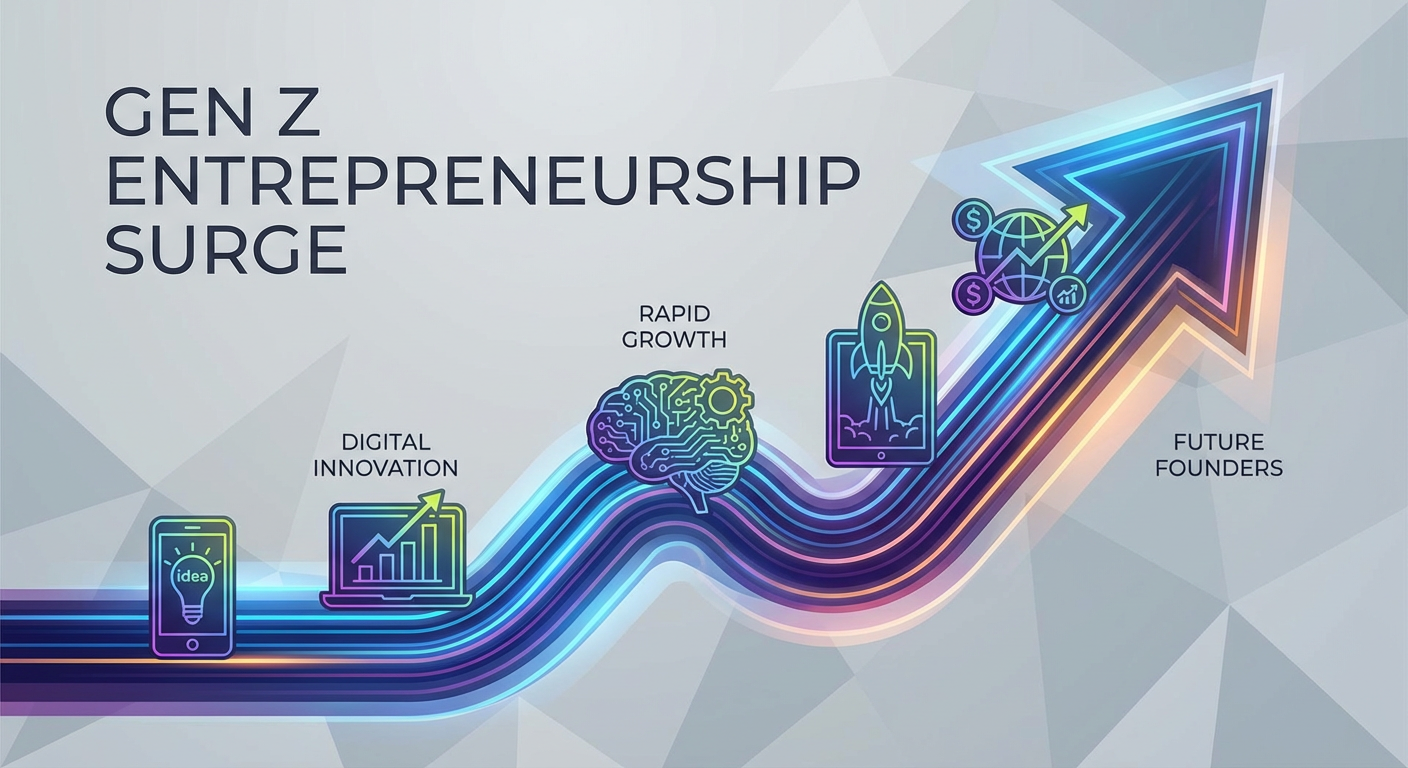
2. The Rise of Gen Z Entrepreneurship
The landscape of entrepreneurship is undergoing a profound and unprecedented transformation, largely driven by the emergence of Generation Z. This cohort, born roughly between the mid-1990s and early 2010s, is demonstrating an ambitious and distinct embrace of business ownership that significantly surpasses previous generations at similar life stages. No longer content with traditional career paths, Gen Z is actively seeking to forge their own professional destinies, propelled by a unique confluence of motivations, technological fluency, and the impactful lessons learned from recent global events. This section delves into the foundational data underscoring this entrepreneurial surge, comparing Gen Z’s aspirations with those of their predecessors, and examining the critical role of phenomena like the COVID-19 pandemic in accelerating this trend. The shift is not merely statistical; it hints at a fundamental redefinition of career aspirations and the future structure of the global economy.
The Generational Shift: Unprecedented Ambition and Early Engagement
The entrepreneurial spirit among Gen Z is not merely a moderate increase but a significant surge, setting them distinctly apart from preceding generations. Surveys conducted across both the United States and the United Kingdom highlight a remarkable inclination towards self-employment and business creation. In the U.S., approximately half of all Gen Z individuals (aged 16–25) express a strong desire to become entrepreneurs or launch their own businesses1. This figure, reported in a 2023 Morning Consult and Samsung survey, underscores an ambition level that substantially outstrips that observed in older cohorts2. For context, older adults typically show about a third of this entrepreneurial interest2. The disparity is even more pronounced in the United Kingdom. A 2022 survey by the Association of Accounting Technicians (AAT) revealed that a staggering 64% of UK Gen Z workers (aged 16–25) had either already started a business or planned to do so in 20233. This rate is nearly double that of the general population, which registers at approximately 32%3. Such a significant generational gap signals an impending wave of youth-led startups as this cohort matures into full economic participation. This heightened interest translates into concrete plans and actions. A 2023 GOBankingRates survey found that 54% of Gen Z individuals (aged 18–24) would prefer to launch their own business rather than remain in a traditional salaried job with benefits4. More broadly, an overwhelming 86% of this demographic intends to start a business at some point in their lives5. This aspirational data is supported by tangible preparatory steps: a ZenBusiness study in mid-2023 indicated that 93% of Gen Z adults (18–25) had already taken at least one concrete action towards entrepreneurship, such as developing a product idea, building a website, or creating content6. This unparalleled early engagement suggests that Gen Z is not simply dreaming of entrepreneurship; they are actively laying the groundwork. The urgency with which Gen Z approaches business creation is equally striking. Among those who harbor entrepreneurial intentions, nearly 46% aim to launch their venture within the next 12 months7, with 21% targeting a launch within six months and another 25% within six to twelve months. This short-term outlook reflects a generation eager to implement their ideas immediately, potentially buoyed by the perceived opportunities arising from recent economic shifts. The title of “Founder” is now the second-fastest growing job title among recent Gen Z graduates on LinkedIn8, further illustrating this directional shift in career ambitions.
| Demographic Group | Entrepreneurial Aspiration Rate | Source (Year) |
|---|---|---|
| Gen Z (US, 16-25) | 50% | Samsung/Morning Consult (2023)1 |
| Gen Z (UK, 16-25) | 64% (started or plan to start) | AAT News (2022)3 |
| Gen Z (US, 18-24) – prefer to be own boss | 54% | GOBankingRates (2023)4 |
| General Population (UK) | ~32% | AAT News (2022)3 |
| Older Adults (US) | ~33% | AAT News (2022)2 |
This table clearly illustrates the exceptional entrepreneurial ambition demonstrated by Gen Z compared to other demographics. This statistical trend signifies a fundamental redirection of career trajectories, moving away from a primary reliance on traditional corporate employment towards self-determination and business creation.
The Pandemic’s Catalytic Impact and Evolving Economic Realities
The COVID-19 pandemic served as a significant catalyst, accelerating Gen Z’s existing interest in entrepreneurship and reshaping their perceptions of work, financial security, and career trajectories. The widespread disruption to traditional employment models, coupled with an increased emphasis on remote work and digital interaction, created a fertile ground for young individuals to explore self-employment. A 2021 Ernst & Young survey highlighted this effect, with 44% of Gen Z (aged 14–24) reporting that their interest in entrepreneurship had intensified since the onset of the pandemic9. At that point, 45% of Gen Z already considered themselves very or extremely likely to start a business in the future9, a figure that had noticeably increased from prior years. This suggests that the pandemic didn’t just introduce the idea of starting a business; it legitimized and invigorated it. The economic instability brought about by the pandemic also deeply impacted Gen Z’s outlook on job security. This generation came of age during or immediately after the 2008 financial crisis, and then experienced the economic downturn accompanying COVID-19. They witnessed firsthand massive layoffs and financial precariousness that affected their parents and older siblings. Half of older Gen Z individuals (18–23) reported that a household member lost a job or income during the pandemic10. Consequently, younger workers today are the most concerned about job stability, with polls indicating that 18–34-year-olds are most likely to fear being laid off11. This ingrained apprehension about employer reliability has instilled a desire for greater personal control over their financial futures. For many, owning a business is seen as a more controllable path to stability, where their efforts directly correlate with their success, regardless of external circumstances12. As Chase Gallagher, a Gen Z entrepreneur, observed regarding his mother’s repeated layoffs, he felt he had “more potential betting on [himself] than going to work for someone”13. This sentiment is prevalent among his peers, who reject the notion that corporate employment offers inherent security. Furthermore, the shift to remote work and online schooling during the pandemic inadvertently exposed Gen Z to new entrepreneurial avenues. The sight of peers monetizing their talents via platforms like TikTok, YouTube, or e-commerce storefronts normalized the idea of starting a business at a young age, often from the confines of their homes. This made entrepreneurship feel more accessible and less intimidating. Government data also recorded a noticeable spike in new business applications from 2020 to 2022, with a significant increase in young applicants, underscoring the direct link between global events and burgeoning youth entrepreneurship. This “startup boom” is widely expected to be sustained by Gen Z founders in the coming years, bringing new dynamism to the small business sector.
Motivations Beyond Money: Autonomy, Purpose, and Work-Life Integration
While financial independence is undoubtedly a factor, Gen Z’s entrepreneurial drive is fueled by a constellation of profound motivations that extend beyond mere profit. At the forefront is an overwhelming desire for **autonomy and control**. The prevalent sentiment among Gen Z entrepreneurs is a fervent wish to “be my own boss” and escape the perceived constraints and rigidity of the traditional 9-to-5 corporate grind1415. Surveys consistently rank independence and self-governance as primary motivators. For instance, in the UK, 20% of Gen Z aspire to start a business “to have something of my own,” while 16% explicitly state “being their own boss” as the key reason15. This craving for self-determination stems partly from observing previous generations grapple with stagnant wages, corporate burnout, and a lack of fulfillment in conventional roles. Having witnessed their parents’ and Millennials’ struggles with job insecurity and diluted work-life boundaries, Gen Z is determined to craft careers that offer greater personal agency. Closely linked to autonomy is the prioritization of **flexibility and work-life balance**. Unlike some older generations who might have embraced workaholic tendencies, Gen Z places a high value on integrating work with their personal lives in a meaningful way. Entrepreneurship is viewed as the optimal pathway to achieve this equilibrium, allowing them to set their own schedules, work from diverse locations, and avoid the institutionalized strictures of corporate environments16. The ability to design a work structure that aligns with their personal values and well-being is a powerful draw. A LendingTree survey found that 73% of Gen Z consider enjoying their work to be extremely important, a notable increase from 62% in the preceding generation17. This cohort seeks to build businesses around their passions, believing that such endeavors will be inherently more fulfilling than traditional employment. Moreover, many Gen Z founders are acutely aware of mental health considerations and opt for entrepreneurial paths that allow them to create sustainable work cultures, thereby mitigating the risk of burnout often associated with high-pressure corporate jobs18. Entrepreneurship, for them, is not just a means to wealth but a strategy for constructing a desirable lifestyle. Perhaps the most distinctive motivation for Gen Z entrepreneurs is their pronounced focus on **purpose and mission-driven ventures**. This generation is deeply concerned with societal and environmental issues, demonstrating a strong emphasis on meaning and social impact in their work. Data from Deloitte and other sources reveal Gen Z’s profound commitment to causes such as climate change, social equality, and community improvement19. As a result, many Gen Z-led businesses are inherently mission-oriented, ranging from sustainable product lines to mental health platforms. Examples abound: Siddharth Thakur, at 19, founded a robotics company to aid firefighters and reduce casualties2021, while Brian Femminella, 23, co-founded SoundMind to deliver music therapy for trauma survivors22. Roberta Katz, a senior research scholar at Stanford, describes the typical Gen Z entrepreneur as a “self-starter who deeply cares about others” and is pragmatic in solving inherited problems23. This translates into ventures that not only generate profit but also align with personal ethics, advocating for eco-friendly practices or supporting marginalized communities. Crucially, Gen Z does not perceive purpose and profit as mutually exclusive; instead, they believe that a strong social or environmental mission can be a competitive differentiator that resonates powerfully with their demographic’s conscious consumer base. Finally, a pervasive **disillusionment with corporate life** serves as a potent underlying factor. Gen Z largely views the traditional corporate ladder as unappealing, unstable, and even inherently risky. Their formative years were marked by economic turmoil, leading to skepticism about the implied job security of large organizations. A HubSpot report indicates that Gen Z perceives fewer opportunities than their parents did and consequently feels compelled to carve out their own paths24. Coupled with witnessing Millennials struggle with slow career progression and the pressures of “hustle culture,” Gen Z is wary. They prioritize authenticity and inclusion, often rejecting companies whose values don’t align with their own standards. As such, entrepreneurship is frequently seen not merely as an alternative, but as *the preferred or essential route* to achieve career satisfaction and stability.
The Digital Native Advantage: Tech-Savvy Methods and the Creator Economy
Gen Z’s identity as true **digital natives** fundamentally reshapes the landscape of entrepreneurship. Their innate fluency with technology provides them with a distinct advantage, allowing them to initiate and scale businesses using tools and platforms that were either nonexistent or nascent for previous generations. The process of setting up an online store, for instance, can now be accomplished rapidly through platforms like Shopify or Etsy, enabling quick market entry. Customer acquisition often involves native engagement on social media platforms such, with products marketed through trending TikTok videos or viral Instagram Reels25. Digital tools like website builders, on-demand manufacturing services, and specialized gig marketplaces significantly lower the barrier to entry, making entrepreneurship feel “that much more attainable” for this generation26. This technological comfort allows Gen Z entrepreneurs to **bootstrap their ventures with minimal upfront costs**. They are adept at guerrilla marketing tactics, leveraging viral content and hashtag trends to achieve broad reach without substantial advertising budgets. The ability to prototype products using 3D printing or to source freelancers online further exemplifies their resourceful, lean operational approach. This facilitates **rapid iteration** – concepts can be tested, feedback gathered from online communities, and products refined in weeks, a process that historically took months or years. Venture capitalists observe that Gen Z founders “move at breakneck speeds”27, a trait honed by growing up in an era of instant applications and continuous digital updates. Their self-directed learning approach, often utilizing platforms like YouTube for skill acquisition (be it coding, marketing, or design), further diminishes knowledge gaps and accelerates their entrepreneurial journey. In essence, Gen Z is crafting a new entrepreneurial playbook that is inherently faster, more agile, and deeply integrated with technology. A defining characteristic of Gen Z’s entrepreneurial methods is the central role of social media and the burgeoning **creator economy**. For many young founders, the journey begins not with a formal business plan, but with cultivating a personal brand or content channel which is later monetized. A significant 50% of Gen Z identify as content creators28, a figure that is double that of the overall population. These “creator-preneurs” range from teen YouTubers reviewing gadgets to TikTokers offering fashion advice, all of whom build engaged audiences that can eventually translate into customer bases. The line between influencer and entrepreneur has blurred significantly. For example, fashion influencer Khadijah Oliver leveraged her 64,000-follower TikTok presence to launch a successful e-commerce hair products business through dropshipping, with her online persona driving sales directly2930. This model demonstrates how active online engagement transforms into direct revenue, turning an audience into a market. Platforms like Patreon and Substack further empower creators to monetize their content and build communities, allowing them to generate income (often as a side hustle) before formalizing into traditional businesses. For Gen Z ventures, marketing and product are often intertwined; an engaging online presence becomes the foundation upon which products and services are built. The digital-first approach also grants Gen Z entrepreneurs **global reach from day one**. Unlike traditional local businesses, their ventures can access an international customer base through platforms like Amazon, eBay, Etsy, or their own direct-to-consumer websites. This means a high school entrepreneur selling handmade goods on Etsy can reach customers worldwide, not just local acquaintances. Gen Z founders are naturally adept at cross-border e-commerce, utilizing global payment processors and leveraging social media for worldwide promotion. A viral TikTok video might generate orders from continents away overnight. Square’s report notes that 80% of Gen Z entrepreneurs start with an online or mobile business model, clearly indicating that e-commerce is fundamental to modern entrepreneurship for this group31. Interestingly, while digital-first, nearly 46% of Gen Z entrepreneurs also establish a physical presence, such as pop-up shops or market stalls32. This demonstrates an early understanding of the value of an omnichannel strategy, combining digital reach with real-world customer touchpoints to maximize growth and engagement. Finally, Gen Z’s affinity for technology fosters **innovation in business models**. Having witnessed the rise of disruptive platforms like Uber and Airbnb, they are predisposed to “think outside the box.” Many gravitate towards platform or marketplace models that leverage network effects, such as Whop, founded by Gen Zers Steven Schwartz and Cameron Zoub as a marketplace for digital entrepreneurs, which has facilitated over $700 million in sales in just a few years33. They favor subscription models, freemium apps, and direct-to-consumer brands that align with modern consumption patterns. This experimentation extends to emerging technologies, with young founders exploring NFTs, cryptocurrency projects, or leveraging AI for automation. Their comfort with tech experimentation leads to niches like teenage AI consultants or young Web3 startup founders. This creative and unconstrained approach to business design means Gen Z doesn’t feel bound by traditional industry norms, continually seeking to innovate and optimize using cutting-edge tools.
The Side-Hustle Path: Balancing Entrepreneurship with School and Work
Gen Z’s approach to entrepreneurship is characterized by a flexible and often low-risk entry strategy, commonly manifested through the ubiquitous “side hustle.” Unlike the traditional image of an entrepreneur who jettisons all prior commitments for a singular venture, Gen Z often integrates business pursuits alongside existing responsibilities, be it education or full-time employment. This rise of a **”portfolio career”** is attractive, allowing them to juggle multiple roles and income streams simultaneously34. It’s not uncommon to find a Gen Zer who is a student by day, an employee part-time, and managing an e-commerce side hustle in the evenings. This diversified approach serves to mitigate financial risk, allowing them to explore passions and validate business ideas without immediately sacrificing stability. Career coaches confirm that many Gen Z clients explicitly aim to “have it both ways” – securing a steady paycheck or degree while incrementally building a business part-time35. Increased flexibility in work arrangements, exacerbated by the pandemic’s normalization of remote work, has facilitated this approach, enabling seamless transitions between different roles throughout the day. The synergy between **education and entrepreneurship** is a hallmark of this generation. Many Gen Z founders opt to remain enrolled in schools and universities while cultivating their startups, strategically utilizing campus resources such as incubators, pitch competitions, and specialized entrepreneurship courses3637. Institutions like Blackstone LaunchPad actively support student ventures with funding and mentorship. Historically, a successful startup might have led to a university dropout, but today’s educational environment often encourages students to pursue both academic degrees and business ventures concurrently. Colleges now offer academic credit for startup work, seed funding, and access to alumni networks, providing a crucial safety net for young entrepreneurs. The robust presence of Gen Z founders who have been running their businesses for two years or less suggests that many launched these enterprises during their high school or college years38, demonstrating this integrated approach. Even within traditional employment, Gen Z often views their early jobs as **incubators for future entrepreneurship**. Sensing a lack of advancement and persistent concerns about layoffs in corporate roles39, many treat their tenure as temporary, designed to acquire skills, industry knowledge, and capital before transitioning to full-time entrepreneurship. It is common for a Gen Z employee to maintain a side business throughout their employment, with the strategic intent of eventually scaling it into their primary source of income. This pragmatic approach also extends to “intrapreneurship,” where young employees hone entrepreneurial skills within a corporate setting and later apply them to their own ventures. The steady income and mentorship from a day job provide stability and learning opportunities as they plan their eventual exit. Maintaining this delicate balance is challenging, with many Gen Z founders effectively working two full-time jobs. Their reliance on productivity technology and flexible scheduling is key to managing these demands. Employers are increasingly aware of this side-hustle culture, with some even fostering it, recognizing that entrepreneurial employees can inject creativity and drive into their organizations. **Financial prudence** also underpins the side-hustle approach. Facing student loan debt or high living costs, many Gen Zers cannot afford to forgo income to launch a full-time business. The side-hustle model provides a crucial bridge, ensuring income stability until the venture can sustain itself. Khadijah Oliver, a Gen Z entrepreneur with a successful social media and e-commerce business, maintains her day job as a licensed chiropractor, referring to her doctorate as a “security blanket”4041. This dual-track strategy is common, reflecting a generation that is debt-averse and risk-aware. Many rely on family support or parental health insurance in their early twenties to mitigate personal risk while building their businesses. Once a venture demonstrates traction and generates sufficient revenue, founders make the calculated decision to transition into full-time roles. Square’s report found that 73% of Gen Z entrepreneurs now consider their business their main income42, indicating a significant portion have successfully navigated this transition. The side-hustle paradigm democratizes entrepreneurship, lowering entry barriers and allowing for a gradual progression into business ownership. While this might lead to slower initial growth for some ventures, it fosters a resilient and versatile generation of entrepreneurs.
Challenges and Opportunities: Navigating Business as a Teen/Young Founder
While Gen Z’s entrepreneurial drive is robust, these young founders confront a unique set of challenges, predominantly stemming from their limited experience and access to traditional resources. Simultaneously, their inherent strengths present significant opportunities for innovation and disruption. The most frequently cited hurdle for Gen Z entrepreneurs is **lack of funding and resources**. A survey by iStock/Forbes revealed that 62% of Gen Z business owners struggled with inadequate resources, encompassing capital, time, or personnel, hindering their growth43. Starting a business in one’s late teens or early twenties often means a lean personal savings account, limited collateral for bank loans, and a nascent professional network. Consequently, 45% of Gen Z entrepreneurs rely on personal savings for startup capital44. This reliance on bootstrapping necessitates a steep learning curve in financial management, often leading to mispricing or unforeseen budget shortfalls. Beyond capital, a lack of formal management experience often translates into challenges with hiring, leading teams, and operational efficiency. The absence of extensive professional networks at a young age further compounds problems, making it difficult to find critical mentors, reliable partners, or early customers. This is reflected in the data, where 50% of Gen Z entrepreneurs cite difficulties in generating customer leads and increasing visibility as a major challenge45, and 46% struggle with consistent marketing efforts46. Navigating these multifaceted demands—from finance and marketing to operations and legal compliance—all while building a business, is a monumental task. Another significant challenge is **credibility and age bias**. Young founders often encounter skepticism from potential customers, partners, and investors solely due to their youth. Many report not being taken seriously, with questions arising about their experience or ability to manage projects. Flori Needle’s Gen Z survey indicated that customers sometimes distrust the expertise of young entrepreneurs, requiring them to exert extra effort to prove their professionalism47. In the investment landscape, where the average age of a successful startup founder is around 4548, a 22-year-old pitching a venture must overcome a statistical bias. Tash Grossman, a Gen Z founder of the digital receipts app Slip, noted that she had to significantly refine her profit model and demonstrate clear business value to secure investment, moving beyond presenting her venture solely as a sustainability initiative449. This highlights the necessity for young entrepreneurs to articulate a robust business case to be taken seriously. Despite these hurdles, Gen Z entrepreneurs possess inherent strengths that enable resilience and adaptability. They are typically **highly adaptable**, characterized by a “fail fast, learn fast” mentality cultivated in an era of rapid technological evolution. Setbacks are often met with a pivot rather than defeat. Their comfort with digital platforms extends to problem-solving: if they lack specific knowledge, they readily seek answers from online communities or self-directed learning tools. This resourcefulness allows for quick solutions and continuous improvement. Moreover, Gen Z displays remarkable optimism, with 84% planning to continue their businesses five years into the future50, largely confident in their ability to navigate challenges and achieve success through consistent effort51. Their youth also offers a significant advantage: failures at an early age are often viewed as invaluable learning experiences that pave the way for future successes. Furthermore, their authenticity and deep understanding of their own generation can be powerful marketing assets, fostering brand loyalty by creating “by Gen Z, for Gen Z” narratives. The long-term success of Gen Z entrepreneurs will largely depend on the development of robust support systems. This includes specialized accelerator programs and mentorship initiatives tailored for young founders. Corporations, recognizing the trend, are increasingly offering resources for young creators to monetize and scale their ideas. Business solution providers that offer integrated tools for sales, e-commerce, and analytics will be particularly valuable to young entrepreneurs who lack the time or expertise to manage disparate systems52. Policy adjustments, such as reduced business registration fees or grants for young innovators, could also foster a more accessible entrepreneurial environment. Ultimately, as more success stories emerge, public perception is gradually shifting, empowering young founders to overcome age-related biases. The synthesis of Gen Z’s intrinsic drive and external support structures will dictate the extent to which this generation transforms their raw ambition into sustainable, impactful businesses. Their blueprint for entrepreneurship is still being written, but already promises a significant and lasting impact on the global economy. (Transition to next section: “Having explored the unprecedented rise of Gen Z entrepreneurship and the catalytic factors at play, the subsequent section will delve deeper into the specific motivations that propel these young individuals, examining in detail their pursuit of autonomy, purpose, and work-life balance.”)
References
- Samsung Newsroom. (2023, October 19). Gen Z is Defining the Future of Work – on Their Own Terms, Reveals Morning Consult & Samsung Survey. Link to source
- AAT News (Association of Accounting Technicians). (2022, December 2). The Great Rejuvenation: New survey shows majority of Generation Z aspire to be their own boss. Link to source
- AAT News (Association of Accounting Technicians). (2022, December 2). The Great Rejuvenation: New survey shows majority of Generation Z aspire to be their own boss. Link to source
- GOBankingRates via Nasdaq. (2023, August 24). 40% of Gen Zers Plan To Start Their Own Business Within the Next Year, Survey Finds. Link to source
- GOBankingRates via Nasdaq. (2023, August 24). 40% of Gen Zers Plan To Start Their Own Business Within the Next Year, Survey Finds. Link to source
- Business Wire. (2023, June 14). New ZenBusiness Research Finds Class of 2023 Sees Neurodiversity as an Asset in Leadership & is Primed to be the Most Entrepreneurial. Link to source
- GOBankingRates via Nasdaq. (2023, August 24). 40% of Gen Zers Plan To Start Their Own Business Within the Next Year, Survey Finds. Link to source
- Fortune. (2025, January 22). Meet the Gen Zers who launched their side hustles before even starting high school—now they’re making a fortune as their own bosses. Link to source
- LendingTree (TreeNews). (2021). Pandemic Sparks Greater Entrepreneurship Among Gen Zers. Link to source
- HubSpot Blog. (2024, September 11). Is Gen Z the Entrepreneurial Generation? Data + Insight from the Generation. Link to source
- SBDC. (n.d.). The Rise of Gen Z Small Business Owners. Link to source
- HubSpot Blog. (2024, September 11). Is Gen Z the Entrepreneurial Generation? Data + Insight from the Generation. Link to source
- Fortune. (2025, January 22). Meet the Gen Zers who launched their side hustles before even starting high school—now they’re making a fortune as their own bosses. Link to source
- HubSpot Blog. (2024, September 11). Is Gen Z the Entrepreneurial Generation? Data + Insight from the Generation. Link to source
- AAT News (Association of Accounting Technicians). (2022, December 2). The Great Rejuvenation: New survey shows majority of Generation Z aspire to be their own boss. Link to source
- HubSpot Blog. (2024, September 11). Is Gen Z the Entrepreneurial Generation? Data + Insight from the Generation. Link to source
- LendingTree (TreeNews). (n.d.). Pandemic Sparks Greater Entrepreneurship Among Gen Zers. Link to source
- Fortune. (2025, January 22). Meet the Gen Zers who launched their side hustles before even starting high school—now they’re making a fortune as their own bosses. Link to source
- Fortune. (2023, December 17). How Gen Z is rewriting the rules of entrepreneurship. Link to source
- Fortune. (2023, December 17). How Gen Z is rewriting the rules of entrepreneurship. Link to source
- Fortune. (2023, December 17). How Gen Z is rewriting the rules of entrepreneurship. Link to source
- Fortune. (2023, December 17). How Gen Z is rewriting the rules of entrepreneurship. Link to source
- Fortune. (2023, December 17). How Gen Z is rewriting the rules of entrepreneurship. Link to source
- HubSpot Blog. (2024, September 11). Is Gen Z the Entrepreneurial Generation? Data + Insight from the Generation. Link to source
- Fortune. (2025, January 22). Meet the Gen Zers who launched their side hustles before even starting high school—now they’re making a fortune as their own bosses. Link to source
- Fortune. (2025, January 22). Meet the Gen Zers who launched their side hustles before even starting high school—now they’re making a fortune as their own bosses. Link to source
- Fortune. (2023, December 17). How Gen Z is rewriting the rules of entrepreneurship. Link to source
- HubSpot Blog. (2024, September 11). Is Gen Z the Entrepreneurial Generation? Data + Insight from the Generation. Link to source
- Fortune. (2025, January 22). Meet the Gen Zers who launched their side hustles before even starting high school—now they’re making a fortune as their own bosses. Link to source
- Fortune. (2025, January 22). Meet the Gen Zers who launched their side hustles before even starting high school—now they’re making a fortune as their own bosses. Link to source
- Yahoo. (2023). New Study Reveals Driving Forces Fueling Rise in Gen Z Entrepreneurship. Link to source
- Yahoo. (2023). New Study Reveals Driving Forces Fueling Rise in Gen Z Entrepreneurship. Link to source
- Fortune. (2025, January 22). Meet the Gen Zers who launched their side hustles before even starting high school—now they’re making a fortune as their own bosses. Link to source
- Fortune. (2025, January 22). Meet the Gen Zers who launched their side hustles before even starting high school—now they’re making a fortune as their own bosses. Link to source
- Fortune. (2025, January 22). Meet the Gen Zers who launched their side hustles before even starting high school—now they’re making a fortune as their own bosses. Link to source
- Fortune. (2023, December 17). How Gen Z is rewriting the rules of entrepreneurship. Link to source
- Fortune. (2023, December 17). How Gen Z is rewriting the rules of entrepreneurship. Link to source
- Yahoo. (2023). New Study Reveals Driving Forces Fueling Rise in Gen Z Entrepreneurship. Link to source
- SBDC. (n.d.). The Rise of Gen Z Small Business Owners. Link to source
- Fortune. (2025, January 22). Meet the Gen Zers who launched their side hustles before even starting high school—now they’re making a fortune as their own bosses. Link to source
- Fortune. (2025, January 22). Meet the Gen Zers who launched their side hustles before even starting high school—now they’re making a fortune as their own bosses. Link to source
- Yahoo. (2023). New Study Reveals Driving Forces Fueling Rise in Gen Z Entrepreneurship. Link to source
- Forbes. (2024, March 3). What Gen Z Entrepreneurs Want. Link to source
- Yahoo. (2023). New Study Reveals Driving Forces Fueling Rise in Gen Z Entrepreneurship. Link to source
- Forbes. (2024, March 3). What Gen Z Entrepreneurs Want. Link to source
- Forbes. (2024, March 3). What Gen Z Entrepreneurs Want. Link to source
- HubSpot Blog. (2024, September 11). Is Gen Z the Entrepreneurial Generation? Data + Insight from the Generation. Link to source
- Fortune. (2023, December 17). How Gen Z is rewriting the rules of entrepreneurship. Link to source
- Fortune. (2023, December 17). How Gen Z is rewriting the rules of entrepreneurship. Link to source
- Yahoo. (2023). New Study Reveals Driving Forces Fueling Rise in Gen Z Entrepreneurship. Link to source
- HubSpot Blog. (2024, September 11). Is Gen Z the Entrepreneurial Generation? Data + Insight from the Generation. Link to source
- Yahoo. (2023). New Study Reveals Driving Forces Fueling Rise in Gen Z Entrepreneurship. Link to source

3. Motivations Behind Gen Z’s Entrepreneurial Drive
The current generation, known as Generation Z (Gen Z), broadly encompassing individuals born between the mid-1990s and early 2010s, is demonstrating a profound and unprecedented shift in career aspirations, marked by a surge in entrepreneurial drive. Unlike previous generations that often viewed entrepreneurship as a mid-career pivot or a risk-laden path, Gen Z is actively seeking self-employment and business ownership as a primary vocational goal, often starting ventures in their teenage years or early twenties. This section delves into the core motivations fueling this entrepreneurial fervor, exploring how a desire for autonomy, flexibility, work-life balance, and purpose-driven initiatives, coupled with a fundamental disillusionment with traditional corporate structures, are shaping the career trajectories of today’s young business owners. The data unequivocally points to a seismic shift in mindset, with young adults prioritizing control, meaning, and personal well-being over the perceived stability of conventional employment. A significant body of research underscores this trend: approximately half of Gen Z individuals (ages 16–25) aspire to start their own businesses. This ambition far surpasses that of older generations, signaling a substantial increase in youth entrepreneurship interest that has accelerated significantly since the COVID-19 pandemic [1], [2], [3]. For example, a 2023 survey found that 54% of Gen Z would rather launch a business than work for someone else, with an overwhelming 86% planning to embark on an entrepreneurial journey at some point in their lives [4]. In the United Kingdom, this inclination is even more pronounced, with 64% of Gen Z workers either having already started a business or planning to do so in 2023, effectively doubling the rate observed in the general population (approximately 32%) [5]. This profound generational gap highlights Gen Z’s distinct entrepreneurial orientation. This section will unpack these motivations, demonstrating how they coalesce into a powerful blueprint for the next generation of business leaders.
Independence, Control, and the Rejection of the 9-to-5 Grind
At the heart of Gen Z’s entrepreneurial ambition lies a deep-seated craving for autonomy and control over their professional lives. The desire to “be my own boss” is consistently cited as a primary driver for young entrepreneurs, reflecting a pervasive rejection of the traditional corporate hierarchy and the perceived rigidity of the 9-to-5 work model [6], [7]. This sentiment is not merely a preference but often a learned response to observed economic instability and a growing skepticism towards the promises of long-term corporate employment. Historical context plays a significant role here. Gen Z came of age during or immediately after major economic upheavals, including the 2008 financial crisis and the destabilizing impact of the COVID-19 pandemic. They witnessed firsthand the vulnerability of employees to corporate layoffs and the burnout experienced by previous generations. For instance, Chase Gallagher, a 23-year-old entrepreneur who transformed his childhood lawn-mowing business into a $1.5 million landscaping company, explicitly stated that observing his mother being laid off five times convinced him that he had “more potential betting on myself than going to work for someone” [8]. This personal anecdote encapsulates a widely held belief among Gen Z: self-employment offers a more reliable path to financial security and career stability than relying on an employer. The perceived “broken promises” of the traditional career ladder, where stagnant wages and demanding work cultures often fail to deliver proportionate rewards, have led them to seek alternative avenues for prosperity and fulfillment. This quest for control extends beyond financial stability to encompass a desire for greater flexibility and a healthier work-life balance. Unlike older generations, who sometimes glorified “workaholic” tendencies, Gen Z places a high value on personal well-being and the integration of work with a fulfilling lifestyle. They view entrepreneurship as a means to design their work around their lives, rather than the other way around. The ability to set one’s own schedule, work from diverse locations, and escape the often-stifling constraints of corporate office environments are highly attractive aspects of business ownership. Surveys reveal that young business owners frequently highlight freedom from corporate rules and the capacity to work on their own terms as significant benefits of running their ventures [9]. Explicitly, 73% of Gen Z emphasize the importance of enjoying their work, a notable increase from the 62% seen in the previous generation [10]. Many fear burnout in high-pressure corporate roles and believe that building a business centered on their passions offers a more sustainable and personally enriching career path [11]. Thus, entrepreneurship is not solely considered a vehicle for wealth accumulation, but increasingly, a powerful tool for achieving a desired lifestyle. The pandemic further amplified these motivations. Its disruptive impact on traditional employment pathways, combined with the normalization of remote work and the visible success of peers monetizing online activities, made entrepreneurship an even more appealing and accessible option. A 2021 Ernst & Young survey highlighted this catalyst effect, with 44% of Gen Z reporting increased interest in entrepreneurship since the onset of COVID-19 [3].
| Motivation Factor | Gen Z Perspective | Key Data/Examples |
|---|---|---|
| Autonomy & Control | Desire to be their own boss; rejection of hierarchy. | 54% of Gen Z prefer launching a business over traditional jobs [4]. Chase Gallagher chose self-employment citing layoffs as a risk motivator [8]. |
| Flexibility & Work-Life Balance | Seeking personalized schedules, remote work, avoidance of 9-to-5. | 73% of Gen Z find enjoyment in work “extremely important,” up from 62% in previous generations [10]. |
| Job Security Perception | Entrepreneurship seen as more stable than corporate jobs due to economic uncertainties. | Gen Z is most anxious about job stability, seeing entrepreneurship as a means to control destiny [12]. |
| Influence of Parents’ Experiences | Witnessing parents’ layoffs and corporate burnout shapes career choices. | Gallagher’s mother’s repeated layoffs directly influenced his entrepreneurial path [8]. |
| “Side-Hustle” Mentality | Leveraging technology to incrementally build ventures while maintaining other commitments. | Nearly two-thirds of young adults (18-35) have or plan side gigs, primarily for autonomy [7]. |
Purpose, Impact, and Ethical Entrepreneurship
Beyond personal autonomy, a defining characteristic of Gen Z entrepreneurs is their profound commitment to purpose-driven ventures. This generation prioritizes meaning and social impact in their work, often integrating ethical considerations, social responsibility, and environmental consciousness into their business models from inception. This emphasis stems from their upbringing in an era marked by heightened awareness of global challenges such as climate change, social inequality, and mental health crises. Consequently, many Gen Z-led businesses are explicitly mission-oriented, aiming to generate positive societal value alongside financial returns. Research consistently indicates Gen Z’s deep concern for these issues. For example, 64% of Gen Z consumers are willing to pay more for sustainable products, a significantly higher proportion than older cohorts (around 50%) [13]. This consumer behavior is mirrored in their entrepreneurial choices, where social impact and business objectives are intrinsically linked. They are more likely than previous generations to pursue ventures designed to address social or environmental problems directly. Notable examples abound. Brian Femminella, at 23, co-founded SoundMind, a mobile application that provides music therapy for mental health, after observing fellow service members struggling with PTSD and anxiety. His personal experience fueled a mission to “help others heal” through an innovative, tech-driven solution. SoundMind has already garnered over 100,000 users across approximately 50 organizations, attracting over $2 million in seed funding due to its compelling vision and social utility [14]. Similarly, Sidneyharth Thakur, a 19-year-old, founded a robotics company aimed at assisting firefighters and minimizing casualties, driven by a desire to innovate solutions for critical public safety issues [15]. In the UK, Natasha “Tash” Grossman, 26, launched Slip, a digital receipts platform, after realizing the environmental waste and inconvenience caused by paper receipts. Her business directly addresses sustainability by reducing paper consumption while offering a convenient solution for consumers and retailers alike [16]. These examples illustrate that Gen Z views their businesses as platforms for change. They are pragmatic problem-solvers who are “dismayed by inherited problems but pragmatic about solving them,” seeking to “do well by doing good” [17]. For these entrepreneurs, purpose is not a secondary consideration or a marketing tactic; it is an inherent part of their value proposition and a fundamental motivation for their endeavors. They believe that a strong social or environmental mission can be a distinct competitive advantage, resonating deeply with consumers and stakeholders who share similar values. The integration of ethics and profit is not seen as a compromise but as a synergistic approach to modern business.
Disillusionment with Corporate Structures and the Search for Security
The entrepreneurial surge among Gen Z is also heavily influenced by a profound disillusionment with traditional corporate careers and a skepticism towards the security they are commonly perceived to offer. This generation has witnessed economic volatility, corporate downsizing, and the unappealing realities of “hustle culture” that often characterize large organizations. This exposure has shaped their perception of job security, leading many to conclude that the traditional corporate ladder is less stable than self-employment. Gen Z’s formative years were marked by significant economic disruptions. Many observed family members or friends losing jobs during the 2008 recession and the COVID-19 pandemic, instilling a deep-seated apprehension about relying solely on external employers for livelihood. Consequently, young workers today are the most concerned about layoffs, with a poll indicating that 18–34-year-olds are most likely to fear job loss [18]. This heightened anxiety about job stability stands in stark contrast to the perspectives of previous generations who often sought large corporations for perceived lifetime employment. Moreover, Gen Z has observed the struggles of Millennials who, despite working long hours and often accumulating significant student debt, have faced slow career advancement, stagnant wages, and widespread burnout. The promise of a stable, rewarding corporate career seems incongruous with the experiences of those immediately preceding them. This has led to a collective skepticism towards the corporate contract, where loyalty and hard work do not guarantee proportional rewards or protection from economic vicissitudes. The prevailing sentiment among Gen Z entrepreneurs is often encapsulated in phrases like, “I’d rather work hard for my own dream than for someone else’s” or “No job is truly secure, so I might as well create my own.” [19], [20] They perceive that traditional employment offers fewer opportunities now than were available to their parents, necessitating a proactive approach to career creation rather than passive participation [21]. This pragmatic view encourages them to take matters into their own hands, betting on their own capabilities rather than on the fluctuating fortunes of large companies. Beyond security, Gen Z also values authenticity and ethical alignment. They are increasingly turned off by corporate cultures that diverge from their personal values, such as a lack of diversity, sustainability, or social responsibility. This generation expects transparency and genuine commitment to social good from the brands they engage with, and this expectation extends to their employers. If a traditional company fails to meet these ethical benchmarks, Gen Z is more likely to view entrepreneurship as an avenue to create workplaces and businesses that reflect their values from the ground up. Therefore, for many in Gen Z, entrepreneurship is not merely an attractive alternative but often a preferred or even necessary pathway to achieve a career that offers both stability and satisfaction. It represents a strategic move to regain control, mitigate risk, and align their professional pursuits with their deeply held personal and ethical convictions.
Digital Natives, Lean Operations, and the Creator Economy
Gen Z’s intrinsic identity as “digital natives” fundamentally shapes their entrepreneurial methods and further fuels their drive. Having grown up immersed in an always-on, interconnected digital world, they wield technology as an intuitive extension of their business toolkit. This innate familiarity with digital platforms, social media, and online marketplaces empowers them to launch and scale ventures with unprecedented speed, agility, and cost-effectiveness. The very infrastructure that underpins modern entrepreneurship – from website builders to payment processing – is second nature to them. The impact of this digital fluency is profound. Approximately 80% of Gen Z entrepreneurs initiate their businesses online or with a significant mobile/virtual component [22]. Social media, e-commerce marketplaces (like Shopify, Etsy, Amazon), and creator platforms serve as their primary launchpads, enabling them to bypass traditional barriers to entry that once required substantial capital and physical infrastructure. Natasha Stanley, a career coach, notes the abundance of “infrastructure available for people who want to create things of their own,” which makes entrepreneurship “feel that much more attainable” for this generation [23], [24]. This familiarity translates into a lean, fast, and iterative approach to business development. Gen Z entrepreneurs are comfortable launching minimum viable products, gathering real-time feedback from online communities, and rapidly adapting their offerings. This “fail fast, learn fast” mentality, ingrained from the tech world, allows them to iterate in weeks what might have taken months or even years for previous generations. Venture capitalists observe that Gen Z founders “move at breakneck speeds” [25], a testament to their comfort with rapid iteration and constant innovation. A critical aspect of Gen Z’s digital entrepreneurship is the rise of the “creator economy.” A significant 50% of Gen Z identifies as content creators, blurring the lines between influencer and entrepreneur [26]. This involves monetizing online presence through platforms like YouTube, TikTok, Instagram, Patreon, and Substack. Many young founders begin by cultivating a personal brand or content channel, which then serves as a direct bridge to their customer base. For example, fashion influencer Khadijah Oliver leveraged her 64,000-follower TikTok presence to launch a successful e-commerce hair products business through drop-shipping, effectively using her online persona to drive sales [27], [28]. This model demonstrates how Gen Z can start generating revenue without traditional business setups, eventually formalizing their operations as their ventures grow. In essence, for many, marketing and product development are indistinguishable: an engaging online presence often precedes and defines their product offerings. Furthermore, digital platforms afford Gen Z entrepreneurs global reach from day one. Unlike local businesses of the past, a Gen Z venture can access customers worldwide through e-commerce platforms and social networks. This global perspective is naturally integrated into their business strategies. The founders of Whop, Steven Schwartz and Cameron Zoub, exemplify this, having built a marketplace for digital entrepreneurs that has facilitated over $700 million in sales for users, leveraging their native understanding of online markets to create a platform with widespread reach and utility [29]. However, this digital-first approach also presents challenges. The online marketplace is saturated and intensely competitive, demanding sophisticated digital marketing skills to stand out. Many young entrepreneurs struggle with “algorithm literacy” and the constant content creation required for visibility. In one survey, 50% of Gen Z business owners cited difficulty in generating customer leads and increasing visibility as a top challenge, and 46% struggled with consistent marketing efforts [30]. The low barrier to entry means increased competition. Moreover, heavy reliance on specific platforms can create vulnerabilities, as changes in platform algorithms or policies can drastically impact a business’s reach and revenue. Despite these hurdles, Gen Z’s digital prowess remains a unique strength, enabling them to innovate business models, often focusing on subscription services, freemium apps, or direct-to-consumer brands that align with their own consumption habits.
The Side-Hustle Paradigm: Gradual Entry and Resilience
A significant aspect of Gen Z’s entrepreneurial journey is the widespread adoption of the “side-hustle” model. Rather than immediately abandoning traditional employment or education, many Gen Z individuals embark on entrepreneurship as a parallel endeavor, gradually nurturing their ventures while maintaining other commitments. This approach is rooted in a pragmatic understanding of financial realities and a desire to mitigate risk. The concept of a “portfolio career,” where individuals juggle multiple roles and income streams, is highly appealing to Gen Z [31]. This diversified strategy allows them to explore their passions and test business ideas without immediately sacrificing financial stability. For instance, a college student might run an e-commerce side business, or a young professional might freelance on platforms like Fiverr while holding a full-time job. These side hustles serve as invaluable entrepreneurial training grounds, providing practical experience in sales, marketing, and customer service. The pandemic accelerated this trend, as remote work and flexible schedules made it easier to balance multiple endeavors. About two-thirds of young adults aged 18–35 have already started or plan to start a side hustle alongside their primary commitments [7]. This demonstrates a shift away from the “all-or-nothing” approach often associated with previous generations of entrepreneurs. Many Gen Z side-hustlers explicitly intend to eventually transition their ventures into full-time careers, once they achieve sufficient scale and financial viability [4]. Education and entrepreneurship are also increasingly intertwined for Gen Z. Universities are adapting to this trend by offering robust entrepreneurship programs, incubators, and pitch competitions, encouraging students to develop their ventures while pursuing their degrees. This institutional support allows young founders to leverage academic resources, mentorship, and networks, reducing the perceived risk of launching a business at a young age. The prevalence of Gen Z founders who have been running their businesses for two years or less suggests that many begin during high school or college years [32]. Financial considerations are a key motivator for this gradual approach. Given potential student loan debt and high living costs, many Gen Z individuals cannot afford a period of zero income to focus solely on a startup. The side hustle provides a crucial income buffer until their business can sustain them. Khadijah Oliver, for example, maintains her career as a licensed chiropractor even as her influencer and e-commerce businesses thrive, viewing her doctorate as a “security blanket” [33], [34]. This prudent strategy reflects a generation that is risk-aware, often having witnessed recessions and economic uncertainty throughout their lives. They build their businesses incrementally, reinvesting profits and ensuring a safety net before making the full leap. The side-hustle paradigm democratizes entrepreneurship by lowering the barrier to entry. It indicates that entrepreneurship is transforming from an exclusive path for a select few into an accessible option for almost anyone willing to dedicate time and effort. While this approach might result in slower initial growth for some ventures, it fosters a highly resilient and adaptable generation of business owners who gain diverse experiences before committing to a singular path. This blended approach to career development is a hallmark of Gen Z, allowing them to pursue their entrepreneurial dreams without abandoning crucial financial and educational commitments.
Challenges and the Need for Support Systems
Despite their unparalleled ambition, digital fluency, and strong motivations, Gen Z entrepreneurs face significant challenges that differentiate their journey from that of older founders. These hurdles often stem from their youth and relative inexperience, highlighting a critical need for targeted support systems. The most frequently cited challenge is the **lack of capital and resources**. A 2024 survey revealed that 62% of Gen Z business owners struggle with inadequate resources, encompassing capital, time, or personnel [35]. Unlike older entrepreneurs who may have established savings, collateral for traditional loans, or extensive professional networks, young founders often start with limited financial backing. Almost 45% use personal savings to fund their startups, reflecting a reliance on bootstrapping rather than external investment [36]. This financial constraint can limit growth, with many businesses struggling to scale beyond micro-enterprise status due to insufficient funds for inventory, marketing, or hiring. Building credit history, securing bank loans, or attracting investors can be particularly challenging for individuals in their late teens or early twenties, who may lack proven track records or extensive professional contacts. **Inexperience in core business functions** is another significant hurdle. Gen Z entrepreneurs are often learning critical financial management, operational, legal, and human resources skills simultaneously while building their ventures. Errors in pricing, budgeting, or hiring can lead to setbacks. For instance, 50% of young entrepreneurs struggle with generating customer leads and increasing market visibility, and 46% find it difficult to maintain consistent marketing efforts [37], [38]. These challenges are reported at higher rates than by older entrepreneurs, reflecting a gap in experienced leadership and established networks. Furthermore, **age bias and credibility concerns** can hinder their progress. Young CEOs may encounter skepticism from potential customers, partners, and investors. Some Gen Z entrepreneurs report that their youth leads to their expertise being questioned, or difficulties in securing leases or partnerships [39]. The average age of a successful startup founder is around 45, meaning a 22-year-old presenting a pitch often has to overcome this statistical barrier [40]. Tash Grossman, founder of Slip, learned that while her sustainability mission was compelling, she needed to refine her profit model to satisfy investors who sought a clear business case over pure idealism [41]. This highlights the need for young founders to articulate strong economic viability alongside their passion. The lean operational model, while efficient, also presents scaling issues. The majority of Gen Z businesses operate solo or with a handful of employees (around 61%), and only 39% have scaled to five or more staff members [42]. Moving from a one-person operation to a structured business with complex supply chains and distribution networks requires different skill sets and significant capital, areas where many young founders lack guidance. Despite these challenges, Gen Z demonstrates remarkable **resilience and adaptability**. They are comfortable with rapid change, unafraid of experimenting, and possess a “fail fast, learn fast” mentality. Their native digital skills enable them to quickly find information and crowdsource solutions online. Encouragingly, 84% of Gen Z entrepreneurs are confident their businesses will still be operational in five years, reflecting a high degree of optimism and commitment [43]. To fully unleash Gen Z’s entrepreneurial potential, robust support systems are crucial. These include: * **Enhanced Financial Literacy and Access to Capital:** Programs that teach financial management, responsible debt, and strategies for attracting early-stage funding (e.g., micro-loans, grants, angel investors focused on youth). * **Mentorship and Networking:** Connecting young founders with experienced business owners and industry leaders who can provide guidance on strategic planning, operational scaling, and navigating market complexities. A significant 73% of Gen Z entrepreneurs welcome guidance from experienced owners [44]. * **Entrepreneurship Education:** Integrating practical business skills into educational curricula, including modules on marketing, legal structures, and financial planning, often delivered through accelerators and incubators. * **Technological Tools and Platforms:** Continued development of user-friendly business management tools that consolidate various functions (POS, e-commerce, marketing analytics) to alleviate the burden on lean teams [45]. * **Policy Support:** Government initiatives that simplify business registration, offer tax incentives for youth-led ventures, or provide dedicated grants for young innovators. By addressing these challenges and fostering a supportive ecosystem, society can help Gen Z transform their ambitious motivations into sustainable, impactful enterprises, further validating their belief that they are poised to become the most entrepreneurial generation in history [46]. This deep dive into Gen Z’s motivations for entrepreneurship reveals a complex interplay of personal aspirations, reactions to societal conditions, and leveraging of technological advancements. The next section will delve into the specific methods and characteristics of these young entrepreneurs, examining how their digital literacy, innovative marketing strategies, and unique business models are shaping the future of commerce.

4. Digital Native Strategies and the Creator Economy
The current generation of entrepreneurs, often referred to as Generation Z (individuals born between the mid-1990s and early 2010s), is intrinsically linked to the digital world. Having grown up with the internet, social media, and mobile technology as a constant and ubiquitous presence, Gen Z exhibits an innate digital fluency that fundamentally reshapes their approach to business formation and growth. This section explores how this digital native orientation, coupled with the emergence of the creator economy, forms the core blueprint for today’s teen business owners. It delves into their utilization of technology as an enabler, the blurring lines between content creation and traditional entrepreneurship, their digital-first launch strategies, and the new models of innovation they bring to the marketplace.
4.1 Technology as an Inherent Enabler and Accelerator for Gen Z Entrepreneurs
For Gen Z, technology is not merely a tool but an extension of their daily lives, influencing every facet of their entrepreneurial journey. This generation has never known a world without instant digital connectivity, easy access to information, and readily available online platforms, positioning them to leverage these resources with unparalleled agility and innovation[18]. The barrier to entry for starting a business has been dramatically lowered due to the availability of robust digital infrastructure, transforming what once required significant capital and specialized knowledge into easily accessible processes. One of the most significant impacts of digital fluency is the ability for Gen Z entrepreneurs to **bootstrap businesses with minimal upfront cost**[37]. Platforms like Shopify or Etsy allow for the creation of an online storefront in a matter of hours or days, negating the need for physical retail space or complex web development. Marketing, traditionally an expensive endeavor, can now be executed effectively through organic content creation on social media platforms like TikTok and Instagram, utilizing trending formats and viral hashtags[37]. This enables young founders to reach a global audience without large advertising budgets. The process of product development and refinement has also been revolutionized. Gen Z takes advantage of online resources for rapid iteration—launching minimum viable products (MVPs), gathering real-time feedback from online communities, and refining their offerings at speeds unimaginable to previous generations. This comfort with fast, tech-enabled cycles is a significant competitive advantage[37]. Venture capitalists have observed that Gen Z founders “move at breakneck speeds” due to their upbringing in an era defined by instant applications and continuous updates[39]. Furthermore, the accessibility of online tutorials and courses (e.g., YouTube videos, Coursera) allows them to quickly acquire necessary skills in areas such as marketing, coding, or design, further reducing traditional startup hurdles[37]. This results in an entrepreneurial playbook that is faster, leaner, and more deeply integrated with technology than ever before. This digital comfort extends to logistical aspects as well. Services for on-demand manufacturing, freelance marketplaces for specialized tasks (e.g., graphic design, virtual assistance), and gig economy platforms mean that a young entrepreneur can quickly assemble the necessary resources and talent without extensive hiring or capital investment. Natasha Stanley, a career coach, highlights this shift, noting that “there’s so much more infrastructure available for people who want to create things of their own” today[36], [37]. This facilitates an agile approach where experimentation and rapid evolution are the norm. The collective impact is that approximately **80% of Gen Z entrepreneurs initiate their businesses online or with a strong mobile/virtual component**[17], [43]. This statistic underscores a fundamental truth: for Gen Z, the digital realm is the default launchpad for entrepreneurial ventures.
Table 4.1: Characteristics of Gen Z’s Tech-Enabled Entrepreneurship
| Characteristic | Description | Impact |
|---|---|---|
| Low Start-up Costs | Utilizes readily available e-commerce platforms (Shopify, Etsy) and social media for marketing. | Democratizes entrepreneurship, allowing young founders with limited capital to launch. |
| Rapid Iteration & Feedback | Quickly launches MVPs, gathers community feedback, and refines products/services. | Fosters agility, responsiveness to market demands, and faster product-market fit. |
| Global Reach | Leverages online marketplaces (Amazon, eBay) and social media for international customer acquisition. | Expands market potential far beyond local geographical constraints from day one. |
| Skill Acquisition | Accesses online tutorials (YouTube), courses, and freelance platforms for specialized skills. | Reduces dependence on formal education or extensive hiring for diverse business needs. |
| Lean Operations | Employs contractors, gig workers, and automation tools rather than large salaried teams. | Optimizes resource allocation and maintains flexibility in scaling. |
4.2 Social Media and the Rise of the “Creator-preneur”
Perhaps no other aspect of Gen Z entrepreneurship highlights their digital nativism more vividly than their seamless integration of social media and their role within the burgeoning “creator economy.” For many Gen Z individuals, entrepreneurship doesn’t begin with a traditional business plan or a tangible product, but with the cultivation of a personal brand or content channel that is subsequently monetized[19]. This blurring of lines between content creation and formal business ownership has given rise to the “creator-preneur.” A significant **50% of Gen Z identify as content creators** of some form[19]. This figure contrasts sharply with 25% of the general population identifying as creators[19], underscoring the intrinsic connection this generation makes between online presence and commercial activity. These are not merely hobbyists; they are individuals actively building audiences on platforms like YouTube, TikTok, and Instagram, with the explicit or implicit intention of translating that audience into a revenue stream. The phenomenon can be observed across various niches: * **Teen YouTubers** reviewing gadgets or offering specialized tutorials can earn ad revenue, sponsorships, and affiliate commissions. * **TikTokers** providing fashion advice, skincare routines, or comedic skits can leverage their viral content for brand deals, merchandise sales, or even launch their own product lines. * **Instagrammers** with a flair for photography or lifestyle curation can become brand ambassadors or open online boutiques featuring products they endorse or design. A prime example is Khadijah Oliver, a fashion influencer who leveraged her 64,000-follower TikTok presence to launch an e-commerce hair products business through drop-shipping[40]. Her online persona directly fuels sales for her entrepreneurial venture, illustrating how the audience she cultivated becomes the market for her products[40], [41]. This model signifies a paradigm shift where marketing and product development are often intertwined from the outset; an engaging online presence is built first, and then products or services are layered upon that established engagement platform. The expansion of the creator economy is further facilitated by specialized platforms like Patreon, Substack, and OnlyFans, which provide creators with direct mechanisms to monetize their content or community support, often through subscription models[19]. This enables many Gen Z entrepreneurs to generate revenue without needing a traditional business setup, eventually leading to the formalization of their ventures into LLCs or established brands. The democratic nature of this approach is profound: if one can gain followers from their bedroom, they can theoretically start a business. The implications for entrepreneurship are significant. It has opened entrepreneurial avenues to individuals, including teenagers, who might not have previously considered it, demonstrating that building a loyal audience can precede the creation of a formal product or service. This means that young founders often bring a deep understanding of digital communication, community building, and customer engagement into their ventures, skills honed through years of participation in online culture.
4.3 E-commerce and Global Reach from Day One
The default market for a Gen Z entrepreneur transcends geographical boundaries, encompassing the entire internet-connected world. Unlike the local brick-and-mortar businesses of previous eras, a Gen Z micro-business, even one run by a teenager, can reach a global customer base immediately through various digital channels. This inherent global perspective is a hallmark of their digital native strategies. The primary mechanism for this expanded reach is e-commerce. Platforms such as Amazon, eBay, Etsy, and direct-to-consumer websites empower young entrepreneurs to sell products and services internationally without requiring physical presence in multiple regions. For example, many high school entrepreneurs have gained initial experience by selling items like sneakers or vintage clothing on eBay, catering to buyers far beyond their immediate locality[42]. By the time they launch more formalized startups, Gen Z founders are generally proficient in managing cross-border transactions, utilizing payment processors like Stripe or PayPal, and even exploring cryptocurrencies for certain niches. Social media platforms further amplify this global accessibility. A viral TikTok video featuring an entrepreneur’s unique product or service can generate orders from across continents overnight. This dramatically collapses the distance between producer and consumer, enabling rapid scaling and market validation. Data shows that **80% of Gen Z entrepreneurs opted for an online or mobile business model** at launch[17], [43], illustrating that e-commerce is not a supplementary channel but an foundational element of their business strategy. Interestingly, while digital-first, many Gen Z entrepreneurs are not exclusively online. Square’s research indicates that nearly **46% also establish a physical component** to their businesses, such as pop-up shops, market stalls, or even traditional brick-and-mortar storefronts, in addition to their online operations[17], [44]. This suggests a sophisticated understanding of an “omnichannel” approach, integrating digital reach with real-world customer interaction to maximize growth and engagement. A Gen Z baker, for instance, might sell their creations via Instagram, take orders through a dedicated website, and also host a local cupcake stand at a weekend market. The seamless integration of these diverse channels is facilitated by modern technology, including unified point-of-sale systems, online booking tools, and integrated digital marketing campaigns. The net effect is that Gen Z ventures are equipped to scale rapidly and compete effectively with larger, more established businesses by being accessible wherever their customer resides, whether virtually or physically. This omnichannel mindset leverages their digital proficiency while recognizing the value of tangible customer experiences.
4.4 Innovation in Business Models: The Disruptive Approach
Growing up in an era defined by disruptive innovations like Uber, Airbnb, and numerous social media platforms, Gen Z entrepreneurs are predisposed to challenge existing norms and think creatively about business models. This generation often gravitates towards approaches that leverage networks, platforms, and evolving technologies, consistently seeking efficiencies and new ways to deliver value. One prominent trend is their focus on **platform or marketplace ideas**. A notable example is **Whop**, founded by Gen Z entrepreneurs Steven Schwartz and Cameron Zoub. What began with Schwartz developing a sneaker-reselling bot at age 13 evolved into Whop, a robust marketplace platform for digital entrepreneurs and creators[51], [52]. Launched in 2021, Whop provides infrastructure for individuals to sell access to software, memberships, and various digital services, handling payments, subscriptions, and community management. Within just a few years, Whop has facilitated over **$700 million in sales** for its users, with over **5.5 million users signed up**[45], [53]. This exemplifies how Gen Z isn’t just participating in the creator economy or gig economy; they are actively building the platforms that enable it. Beyond marketplaces, Gen Z founders frequently adopt business models that align with their own consumption habits. **Subscription models, freemium apps, and direct-to-consumer (DTC) brands** are highly favored. They often prioritize recurring revenue streams and community-building elements, such as Discord servers or private social groups, which foster strong brand loyalty and engagement. Their comfort with technological experimentation extends to embracing cutting-edge innovations. It is common to see Gen Z entrepreneurs launching ventures in nascent fields like Non-Fungible Tokens (NFTs) or cryptocurrency projects, or employing Artificial Intelligence (AI) tools to automate business processes that historically required human staff. This leads to the emergence of novel roles, such as teenage AI consultants or young Web3 startup founders, operating in niches that were non-existent only a few years prior. Even for more traditional businesses like clothing lines or food products, the operational and marketing strategies are invariably digital-first, showcasing a consistent creative application of technology. The common thread across these diverse ventures is a **creativity in method** where Gen Z founders operate unconstrained by traditional industry boundaries. They possess an inherent curiosity and a willingness to question “why not do it differently?” when encountering inefficiencies. This inventive spirit, while occasionally leading to engagement with short-lived fads, frequently results in groundbreaking solutions that challenge established markets. However, this digital-first and innovative approach also presents its own set of challenges. The online marketplace is intensely competitive and rapidly evolving, demanding mastery of digital marketing and constant differentiation. Many young entrepreneurs confront difficulties in navigating complex algorithms and maintaining the consistent content creation required to sustain visibility. A survey indicated that **50% of Gen Z business owners struggle with generating leads and increasing visibility**, and **46% find it challenging to maintain consistent marketing efforts**[25]. The low barrier to entry means immense competition, while reliance on specific platforms can be a double-edged sword; changes in platform policies (e.g., Instagram algorithm changes, Amazon fee adjustments) can severely impact a business’s revenue if not strategically mitigated. Cybersecurity risks and the potential for reputational damage from a negative viral moment also represent significant concerns in the digital landscape. These challenges highlight the need for young founders to develop robust, diversified strategies alongside their innovative spirit, often seeking guidance from experienced mentors to navigate these complexities.
4.5 The Side-Hustle Path: Balancing Entrepreneurship with Education and Employment
The entrepreneurial journey for Gen Z often diverges from the traditional “all-in” startup narrative, instead embracing a “side-hustle” culture that allows them to balance business ventures with their education and employment commitments. This approach views entrepreneurship as a component of a larger “portfolio career,” a strategy that spreads risk, provides financial stability, and allows for gradual exploration of business ideas. Nearly **two-thirds (roughly 66%) of individuals aged 18-35 either have a side hustle or plan to start one**[5], [6], [26]. This statistic underscores the prevalence of this flexible entrepreneurial model. Many Gen Z entrepreneurs begin their ventures as small online businesses or freelance gigs, operating during evenings, weekends, or academic breaks. Examples include students running Etsy shops, college attendees managing Instagram resale businesses, or individuals offering specialized freelance services through platforms like Fiverr. These low-barrier side hustles serve as invaluable “entrepreneurial training grounds,” providing practical experience in areas like marketing, customer service, and product management without the immediate pressure of full-time operations. Over time, a significant portion of these side ventures grow into full-time enterprises, with nearly half of aspiring Gen Z side-hustlers aiming to transition their businesses into their primary careers within a few years[29]. This blend of activities is facilitated by significant societal and technological shifts. The proliferation of remote work arrangements following the COVID-19 pandemic has increased flexibility, enabling more individuals to juggle multiple roles[28]. Gig and freelance platforms also offer seamless integration of different work types. This means a Gen Z individual might attend classes in the morning, work a part-time job in the afternoon, and then fulfill orders for their e-commerce store in the evening. While this demanding schedule can lead to potential overextension and burnout, Gen Z appears willing to undertake this hustle for the long-term benefits of autonomy and control over their careers. Educational institutions are increasingly adapting to this trend, offering support for student entrepreneurship through campus incubators, pitch competitions, and specialized entrepreneurship courses[30], [31]. Rather than forcing a choice between studies and startups, many universities now encourage students to pursue both, providing academic credit for venture development, seed funding, and access to mentorship and alumni networks. This supportive environment allows young founders to acquire critical skills and networks while retaining the safety net of their education. The fact that a majority of Gen Z founders in one survey had been running their businesses for two years or less suggests they primarily initiated these ventures during their high school or college years[32]. Even for Gen Z individuals entering traditional employment, many view their early jobs as strategic learning opportunities and stepping stones toward future entrepreneurship. Witnessing economic downturns and corporate layoffs has made Gen Z particularly risk-averse regarding traditional job security, with younger workers being the most concerned about layoffs today[23], [50]. Consequently, a corporate role may be perceived as a temporary phase to gain experience, build a professional network, and accumulate savings. Many continue to maintain side businesses during their employment, with the goal of eventually scaling them to full-time operations. This pragmatic approach includes “intrapreneurship,” where Gen Z employees hone entrepreneurial skills within a corporate setting by leading new projects or initiatives, which they later apply to their own ventures. Financial prudence is another key motivator for the side-hustle path. Faced with student loan debt and high living costs, many Gen Z individuals cannot afford to forego income to launch a startup full-time. The side hustle provides necessary financial stability until the business matures sufficiently to sustain them. Khadijah Oliver, for example, successfully manages a social media influencer business and an online store while maintaining her day job as a licensed chiropractor, referring to her doctorate as her “security blanket”[54], [55], [56]. This dual-track strategy is common, allowing Gen Z to mitigate financial risks by gradually transitioning into full-time entrepreneurship once their ventures prove viable. Approximately **73% of Gen Z business owners now report their venture as their primary source of income**[14], [57], indicating a successful transition for many after an initial period of balancing multiple commitments. This approach signifies a departure from the singular, high-risk entrepreneurial stereotype. It democratizes entrepreneurship by enabling gradual entry, making it accessible even without substantial initial investment. However, it also implies slower growth for many businesses in their nascent stages and poses potential mental health challenges due to the demands of juggling multiple responsibilities.
4.6 Case Studies: Exemplars of Gen Z Digital Native Strategies
4.6.1 Steven Schwartz & Cameron Zoub – Whop (USA)
Steven Schwartz (26) and Cameron Zoub epitomize the digital-native entrepreneurial journey, illustrating how deep familiarity with online niches can lead to building transformative platforms. Their entrepreneurial trajectory began precociously: at just 13, Schwartz, seeking an expensive pair of sneakers his parents wouldn’t buy, teamed up with Zoub to create a sneaker-reselling bot[51]. This early, digitally-focused venture was one of at least 22 side hustles the duo developed throughout their high school and college years, ranging from software tools to online communities[52]. This iterative experimentation provided a foundational understanding of online markets and digital product development.
In 2021, armed with this extensive experience, they founded Whop, a marketplace platform designed specifically for digital entrepreneurs and creators[45], [53]. Responding to the growing need for simplified infrastructure for online businesses, Whop enables users to sell access to software, memberships, and a variety of digital services. It provides essential tools for payments, subscription management, and community engagement. Whop’s rapid ascent is a testament to the founders’ prescient understanding of the creator economy: within a few years, the platform has seen over 5.5 million users sign up to buy or sell services, facilitating a combined $723 million in earnings for its users as of late 2023[45], [53]. Schwartz’s journey underscores how Gen Z entrepreneurs can leverage their native understanding of digital culture to build new, empowering platforms, demonstrating that starting small and iterating through various digital ventures can lead to leading a multi-million-dollar enterprise.
4.6.2 Tash Grossman – Slip (UK)
Natasha “Tash” Grossman (26) exemplifies Gen Z’s ability to identify common inefficiencies and apply technological solutions with a strong social conscience. Her startup, Slip, addresses the pervasive problem of paper receipts. The idea originated in 2020 when Grossman, then 23, was unable to return pants due to a lost paper receipt, prompting her to consider the environmental waste and inconvenience associated with traditional paper slips[58]. Her research revealed that millions of paper receipts contribute to landfill waste and are often unrecyclable, reinforcing her commitment to a digital solution[59].
Grossman left her consulting job in 2020 and co-founded Slip as a **digital receipts platform** that stores proof of purchase directly on a user’s phone, aiming to minimize waste and streamline returns[59]. By 2023, Slip had achieved significant traction, integrating with retailers’ point-of-sale systems and hosting approximately **30,000 digital receipts monthly** for users[60], [61]. The startup has secured 7 retail partners and successfully raised around $1 million in pre-seed funding[62], [64].
Grossman’s experience also highlights the practical challenges faced by young, purpose-driven entrepreneurs. She learned that while her initial pitch focused on sustainability, investors required a clear and compelling profit model. Adaptably, she refined her approach, demonstrating how Slip could benefit retailers through customer data and loyalty, which proved crucial in attracting funding[63], [64]. Slip’s success illustrates how Gen Z founders marry mission-driven ideals with sound business acumen, driving innovation in traditional sectors like retail by prioritizing convenience, digital integration, and environmental responsibility.
4.7 Conclusion: A New Era of Digital Entrepreneurship
The digital native strategies and inherent participation in the creator economy are defining characteristics of Gen Z entrepreneurship. Their comfort with technology, penchant for social media, and ability to think globally from day one allow them to launch and scale businesses with unprecedented speed and efficiency. The blurred lines between content creation and traditional business are not merely a trend but a fundamental shift in how entrepreneurial ventures are conceived and grown. While confronting challenges related to resources, experience, and age bias, Gen Z entrepreneurs mitigate these through adaptability, resourcefulness, and a strong commitment to learning and iteration. This deep dive into their digital methods reveals a dynamic, innovative, and increasingly impactful cohort poised to significantly reshape the global business landscape, underscoring the critical need for tailored support systems to nurture their potential.
The next section of this report will delve into the challenges and opportunities for Gen Z entrepreneurs, examining their access to funding, mentorship, and the broader ecosystem that can either propel or hinder their ventures.
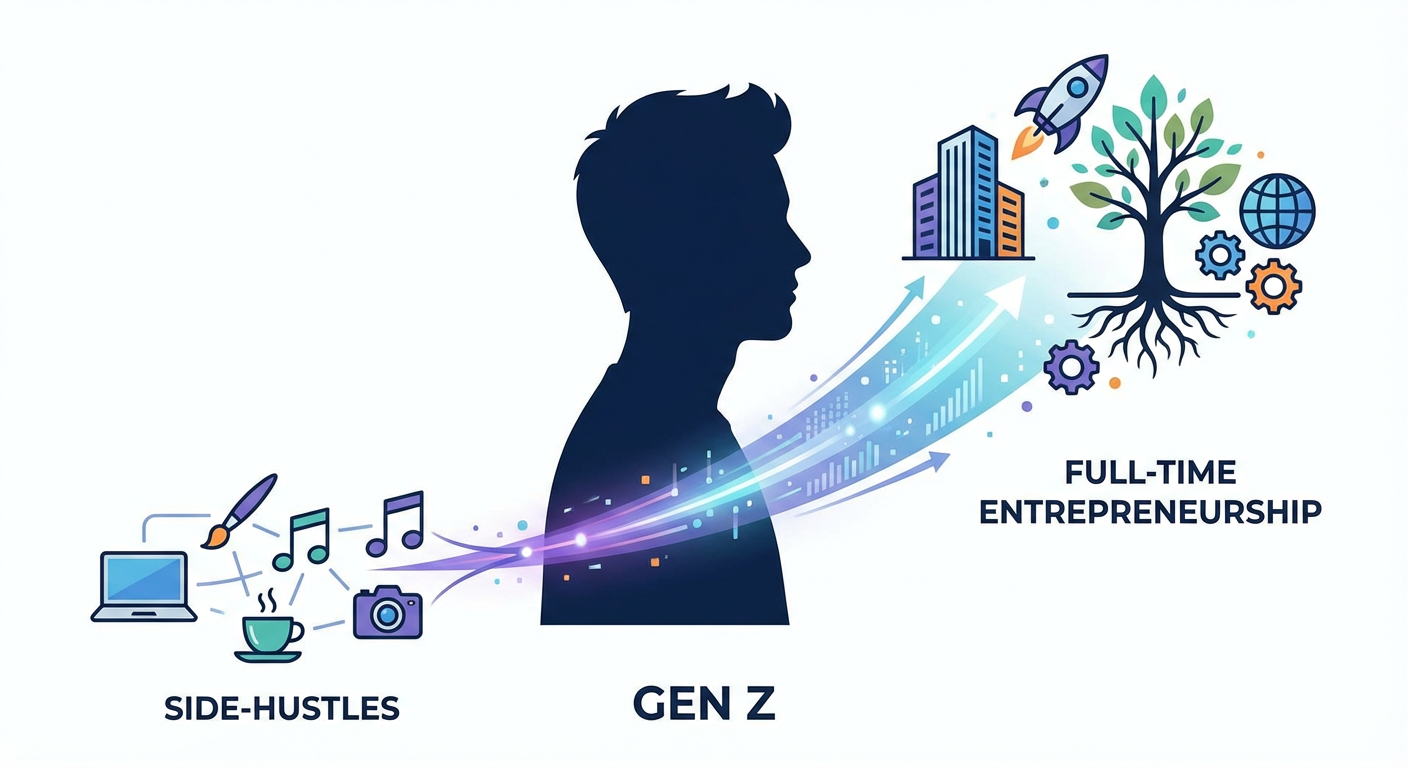
5. The Side-Hustle as a Gateway to Full-Time Entrepreneurship
The entrepreneurial landscape is undergoing a profound transformation, largely driven by Generation Z’s distinctive approach to career development. Far from the traditional linear path of education followed by stable employment, Gen Z is redefining what it means to build a career, often blending multiple pursuits and leveraging part-time ventures as launchpads for full-scale businesses. This section delves into the pervasive side-hustle culture among Gen Z, analyzing how these initial, often experimental, ventures serve as invaluable training grounds. We will explore the motivations behind this trend, the methods employed, and the significant impact it has on carving out a path toward full-time entrepreneurship, fundamentally reshaping career development for this generation.
A staggering share of Gen Z harbors entrepreneurial ambition. Roughly half of Gen Z individuals (ages 16–25) in the U.S. aspire to start their own businesses, a figure that significantly outpaces older generations[8]. In the UK, this ambition is even more pronounced, with 64% of Gen Z workers (16–25) having already started or planning to start a business in 2023, nearly double the rate of the general population (approximately 32%)[5]. Such statistics highlight a seismic shift in career mindset, with 54% of Gen Z willing to choose launching a business over a traditional job, complete with salary and benefits, as revealed by a 2023 GOBankingRates survey[6]. An overwhelming 86% of this generation plans to embark on entrepreneurship at some point in their lives[6]. This intense interest isn’t just aspirational; nearly half of aspiring Gen Z founders (46%) aim to launch their ventures within the next year, indicating an urgent and palpable desire to act on their entrepreneurial dreams[6].
This widespread entrepreneurial inclination is heavily intertwined with the rise of the “side-hustle culture.” Nearly two-thirds of young adults (18–35) have either initiated a side gig or intend to do so, with about 46% planning to start within 12 months[6][11]. This phenomenon isn’t merely about supplementing income; about 50% state that their primary motivation is the desire to be their own boss[11]. The side-hustle serves as a crucial intermediary step, allowing Gen Z to test business ideas, develop skills, and build capital without the immediate pressure of full-time commitment. While only a small fraction (<5%) of this cohort currently freelance or run a business full-time, the majority are actively balancing part-time entrepreneurship alongside school or traditional employment, waiting for their ventures to grow sufficiently to become primary income sources[11].
The Side-Hustle as a Training Ground and Experimentation Lab
For Gen Z, the side-hustle is more than just a supplementary income stream; it’s a strategically chosen, low-risk environment for incubating entrepreneurial talent. These ventures provide practical, real-world experience that formal education often cannot replicate. They allow young entrepreneurs to experiment with business models, refine products or services, and learn directly from market feedback.
- Learning Agility and Problem-Solving: Starting a side-hustle often involves navigating numerous operational challenges, from product development and marketing to customer service and financial management. This hands-on experience forces rapid learning and adaptation. For example, a student running an online apparel shop learns about inventory management, supply chain logistics, and digital advertising without the immense pressure of full-time business overhead. This iterative process fosters a “fail fast, learn fast” mentality, which is crucial for long-term entrepreneurial success.
- Skill Development Across Disciplines: Side-hustles necessitate a multidisciplinary approach. A young person creating content for YouTube learns video editing, audience engagement, and monetization strategies. An Etsy seller masters product photography, e-commerce platform mechanics, and shipping logistics. These experiences build a diverse skill set, preparing them for the complexities of running a larger enterprise. Square’s report suggests that Gen Z entrepreneurs will gravitate toward business solutions that can handle multifaceted needs—point-of-sale, e-commerce, marketing analytics—in one platform, indicating their desire to streamline and master various aspects of business management[7].
- Market Validation at Low Risk: Before committing full-time, a side-hustle allows Gen Z entrepreneurs to validate their business ideas with minimal financial exposure. They can gauge customer interest, test pricing strategies, and identify niche markets. This cautious approach is often driven by a risk-averse mindset, a generation that has grown up during periods of economic instability. By using personal savings as the primary funding source for 45% of Gen Z entrepreneurs[7], they begin lean, then reinvest earnings to grow, proving the viability of their concept before scaling.
- Building a Personal Brand and Network: Many Gen Z side-hustles are rooted in the creator economy, where individuals leverage their personal brands and online presence. Half of Gen Z identifies as content creators who monetize their online presence, blurring the lines between influencer and entrepreneur[1]. This allows them to cultivate an audience that can later become a customer base for their products or services. This process also facilitates networking with peers, mentors, and potential investors, building valuable social capital that may not be available through traditional employment.
Transitioning from Side-Hustle to Primary Income Source
The progression from a part-time side endeavor to a primary source of income marks a critical milestone for Gen Z entrepreneurs. This transition is not always linear and often involves careful planning, strategic investment, and a confident leap of faith.
Research indicates a strong intent among Gen Z to convert their passion projects into full-fledged businesses. Nearly half of Gen Z side-hustlers aim to turn their ventures into primary careers within a few years[6]. This ambition is supported by data from Square’s 2023 Gen Z report, showing that 73% of Gen Z business owners already consider their venture their primary source of income[7]. Furthermore, a remarkable 84% express confidence in still running their businesses five years from now, signaling a long-term commitment beyond just a fleeting trend[7]. This table illustrates the progression from aspiration to commitment:
| Metric | Gen Z Percentage | Source |
|---|---|---|
| Aspirations to start own business | 50% (U.S.) – 64% (UK) | Samsung Newsroom[8], AAT News[5] |
| Prefer owning business to traditional job | 54% | GOBankingRates via Nasdaq[6] |
| Already started/plan side-hustle | ~66% (18-35 age group) | Fortune[11] |
| Aim to launch business within 12 months (of aspiring) | ~46% | GOBankingRates via Nasdaq[6] |
| Business is primary income source | 73% | Square[7] |
| Plan to still be business owner in 5 years | 84% | Square[7] |
The journey from side-hustle to full-time entrepreneurship is facilitated by several factors unique to this generation:
- Digital Tools and Low Entry Barriers: The digital native prowess of Gen Z is a significant enabler. Around 80% of Gen Z entrepreneurs initiate their businesses online or via mobile platforms[17]. Platforms such as Shopify, Etsy, TikTok, and Instagram dramatically lower the barriers to entry, making it feasible to launch and test a business idea with minimal upfront investment and operational overhead. This lean startup approach allows them to generate revenue and build customer bases before needing significant capital or a physical presence. The story of Steven Schwartz and Cameron Zoub with Whop exemplifies this; starting with a sneaker-reselling bot as teens, they iterated through multiple digital side hustles before creating a platform that facilitated over $700 million in sales for other digital entrepreneurs[11].
- Reinvestment and Bootstrapping: With less access to traditional loans or investors, Gen Z founders often rely on personal savings (45%) to start their ventures[7]. They are adept at bootstrapping, reinvesting early profits back into their businesses to fuel growth. This organic growth model minimizes external dependencies and allows them to maintain greater control over their ventures. This financial prudence is often a learned response to growing up amidst economic uncertainty. Khadijah Oliver, a Gen Z entrepreneur with a successful social media and online store business, maintains her day job as a licensed chiropractor, referring to her doctorate as a “security blanket” should her entrepreneurial ventures not succeed[11]. This pragmatic approach highlights a desire for financial stability even while pursuing entrepreneurial dreams.
- Educational and Corporate Incubation: Many Gen Z entrepreneurs leverage educational institutions and early corporate jobs as de facto incubators. Universities are increasingly offering support through incubators, pitch competitions, and entrepreneurship courses, allowing students to develop ventures while still in school[10]. Similarly, early careers in traditional companies can provide valuable skills, industry insights, and networking opportunities that are later applied to their own startups. These experiences serve as stepping stones, where they can learn, grow, and build confidence before fully diving into their own businesses.
Impact on Career Development and the Future of Work
The prevalence of the side-hustle and its role as a gateway to full-time entrepreneurship has profound implications for career development and the broader workforce. Gen Z is not just changing how businesses are started; they are fundamentally altering personal career trajectories and societal expectations around work.
Changing Definitions of “Career” and “Job Security”
Gen Z exhibits a clear preference for self-employment. A 2023 poll indicated that 54% of Gen Z would rather start a business than work for someone else, reflecting a marked departure from previous generations’ career aspirations[6]. This is largely driven by a desire for autonomy and flexibility, with “being my own boss” and escaping the 9-to-5 grind cited as top motivators[1][11]. Having witnessed economic turmoil such as parents’ layoffs and corporate burnout, Gen Z views entrepreneurship as a means to gain control over their careers and secure financial stability on their own terms[11][1]. This skepticism towards corporate stability is echoed in the fact that younger workers are most concerned about layoffs today[3].
- Portfolio Careers: Instead of a single, lifelong career path, Gen Z is embracing “portfolio careers” where individuals juggle multiple roles—student, employee, freelancer, and business owner—simultaneously. This diversified approach spreads risk and allows for continuous learning and exploration of interests. Remote work and gig platforms have further enabled this flexibility, allowing for seamless transitions between different work contexts.
- Emphasis on Purpose and Values: Gen Z explicitly seeks work that aligns with their values and offers a sense of purpose. Many are drawn to mission-driven businesses that address social or environmental issues[10]. For example, Brian Femminella, a 23-year-old Gen Z founder, launched SoundMind, a mobile app providing music therapy, after witnessing the struggles of service members with PTSD[10]. This ethos means that career satisfaction is not solely tied to salary but deeply integrated with making a positive impact.
Challenges in Scaling and Resource Acquisition
Despite their ambition and innovative approaches, Gen Z entrepreneurs face unique hurdles due to their age and relative inexperience, particularly as their ventures grow from side-hustles into more substantial operations.
- Lack of Capital and Resources: The most significant challenge cited by 62% of Gen Z business owners is the lack of capital, time, or staff[17]. Unlike older entrepreneurs who may have accumulated savings, assets, or professional networks, young founders often bootstrap using personal savings (45%)[7]. This reliance on self-funding can limit growth potential, as external investment is often crucial for scaling. Traditional bank loans are typically inaccessible due to limited credit history or collateral.
- Experience and Credibility Gaps: Young entrepreneurs may struggle with a perceived lack of credibility from customers, partners, and investors. Some report not being taken seriously, facing questions about their age or perceived expertise[1]. The average age of a successful startup founder is around 45, creating a statistical bias that younger entrepreneurs must overcome[10]. Tash Grossman, founder of Slip, a digital receipts platform, learned that while her sustainability mission was compelling, investors required a clear profit model, forcing her to refine her business case beyond idealism[10].
- Marketing and Customer Acquisition: Nearly 50% of Gen Z entrepreneurs struggle with increasing visibility and acquiring quality customers, and 46% find it hard to maintain consistent marketing efforts[17]. While digitally native, navigating crowded online marketplaces and mastering complex algorithms requires ongoing learning and resources.
Emerging Support Systems and Future Outlook
Recognizing the immense potential of this entrepreneurial generation, new ecosystems are emerging to support their journey. This support is crucial for overcoming the identified challenges and converting Gen Z’s ambition into sustainable economic growth.
- Tailored Mentorship and Education: There is a growing demand for mentorship, financial literacy training, and resources specifically designed for young founders. Programs like Junior Achievement and SCORE, along with university incubators, are stepping up to fill these gaps. For example, 73% of Gen Z entrepreneurs would welcome guidance from experienced business owners, indicating a recognition of their need for external wisdom[6].
- Digital Solutions for Business Management: Fintech startups and business solution providers are developing integrated tools that cater to the lean, digital-first operations of Gen Z entrepreneurs. These platforms simplify tasks like bookkeeping, invoicing, and e-commerce management, allowing young founders to manage multiple business functions efficiently without extensive staff.
- Policy and Regulatory Adaptations: Governments and local entities may need to consider policy adjustments, such as reduced business registration fees or grants, to foster youth entrepreneurship. As more young success stories emerge, public perception is shifting, making it easier for Gen Z founders to gain acceptance and support.
The entrepreneurial blueprint of Gen Z centers on an agile, experimental, and deeply values-driven approach. The side-hustle serves as a robust incubator, allowing young individuals to accumulate experience, validate ideas, and build capital before transitioning to full-time ventures. This generation’s inherent digital fluency, combined with a rejection of traditional corporate life in favor of autonomy and purpose, positions them to reshape the economy. While challenges related to resources and experience persist, the rising tide of support systems, coupled with Gen Z’s resilience and adaptability, indicates a promising future. This ongoing evolution will not only lead to a surge in new businesses but also fundamentally redefine career trajectories and the very nature of work for generations to come. The next section will delve deeper into the specific digital native strategies and tools that empower Gen Z entrepreneurs, expanding on how technology facilitates their unprecedented entrepreneurial activity.

6. Innovative Business Models and Lean Operations
The entrepreneurial landscape is undergoing a profound transformation, spearheaded by Generation Z. This cohort, characterized by its digital native fluency and an innate comfort with rapid technological change, is not merely adopting existing business practices; it is actively redefining them. Gen Z entrepreneurs are “rewriting the rules” through a distinctive blend of agile methodologies, lean operating structures, and an early, often intuitive, adoption of emerging technologies such as Artificial Intelligence (AI) and Web3. This section delves into the specific ways Gen Z approaches business modeling, detailing their digital-first launch strategies, their integration into the burgeoning creator economy, their fluid approach to work-life balance through side hustles, and the inherent challenges and opportunities that shape their innovative operational blueprints.
Digital Native Entrepreneurship: Technology as the Foundational Blueprint
Gen Z’s identity as true digital natives fundamentally shapes their entrepreneurial journey, positioning technology not merely as a tool but as the very foundation of their business models. This generation has grown up immersed in an always-on, interconnected world, where digital communication, e-commerce, and instant information access are defaults. Consequently, their approach to starting and scaling businesses is inherently optimized for the digital realm, enabling unprecedented levels of agility and reach, even for micro-enterprises. One of the most striking statistics supporting this trend is that approximately 80% of Gen Z entrepreneurs initiate their businesses online or with a significant mobile/virtual component[17]. This digital-first mindset stands in stark contrast to previous generations, who often began with physical storefronts or traditional service models before potentially venturing online. For Gen Z, the internet provides a level playing field, democratizing access to markets and resources. Platform providers like Shopify and Etsy empower these young founders to establish online stores in mere hours, significantly lowering the barrier to entry that once required substantial capital and infrastructure[18]. The ability to launch rapidly and affordably means that Gen Z entrepreneurs can experiment with ideas, test market reception, and pivot quickly based on real-time feedback, embodying core principles of agile development. As Natasha Stanley, a career coach, observes, “there’s so much more infrastructure available for people who want to create things of their own” today, making entrepreneurial ventures “feel that much more attainable”[18]. This includes everything from easy website builders and user-friendly payment processors like Stripe or PayPal to on-demand manufacturing and gig economy marketplaces for sourcing talent or specialized services. This comfort with technology extends to their operational speed. Venture Capital investors have noted that Gen Z founders “move at breakneck speeds”[20], a trait attributed to growing up in an era defined by instant apps and continuous updates. They are accustomed to learning new skills on demand, whether it’s through YouTube tutorials or online crash courses, to master areas like digital marketing, basic coding, or graphic design. This self-directed learning minimises reliance on external experts and further supports their lean operational models. They are also adept at leveraging social media for marketing, often crafting viral content on platforms like TikTok or Instagram to reach wide audiences at minimal cost. This integration of their personal digital habits with their business strategies creates a highly cost-effective and dynamic launchpad. The innovation in business models driven by Gen Z is also noteworthy. Many gravitate towards platform or marketplace concepts, reflecting their understanding of network effects and collaborative economies. A prime example is **Whop**, co-founded by Steven Schwartz and Cameron Zoub. Schwartz, now 26, and Zoub launched Whop as a marketplace for digital entrepreneurs, enabling users to sell software access, memberships, or other digital services. Since its 2021 inception, Whop has facilitated over $700 million in sales, with more than 5.5 million users signing up for the platform[43]. This case highlights how Gen Z identifies the needs of their peers in the evolving digital economy and builds solutions that scale rapidly by empowering other digital creators. Furthermore, Gen Z shows a keen interest in emerging technologies. While the research mentions AI and Web3, specific examples include teenage AI consultants or 22-year-old Web3 startup founders, indicating a willingness to explore nascent fields for entrepreneurial opportunities. This experimental approach means they are often among the first to integrate new tech into their business processes, whether for automation, enhanced customer engagement, or creating entirely new product categories (e.g., NFTs). This inventive spirit often leads them to question established industry norms, seeking more efficient or impactful ways of doing business. However, this digital-first approach also presents challenges. The inherent low barrier to entry in online business means intense competition. Gen Z entrepreneurs often struggle with gaining visibility and generating leads, with approximately 50% citing this as a major challenge[26]. The constant evolution of algorithms on social media platforms, or changes in fees on e-commerce marketplaces, also poses risks, potentially disrupting their revenue streams if they are overly reliant on a single channel. Despite these hurdles, Gen Z’s unparalleled digital fluency remains a significant advantage, enabling them to build, market, and operate businesses with a fluidity and scale previously unimaginable for young founders. Their hybrid approach, where nearly 46% also establish a physical presence alongside online channels, demonstrates an emerging omnichannel strategy that seeks to maximize reach and customer touchpoints[17].
The Creator Economy: Blurring the Lines Between Influencer and Entrepreneur
A significant aspect of Gen Z’s innovative business models lies within the burgeoning “creator economy,” where the lines between content creation, personal branding, and formal entrepreneurship are increasingly blurred. For many young Gen Z individuals, the journey into business ownership begins not with a traditional business plan, but with cultivating an online presence and audience. Indeed, data indicates a substantial overlap: 50% of Gen Z identify as content creators, a figure that doubles the overall population’s average of 25%[19]. This statistic is pivotal, as it illustrates how ingrained content creation is in the fabric of this generation’s digital existence, often serving as a de facto entry point into entrepreneurship. These “creator-preneurs” leverage platforms like YouTube, TikTok, and Instagram not just for entertainment, but as vital business tools. They build engaged communities around their interests – be it fashion, gaming, personal finance, or niche hobbies – and subsequently monetize this influence through various channels. Common monetization strategies include: * **Ad Revenue:** From content on YouTube or blogs. * **Sponsorships & Brand Partnerships:** Collaborating with brands for promotional content. * **Merchandise Sales:** Leveraging their personal brand to sell physical or digital products. * **Direct-to-Consumer (D2C) Products:** Launching their own product lines, often manufactured through drop-shipping or on-demand services, and using their social media platforms as primary sales channels. * **Subscription Models:** Offering exclusive content or community access via platforms like Patreon or Substack. A compelling example of this is Khadijah Oliver, a Gen Z fashion influencer. Oliver first established a significant digital footprint, garnering 64,000 followers on TikTok. She then strategically leveraged this audience to launch an e-commerce hair products business, utilizing drop-shipping to manage inventory and fulfillment. Her online persona was the primary driver for sales[42]. Oliver’s case is emblematic of how Gen Z transforms digital engagement into tangible business ventures, where the marketing channel (social media) and the product platform (e-commerce) are intimately intertwined. The creator economy provides a low-cost, low-risk way for Gen Z to “test the waters” of entrepreneurship. They can start generating revenue and gather market feedback without needing a complex corporate structure or significant upfront investment. The iterative nature of content creation—where audience engagement drives subsequent content and offers—mirrors the agile development cycles seen in tech startups. For these young entrepreneurs, their audience is their market, and building an engaging online presence is often synonymous with product development and marketing. This model reshapes traditional marketing paradigms. Rather than marketing a product to an audience, creator-preneurs often cultivate an audience first, then develop products or services tailored to that community’s needs and interests. This approach fosters a deep level of authenticity and trust with consumers, which is a powerful competitive advantage. As one expert noted, Gen Z founders “come in with a built-in understanding of what makes people care about their brand”[23]. The blurring of lines also means that young individuals who might not have previously considered themselves entrepreneurs now find a pathway to business ownership through their creative pursuits. It normalizes the idea of monetizing passions and skills, fostering a generation that is constantly looking for ways to generate income from their online activities. This trend has significant implications for how businesses will acquire customers and build brand loyalty in the future, with authenticity and direct engagement becoming increasingly important. However, it also introduces challenges related to the sustainability of platform-dependent revenue, the constant demand for content creation, and the mental health burden of maintaining a public persona. Despite these, the creator economy continues to be a fertile ground for Gen Z’s innovative business models.
Lean Operations and Agile Methodologies: The Scrappy Startup Approach
Gen Z entrepreneurs are characterized by a strong propensity for lean operations and agile methodologies, reflecting a pragmatic and resource-efficient approach to building businesses. This generation’s experience growing up amidst economic uncertainties and constant technological evolution has instilled a “fail fast, learn fast” mentality. Their goal is often to validate ideas and generate revenue quickly with minimal overhead, rather than adhering to traditional, resource-intensive corporate playbooks. Lean operations are a fundamental characteristic of Gen Z-led ventures. The majority of these businesses remain small in headcount, with approximately 61% operating solo or with just a handful of individuals[14]. This contrasts with the 39% who have scaled to five or more employees[14], indicating that growth in team size is often a later stage development. In the initial phases, Gen Z founders are accustomed to wearing multiple hats, undertaking roles typically handled by entire departments in larger companies—from product development and marketing to sales and customer service. When external expertise is needed, they frequently leverage the gig economy, opting for contractors or freelancers rather than committing to full-time hires. This strategy offers flexibility, allowing them to scale human resources up or down as demand fluctuates, without incurring the fixed costs associated with a large, permanent staff. The adoption of agile methodologies is also deeply embedded in their operational DNA. Having grown up with continuous software updates and iterative product development in their daily lives, Gen Z applies similar principles to their entrepreneurial endeavors. They are less focused on perfecting a product before launch and more inclined to release Minimum Viable Products (MVPs), gather real-time feedback from their online communities, and then iterate quickly. This dynamic approach enables them to: * **Minimise Risk:** By testing ideas on a small scale, they avoid committing significant resources to unproven concepts. * **Adapt Rapidly:** They can pivot their business model or product features based on market shifts or consumer preferences, staying responsive in fast-changing environments. * **Enhance Customer Connection:** Involving customers in the development process fosters loyalty and ensures the product truly meets user needs. This operational philosophy is a direct outcome of their resource constraints. Nearly 45% of Gen Z entrepreneurs finance their initial ventures using personal savings[13], and over 60% report that a lack of capital, time, or staff are major challenges[25]. This forces innovation in cost-management and efficiency. Traditional financing avenues, such as bank loans, are often inaccessible due to limited credit history or collateral, pushing them towards bootstrapping and reinvesting early earnings to fuel growth. This reliance on self-funding makes efficient resource allocation paramount. A notable example of this lean methodology is the foundational journey of **Whop**, co-founded by Steven Schwartz and Cameron Zoub. Their long history of “at least 22 different side hustles” throughout high school and college[44] showcases an iterative, experimental process. Each small venture served as a learning experience, providing practical skills and insights that eventually culminated in their highly successful Whop platform. This demonstrates a portfolio approach to entrepreneurship, where early, smaller projects act as agile experiments to build knowledge and validate market potential. The ability to tell compelling stories and build strong brands on social media plays a crucial role in their lean marketing strategies. Rather than expensive advertising campaigns, Gen Z leverages authenticity and direct engagement to build communities around their offerings. This allows them to foster customer connections organically, compensating for limited marketing budgets. The consequences of this lean approach are mixed. On one hand, it allows for incredible speed, resilience, and resourcefulness. Young founders can launch viable businesses with far less capital than previous generations, fostering a more inclusive entrepreneurial ecosystem. On the other hand, it can lead to challenges in scaling. Transitioning from a solo operation to a business with actual employees, intricate supply chains, or robust customer support systems requires different managerial skills and more substantial capital. While approximately 73% of Gen Z business owners state their venture is their primary source of income[11], implying a successful transition for many, the hurdle of scaling remains significant. Mentorship and access to capital specifically designed for these types of evolving businesses become critical needs for this cohort.
The Side-Hustle Path: Balancing Ambition with Pragmatism
The entrepreneurial journey for Gen Z often commences not with a full-fledged launch but through the cultivation of side hustles, demonstrating a pragmatic blend of ambition and risk management. This approach reflects a generation keen on exploring entrepreneurial ventures while maintaining financial stability, often alongside academic pursuits or traditional employment. The widespread adoption of side hustles has become a defining characteristic of Gen Z’s innovative business modeling. The concept of entrepreneurship for Gen Z is less about a singular, all-consuming commitment and more about building a “portfolio career” – juggling multiple income streams and roles concurrently[45]. Statistics reveal that roughly two-thirds of individuals aged 18-35 have either launched or are planning to launch a side gig[5]. This is a crucial shift, indicating that many young entrepreneurs are testing business ideas during evenings and weekends, using these low-stakes ventures as experimental labs. For instance, it’s common for a high school student to operate an Etsy shop, or a college student to manage an Instagram-based resale business, blending their passion with practical business experience. These side hustles serve as invaluable training grounds, allowing Gen Z to acquire entrepreneurial skills, understand market dynamics, and build a customer base without the immense pressure of full-time financial dependence. Roughly half of these aspiring young entrepreneurs aim to transition their side business into their primary career within a few years[46], illustrating a clear progression pathway from part-time endeavor to full-time enterprise. A significant enabler of this side-hustle culture is the increasing prevalence of flexible work arrangements, especially post-pandemic. Remote work opportunities and the growth of gig and freelance platforms allow Gen Z to fluidly transition between different commitments. A university student might attend virtual classes in the morning, work a part-time job in the afternoon, and then process e-commerce orders for their business in the evening. This balance spreads risk, making entrepreneurship more accessible to those who cannot afford to abandon stable income sources. Education and entrepreneurship are also becoming increasingly intertwined for this generation. Instead of dropping out of college to pursue a startup, as was romanticized in earlier tech narratives, many Gen Z founders choose to remain enrolled, leveraging campus resources such as incubators, mentorship programs, and pitch competitions[47]. Universities are adapting to this trend, offering academic credit for startup work and providing resources like seed funding and free workspace. This supportive environment allows young entrepreneurs to gain critical skills and networks while retaining the safety net of an education. The fact that a majority of Gen Z founders have been running their businesses for two years or less suggests that many started these ventures during their high school or college years[48], reflecting this blended approach. Even joining the traditional workforce is seen by many Gen Z individuals as an interim step, a temporary “incubator” for their entrepreneurial ambitions. Given their anxieties about job security and stagnant wages—a learned response from witnessing economic downturns like the 2008 financial crisis and the pandemic—many view corporate roles as opportunities to acquire skills and capital before launching their own ventures. They might maintain a side business throughout their employment, with the clear intention of scaling it up later. Khadijah Oliver, the previously mentioned social media influencer, exemplifies this by maintaining her day job as a licensed chiropractor even as her online businesses thrive, referring to her doctorate as her “security blanket”[50]. This dual-track strategy underscores a cautious yet determined approach to career development. The financial prudence inherent in the side-hustle model addresses a significant challenge for young entrepreneurs: capital. Without substantial savings, collateral for loans, or investor connections, bootstrapping with personal funds or reinvesting profits from a side gig becomes essential. The side-hustle path allows Gen Z founders to generate revenue and accumulate capital gradually, delaying the need for external investment until their business demonstrates proven traction. This careful approach to financial management is crucial, especially when 62% of Gen Z entrepreneurs cite a lack of capital as a major challenge[25]. In essence, the side-hustle blueprint of Gen Z democratizes entrepreneurship, making it accessible as a gradual process rather than an immediate, high-stakes leap. It reflects a generation that is risk-aware yet highly ambitious, using interim roles and flexible structures to build skills, test ideas, and secure financial foundations before committing fully to their entrepreneurial dreams. This evolving model will likely lead to more resilient and well-rounded entrepreneurs, but it also necessitates new support structures, such as specialized fintech tools for side-hustlers and flexible accelerator programs that accommodate ongoing commitments.
Challenges and Opportunities in the Gen Z Entrepreneurial Journey
While Gen Z entrepreneurs exhibit remarkable innovation and ambition, their journey is not without significant hurdles. Their youth and relative inexperience, coupled with systemic barriers, present unique challenges that must be navigated. Simultaneously, their generational strengths create distinct opportunities that can be leveraged for success. The primary obstacle for Gen Z founders is the **resource and experience gap**. A staggering 62% of Gen Z business owners identify a lack of resources—including capital, time, or personnel—as a major challenge to their growth[25]. Unlike older entrepreneurs who may have accumulated savings, assets, or established professional networks, young founders often start with limited financial backing; 45% rely primarily on personal savings to launch their ventures[27]. This compels them to operate on shoestring budgets, often reinvesting every dollar earned back into the business. Furthermore, a lack of management experience can lead to missteps in pricing, budgeting, or hiring. The absence of extensive professional networks also impacts their ability to find mentors, strategic partners, or even early customers, with 50% struggling with generating customer leads and increasing visibility[26]. The learning curve encompassing finance, marketing, operations, and legal aspects is exceptionally steep, requiring them to learn multiple complex domains simultaneously. Another pressing concern is **credibility and age bias**. A young CEO, particularly one in their teens or early twenties, can face skepticism from potential clients, partners, and investors. Research indicates that the average age of a successful startup founder is around 45[30], presenting a statistical bias that Gen Z founders must overcome. Tash Grossman, co-founder of Slip, initially pitched her digital receipts platform primarily on its sustainability benefits, a cause deeply aligned with Gen Z values. However, she found that investors demanded a clearer profit model, illustrating the need to translate mission into tangible financial returns to gain trust and funding[31]. This demonstrates that while purpose is a strong motivator, the traditional business community still expects strong economic viability. **Table 1: Key Challenges Faced by Gen Z Entrepreneurs** | Challenge | Percentage of Gen Z citing as major hurdle | | :—————————- | :—————————————-: | | Lack of resources | 62%[25] | | Generating leads & visibility | 50%[26] | | Consistent marketing efforts | 46%[41] | Despite these challenges, Gen Z entrepreneurs possess inherent strengths that translate into significant opportunities: * **Resilience and Adaptability:** Having grown up in an era of constant change and disruption, Gen Z is highly adaptable. They tend to view setbacks not as failures but as learning opportunities, quickly pivoting their strategies. Their comfort with digital tools extends to problem-solving, often leveraging online communities (e.g., Reddit, Twitter) to crowdsource advice. * **Authenticity and Purpose-Driven Models:** This generation connects deeply with purpose-driven brands. Gen Z founders often embed social or environmental missions into their business models (e.g., Brian Femminella’s SoundMind, an app providing music therapy for mental health[3] or Tash Grossman’s Slip, which aims to reduce paper waste with digital receipts[45]). This authenticity can resonate strongly with their peers, providing a competitive advantage and fostering genuine customer loyalty, as 64% of Gen Z would pay more for sustainable products[15]. * **Native Understanding of Digital Markets:** Their innate digital literacy provides real-time insights into online trends, consumer behavior, and effective social media marketing. They can effectively tap into niche online communities and leverage viral content to grow their brands quickly and affordably. For some industries, being Gen Z is an advantage, as they embody the target demographic. * **Early Start and Long-Term Vision:** Many Gen Z entrepreneurs start their ventures in their teens or early twenties, like Chase Gallagher, who turned a childhood lawn mowing gig into a $1.5 million landscaping business by age 23[32]. This early start provides them with years of practical experience and learning opportunities that their peers in traditional jobs may lack. Their commitment is high, with 84% planning to still be business owners five years from now[11], and nearly 40% aiming to launch multiple businesses throughout their careers, reflecting a serial entrepreneurship mindset[12]. To successfully navigate these complexities, Gen Z entrepreneurs require targeted support systems. This includes access to capital through micro-loan programs or youth-focused venture funds, but critically, also robust mentorship and educational initiatives. Free bootcamps, small business accelerators, and digital platforms offering practical guides (e.g., GoDaddy, Shopify) are vital for bridging skill and knowledge gaps. Experienced business owners can play a crucial role by offering guidance and sharing their expertise. Policymakers also have a role in creating supportive environments, such as offering tax incentives or easing regulations for young founders. As more Gen Z success stories gain prominence, the collective perception of young entrepreneurs is evolving, gradually reducing age bias. The ultimate impact of Gen Z entrepreneurship hinges on how effectively these challenges are addressed and opportunities are harnessed. If supported appropriately, this generation has the potential to usher in an era of unprecedented innovation, characterized by purpose-driven ventures, agile operations, and a keen eye for leveraging emerging technologies to solve contemporary problems. Their unique approach to business modeling is not just shaping their own futures but is actively molding the future of the global economy. The next section will delve into the societal and economic implications of Gen Z’s entrepreneurial surge, exploring the broader impact these innovative models will have on future job markets, industry landscapes, and consumption patterns.
7. Challenges and Support Systems for Young Founders
Gen Z entrepreneurs, while demonstrating unprecedented ambition and tech-savviness, confront a unique set of challenges rooted in their youth and lack of established resources. The entrepreneurial journey is inherently fraught with obstacles, but for young founders, these hurdles can be amplified due to limited capital, nascent professional networks, and societal perceptions. This section delves into the primary difficulties faced by today’s teen and young adult business owners, encompassing financial constraints, resource acquisition, customer generation, and the critical need for robust support systems such as mentorship, enhanced financial literacy, and comprehensive entrepreneurial ecosystems. Understanding these challenges is crucial for fostering an environment where this highly motivated generation can transform their aspirations into sustainable, impactful enterprises.
7.1. Funding and Resource Acquisition: The Capital Conundrum for Young Entrepreneurs
One of the most formidable obstacles confronting Gen Z entrepreneurs is the acquisition of adequate funding and essential resources. Unlike older, more experienced founders who may possess substantial personal savings, business assets, or established credit, young entrepreneurs often begin their ventures with minimal financial backing. This necessitates a reliance on bootstrapping and creative, often lean, operational strategies.
7.1.1. Limited Access to Capital
The bedrock of nearly every startup is capital, yet for Gen Z, traditional funding avenues are frequently inaccessible. Surveys reveal that nearly half of Gen Z entrepreneurs, specifically 45%, initiate their businesses using primarily personal savings[23]. This figure is notably higher than for older entrepreneurs and highlights a stark reality: many young founders simply lack the collateral, credit history, or established investor networks typically required for bank loans or venture capital investment. For instance, the average age of a successful startup founder is around 45, meaning a 22-year-old seeking venture capital often faces a statistical bias against them[61]. The reliance on personal savings means that the scale and speed of growth are often tethered to the founder’s, or their family’s, financial capacity. While commendable for its lean approach, this can severely limit the ability to invest in crucial areas like inventory, technology development, or aggressive marketing campaigns. Without external financing, scaling rapidly to meet burgeoning demand becomes a significant challenge. This is particularly salient given that a substantial portion of Gen Z-led businesses, about 61%, operate solo or with just a handful of employees (under five), implying that while agile, they are often resource-constrained[22]. Furthermore, statistics corroborate this acute need for financial resources. A 2024 survey of Gen Z business owners explicitly identified “lack of resources (capital, time, or personnel)” as a major challenge for 62% of respondents[24]. This suggests that insufficient capital is often intertwined with shortages in other critical resources, forming a significant barrier to growth.
7.1.2. Constraints in Time and Personnel
Beyond monetary capital, Gen Z entrepreneurs often struggle with the twin constraints of time and personnel. Many Gen Z founders are simultaneously balancing their entrepreneurial endeavors with academic commitments or part-time/full-time jobs. The “side-hustle culture” is prevalent, with two-thirds of young adults (18-35) having launched or intending to launch a side gig[7]. While this allows for low-risk experimentation, it inherently limits the dedicated time one can allocate to scaling a business. The challenge of personnel recruitment and management is also pronounced. Young founders may possess visionary ideas but often lack the managerial experience to build and lead effective teams. Transitioning from a solo operation to managing even a small team of five employees (a threshold reached by only about 39% of Gen Z founders) represents a significant leap requiring new skills in hiring, delegation, and human resources management[21]. The absence of established professional networks further exacerbates this, making it difficult to find reliable co-founders, skilled employees, or trusted contractors[57]. This table summarizes key resource challenges for Gen Z entrepreneurs:
| Challenge Category | Specific Hurdle | Quantifiable Data/Observation | Impact on Business |
|---|---|---|---|
| Financial Capital | Limited personal savings and assets | 45% use personal savings as main funding source[23] | Constrained initial investment, slow growth, inability to scale |
| Lack of access to traditional loans/investors | Most lack credit history/collateral; average founder age is 45[61] | Difficulty securing external capital, perpetuates bootstrapping cycle | |
| Human Capital | Inadequate staffing/personnel | 62% cite lack of staff as a major challenge[24]; ~61% operate with under 5 employees[22] | Founder burnout, limited capacity for expansion, challenges with operational tasks |
| Lack of managerial experience | Young founders often leading teams for the first time[57] | Ineffective team leadership, operational inefficiencies, potential for hiring mistakes | |
| Time Availability | Balancing multiple commitments | Many juggle business with school/jobs; prevalent side-hustle culture[7] | Reduced focus on business growth, slower development cycles, increased stress |
7.2. Customer Generation and Marketing: Navigating a Crowded Digital Landscape
While Gen Z entrepreneurs are digital natives adept at leveraging online platforms, generating consistent customer leads and maintaining effective marketing efforts present significant hurdles. The very accessibility of online tools that enables their launches also creates a highly competitive and noisy digital environment.
7.2.1. Lead Generation and Visibility
Generating customer leads and increasing visibility are primary pain points for young founders. Nearly 50% of Gen Z entrepreneurs report struggling with acquiring customers and making their businesses visible[25]. This challenge stems from several factors:
- Digital Crowding: The low barrier to entry offered by e-commerce platforms and social media means the digital marketplace is saturated. Standing out amidst a multitude of businesses, both large and small, requires sophisticated digital marketing strategies and significant consistent effort.
- Algorithm Dependence: Many Gen Z businesses are heavily reliant on social media platforms for visibility. Changes in platform algorithms (e.g., Instagram, TikTok) can instantly diminish reach and engagement, requiring constant adaptation and a deep understanding of ever-evolving digital trends.
- Lack of Established Networks: Unlike older entrepreneurs who might tap into years of professional contacts for early customers or referrals, young founders often start with limited networks, making initial customer acquisition an uphill battle[57].
7.2.2. Consistent Marketing Efforts
Maintaining consistent marketing efforts is another challenge, with 46% of Gen Z entrepreneurs reporting difficulty in this area[26]. This can be attributed to:
- Time & Resource Constraints: As previously discussed, time and personnel limitations mean young founders often wear many hats, making dedicated, consistent marketing a demanding task. Without professional marketing staff or agencies, campaigns can be sporadic.
- Marketing Expertise Gap: While Gen Z instinctively understands social media, converting likes into sales requires a different skill set—one in data analytics, content strategy, paid advertising, and branding that often comes with experience or formal training. They need to learn how to effectively analyze metrics, adapt campaigns, and craft compelling narratives that resonate beyond initial engagement.
- Perceived Credibility: Some young founders face a “credibility gap” due to their age. Potential customers, partners, or investors may subconsciously (or overtly) question their expertise. For example, Flori Needle’s survey noted that young entrepreneurs mentioned customers sometimes mistrust their expertise due to youth, requiring them to work harder to prove professionalism[60]. Effective, persistent, and professional marketing can help counteract such biases, but it demands consistent effort and strategic planning.
7.3. The Indispensable Role of Support Systems for Young Founders
Given the unique set of challenges faced by Gen Z entrepreneurs, robust and tailored support systems are not merely beneficial but essential for their long-term success. These systems encompass mentorship, financial literacy education, and comprehensive entrepreneurial ecosystems.
7.3.1. Mentorship: Bridging the Experience Gap
Mentorship emerges as a critical need for Gen Z entrepreneurs. Without years of business experience, young founders often navigate complex operational, financial, and strategic decisions for the first time. Experienced mentors can provide invaluable guidance, saving young founders from common pitfalls and offering strategic insights. The appetite for mentorship is evident: 73% of Gen Z entrepreneurs express a desire for guidance from experienced business owners[62]. This highlights their self-awareness regarding their inexperience and their eagerness to learn. Mentors can assist in diverse areas:
- Strategic Planning: Helping young founders refine their business models beyond immediate purpose-driven ideals. For instance, Tash Grossman, founder of the digital receipts app Slip, learned that while her mission was sustainability, investors demanded a clear profit model, a refinement likely guided by experienced input[63].
- Operational Guidance: Advise on scaling manufacturing, managing supply chains, or building efficient operational processes—skills often learned through trial and error over years.
- Network Building: Introductions to investors, potential partners, or even early customers, helping to overcome the network deficits of young founders.
- Emotional Support: Entrepreneurship can be isolating. Mentors provide encouragement, perspective, and a sounding board for navigating the emotional highs and lows of building a business.
- Credibility Enhancement: A credible mentor can lend legitimacy to a young founder and their venture, addressing age bias and opening doors that might otherwise remain closed.
7.3.2. Financial Literacy: Empowering Prudent Management
While Gen Z is technologically savvy, practical financial literacy is a common blind spot, often learned through costly mistakes. Many learn financial management, such as cash flow, budgeting, and tax compliance, only after their journey into entrepreneurship has already begun[58]. Errors in pricing, underestimating costs, or mismanaging cash flow can lead to early business failures, exacerbating initial capital constraints. Tailored education in financial literacy needs to address:
- Basic Accounting and Bookkeeping: Understanding profit and loss, balance sheets, and managing receipts is fundamental.
- Budgeting and Projections: Creating realistic cash flow forecasts and managing expenses within tight budgets.
- Funding Streams: Educating on different types of funding (bootstrapping, grants, debt, equity), their implications, and how to prepare for and pitch to investors.
- Tax Compliance: Understanding legal and tax obligations for small businesses from the outset.
- Risk Management: Learning to assess financial risks, manage debt, and plan for unforeseen circumstances.
Organizations like Junior Achievement and SCORE have begun to expand financial literacy programs targeting young entrepreneurs, and FinTech tools are increasingly being adapted to simplify these processes for small business owners[58].
7.3.3. Robust Entrepreneurial Ecosystems: A Holistic Approach
Beyond individual mentorship and education, broader entrepreneurial ecosystems play a crucial role. These ecosystems should offer a multi-faceted approach to support:
- Educational Institutions: Universities and colleges are increasingly vital, offering dedicated entrepreneurship programs, incubators, pitch competitions, and even academic credit for startup work[50], [51]. These provide a safe environment for experimentation and access to resources like seed funding grants and office space.
- Government Initiatives: Policy support, such as reduced business registration fees for young founders, grants for youth innovators, or simplifying regulatory hurdles, can significantly lower entry barriers.
- Corporate Programs & Resources: Major tech companies like Meta and TikTok offer small-business studios and educational content to help young creators monetize and scale their online presence. Business solution providers are adapting to offer integrated tools (POS, e-commerce, marketing analytics) to simplify operations for time-constrained young founders[68].
- Community Networks: Online and offline communities where young founders can connect, share experiences, and crowdsource advice. The willingness of Gen Z to ask for help on platforms like Reddit or Twitter demonstrates their aptitude for leveraging such networks[64].
- Specialized Accelerators and Funds: Accelerators specifically designed for founders under 25 and venture funds focused on youth-led startups are emerging, recognizing the unique profile and potential of this demographic.
The trajectory of Gen Z entrepreneurship—from early side hustles to full-fledged businesses—underscores the need for support that evolves with their ventures. The “side-hustle path” allows young entrepreneurs to test ideas and generate revenue while maintaining financial stability through other means (jobs, higher education)[49]. As businesses mature, the need for more substantial financial aid and advanced operational guidance becomes paramount. The story of Khadijah Oliver, a Gen Z entrepreneur who maintains her chiropractor day job as a “security blanket” while scaling her influencer business and online store, exemplifies this pragmatic approach to managing financial risk[54], [55]. This layered approach to career and risk-management is a hallmark of Gen Z and requires flexible support structures. In conclusion, while Gen Z entrepreneurs are uniquely positioned with their digital fluency, purpose-driven mindset, and early ambition, they face substantial challenges. These span from fundamental issues of capital and human resource acquisition to the complexities of customer generation in a crowded digital world. Overcoming these hurdles will require a concerted effort from educators, government, mentors, and the wider business community to provide targeted support that addresses their specific needs, thereby unlocking the full entrepreneurial potential of this transformative generation. The success of young founders like Chase Gallagher, Brian Femminella, Steven Schwartz, and Tash Grossman demonstrates that with resilience, adaptability, and the right support, Gen Z can indeed rewrite the rules of entrepreneurship and drive significant innovation. The next section will explore the impact of Gen Z’s entrepreneurial drive on the broader economy, examining how their ventures are reshaping industries and influencing the future of work.
8. Future Outlook and Implications for Society
The rise of Generation Z as a profoundly entrepreneurial cohort signals a significant paradigm shift in the landscape of global economies, educational institutions, and the traditional job market. Unlike previous generations, Gen Z is embracing self-employment and business ownership at an unprecedented rate, driven by a unique confluence of motivations and enabled by digital fluency. This section delves into the long-term commitment and serial entrepreneurial mindset prevalent among Gen Z, forecasting the potential wide-ranging impacts this generational trend will have on various societal pillars. We will explore how their distinguishing characteristics, preferences for autonomy, and innovative methods are not just fleeting trends but foundational elements reshaping what it means to work, learn, and contribute to society in the decades to come.
The Impending Entrepreneurial Deluge: A Generational Shift in Work Culture
Generation Z, comprising individuals roughly aged 16-25, stands poised to become the most entrepreneurial generation in history. This is not a speculative claim but is firmly rooted in compelling statistical evidence reflecting their aspirations and concrete actions. Approximately half of Gen Z (ages 16–25) in the U.S. aspire to start their own businesses, a figure that significantly outpaces older generations [1]. In the UK, this ambition is even more pronounced, with 64% of Gen Z workers aged 16-25 having either started a business or planning to do so in 2023, which is roughly double the rate of the general population (32%) [2]. This surge in youth entrepreneurship interest began to accelerate during the COVID-19 pandemic, with 44% of Gen Z reporting an increased interest in starting a business since the start of the pandemic [3]. This period of widespread economic disruption and forced remote work revealed new pathways and instilled a greater sense of urgency and self-reliance in young individuals. A 2023 GOBankingRates survey further underscored this shift, revealing that 54% of Gen Z (ages 18–24) would rather launch a business than commit to a traditional job with a salary and benefits [4]. A staggering 86% of Gen Z respondents plan to start a business at some point in their lives, and nearly half aim to do so within the next year [5]. Such statistics represent a seismic shift in career mindset, particularly when compared to Millennials or Gen X, who typically exhibited entrepreneurial interests later in their careers. The “side-hustle culture” has become the new normal, serving as an incubation period for many young entrepreneurs. Around two-thirds of young adults (18–35) have already launched or intend to launch a side gig, with about 46% of those eyeing a start within 12 months [6], [7]. While only a small fraction (less than 5%) currently freelance or run a business full-time [8], this indicates that the majority are balancing entrepreneurship part-time until their ventures achieve sufficient scale and profitability. This gradual entry into formal business ownership allows for skill development, market testing, and accumulation of capital without the immediate leap of faith often associated with entrepreneurship in prior eras. Moreover, Gen Z exhibits a strong long-term commitment to their entrepreneurial pursuits. An impressive 84% of Gen Z business owners plan to still be running their business five years from now, with nearly three-quarters (73%) already relying on their venture as their primary source of income [9], [10]. This reflects a profound dedication that goes beyond mere experimentation. This commitment, coupled with a high degree of optimism (over 80% believe their generation will be the most entrepreneurial in history) [11], points towards a sustained and impactful entrepreneurial wave. Many are even preparing to launch *multiple* businesses, evidencing a serial entrepreneurial mindset geared toward building diverse income streams and hedging against economic uncertainties [12]. The implications of this burgeoning entrepreneurial class are profound:
- Economic Dynamism: The sheer volume of new businesses is likely to inject significant dynamism into national and global economies. These lean, agile, and often digitally native ventures will introduce fresh competition, innovation, and job creation, albeit potentially in new economic sectors and with different employment models than traditional enterprises.
- Shift in Labor Market Structure: The traditional employer-employee relationship will continue to evolve. As more young people opt out of the conventional 9-to-5, employers will face increased challenges in attracting and retaining talent. This may necessitate greater flexibility, autonomy, and purpose-driven initiatives within corporate roles to compete with the allure of self-employment.
- Challenges for Academia: Educational institutions, from high schools to universities, must adapt their curricula to foster entrepreneurial skills, offer practical business education, and provide support systems (like incubators and mentorship programs) that cater to this generation’s aspirations. Many universities are already expanding entrepreneurship programs to harness Gen Z’s enthusiasm [13], [14].
This widespread aspiration and active pursuit of entrepreneurship by Gen Z is not merely a passing fad. It is a fundamental realignment of career values and expectations, poised to reshape societal norms around work, wealth creation, and individual purpose.
Motivations Beyond Profit: Autonomy, Purpose, and Resilience
The motivations driving Gen Z entrepreneurs are multifaceted, extending far beyond purely financial gains. Autonomy, flexibility, and a profound sense of purpose are core tenets that define their entrepreneurial blueprint. These motivations stem from a combination of witnessing economic instabilities endured by previous generations and their innate values as digital natives. A paramount driver for Gen Z is the desire for autonomy and independence. The concept of “being my own boss” and escaping the perceived drudgery of the 9-to-5 grind consistently ranks as a top motivator [15], [16]. Nearly half of Gen Z entrepreneurs cite independence as the primary reason for starting a business, alongside boosting income and achieving better work-life balance [17]. This aversion to traditional corporate structures is deeply rooted in their experiences. Many Gen Z individuals witnessed their parents and older siblings experience layoffs and burnout, leading to a determination to take control of their own career destiny [18], [19]. Chase Gallagher, a Gen Z entrepreneur who built a $1.5 million landscaping business, explicitly stated, “I have way more potential betting on myself than going to work for someone” after observing his mother’s multiple layoffs [20]. This sentiment reflects a foundational skepticism towards corporate loyalty and job security. Beyond autonomy, Gen Z founders are significantly driven by values and purpose. They are more likely than previous generations to launch mission-driven businesses that address social or environmental issues [21], [22]. This is reflected in their consumer behavior, where 64% of Gen Z (compared to approximately 50% of older cohorts) would pay more for sustainable products [23]. This integration of social impact and business is not merely a marketing strategy for them; it is a core ethos. Examples abound, such as Siddharth Thakur, who at 19, founded a robotics company to enhance firefighter safety and reduce casualties [24], [25]. Similarly, Brian Femminella, at 23, co-founded SoundMind, a mental health app providing music therapy, after witnessing the struggles of service members with PTSD [26]. Research from Stanford characterizes the typical Gen Z entrepreneur as a “self-starter who deeply cares about others” and is pragmatic about solving inherited problems [27]. This generation sees entrepreneurship not just as a means to wealth but as a powerful vehicle for positive change. The **rejection of the traditional 9-to-5 model** is also tightly intertwined with their desire for flexibility and work-life balance. Gen Z prioritizes a lifestyle that allows for personal well-being, seeing entrepreneurship as a path to structure work around their lives, rather than the other way around [28]. They have observed the burnout experienced by Millennials and are determined to forge a different path. This quest for balance directly influences their business choices and operational strategies, often leading them to adopt agile, remote-friendly, and technology-driven models that can accommodate their preferred lifestyles. However, this ambitious pursuit is not without its challenges. Gen Z’s idealism and relative inexperience can sometimes lead to an underestimation of the arduous realities of entrepreneurship. While flexibility and purpose are critical, sustainable business also requires astute financial management, strategic planning, and operational resilience. Addressing this, education and mentorship are vital, ensuring young founders set realistic expectations and build businesses that align both with their values and sound economic principles. The profound implications of these motivations for society include:
- Innovation in Social Impact: A proliferation of businesses focused on solving real-world social and environmental problems will likely emerge. This could accelerate progress in areas such as sustainable technology, mental health, ethical consumption, and community development.
- Evolution of Corporate Culture: Traditional corporations will be compelled to re-evaluate their value propositions to employees. To attract and retain entrepreneurial Gen Z talent, companies will need to offer more purpose-driven roles, greater autonomy, flexible work arrangements, and foster a culture that respects work-life balance. Failure to adapt will result in a brain drain towards self-employment.
- New Metrics for Success: Beyond profits, the success of Gen Z-led enterprises may increasingly be measured by their social and environmental impact. This could shift investor priorities and consumer expectations, creating a virtuous cycle where purpose becomes a competitive advantage.
In essence, Gen Z is redefining the very meaning of “success” in business, placing a premium on independence and positive societal contribution. This will inevitably lead to a more diverse, values-aligned, and socially conscious business landscape.
Digital Natives Redefining Entrepreneurship: Leveraging Technology and the Creator Economy
Gen Z’s innate digital fluency profoundly shapes their entrepreneurial methods, distinguishing them sharply from predecessor generations. They are not just users of technology; they are architects of digitally native business models, harnessing platforms and tools previously unavailable to launch and scale ventures with unprecedented speed and efficiency. Around 80% of Gen Z entrepreneurs initiate their businesses online or through mobile platforms [29]. This digital-first approach means they are adept at leveraging social media, e-commerce marketplaces (like Etsy, Shopify, Amazon), and creator platforms to establish and grow their ventures at a significantly low cost [30]. Creating an online storefront can be done in an afternoon, and reaching potential customers globally is as simple as publishing a well-crafted post on TikTok or Instagram. This enables “fast, lean, and innovative methods” where Gen Z founders “rewrite the rules” by iterating quickly and embracing the latest tech [31]. Many run lean operations—typically solo or with very small teams (around 60% have fewer than 5 employees) [32]—scaling through agile experimentation rather than traditional corporate playbooks [33], [34]. A salient feature of Gen Z entrepreneurship is the rise of the “creator-preneur.” A striking 50% of Gen Z identify as content creators who monetize their online presence [35]. This blurs the line between influencer and entrepreneur, forming what is now known as the “creator economy.” Young individuals build personal brands or cultivate engaged audiences on platforms like YouTube, TikTok, and Instagram, then leverage this audience to launch products, services, or even spin-off companies. Khadijah Oliver, for instance, built a 64,000-follower TikTok presence before launching an e-commerce hair products business, using her online persona to drive sales [36], [37]. This model signifies a shift where product and marketing are intrinsically linked, and an engaged community can serve as an immediate market. The implications of this digital fluency and creator-economy integration are immense:
- Democratization of Entrepreneurship: The low barrier to entry afforded by digital tools and platforms means that entrepreneurship is becoming more accessible. Individuals with limited capital but strong digital skills can launch businesses, regardless of their geographic location or socioeconomic background. This could lead to a more diverse and inclusive entrepreneurial ecosystem.
- Acceleration of Innovation Cycles: The ability to launch, receive feedback, and iterate rapidly means that product and service development cycles will shorten dramatically. This “fail fast, learn fast” mentality, ingrained in Gen Z from their digital upbringing, will drive continuous innovation across various sectors.
- New Economic Models and Job Types: The growth of the creator economy will continue to spawn new job roles (e.g., community managers, content strategists, platform engineers) and novel business models (e.g., subscription-based content, digital product sales, direct-to-consumer micro-brands) that defy traditional categorization.
- Global Reach from Inception: Gen Z businesses are often global by default. An online store or a social media presence provides immediate access to international markets, fostering cross-border commerce and cultural exchange from the earliest stages of a venture.
However, this digital reliance also presents challenges. The online marketplace is intensely competitive, requiring savviness in navigating algorithms and consistent content creation to maintain visibility. Around 50% of Gen Z entrepreneurs cite difficulties in generating leads and increasing visibility, and 46% struggle with consistent marketing efforts [38], [39]. Moreover, platform dependence can be a vulnerability, as changes in social media algorithms or e-commerce policies can significantly impact revenue. Despite these hurdles, Gen Z’s digital prowess is a significant asset, and their continuous adaptation will likely redefine the standard practices of small business operations.
The Side-Hustle Path: Balancing Entrepreneurship with Education and Employment
Gen Z’s approach to entrepreneurship is characterized by a pragmatic, portfolio-based strategy rather than a singular, all-or-nothing leap. The pervasive “side-hustle” culture exemplifies this, showcasing a generation that seamlessly integrates entrepreneurial ventures with traditional schooling and employment. This balancing act allows young founders to mitigate risk, gain experience, and build capital before committing full-time. Nearly two-thirds (66%) of individuals aged 18-35 either have a side hustle or plan to start one [40]. This demonstrates a flexible and diversified approach to career development, where young individuals are simultaneously students, employees, freelancers, and nascent business owners. Such a strategy allows them to test business ideas, develop skills, and build a customer base without immediately sacrificing financial stability, which is often precarious for younger demographics managing student loans or high living costs. Many envision their side ventures transitioning into their primary income sources, with 73% of Gen Z business owners eventually seeing their venture as their main income [41]. Educational institutions are increasingly recognizing and supporting this trend. Many Gen Z entrepreneurs choose to remain in school while building their startups, leveraging campus incubators, pitch competitions, and specialized entrepreneurship courses [42], [43]. This integrated approach allows access to mentorship, resources, and a supportive environment, mitigating the risk of dropping out prematurely. For instance, the two-year or less average operational time for many Gen Z businesses often aligns with their high school or college years, highlighting the blend of academia and enterprise [44]. Furthermore, many Gen Z individuals view early employment as a strategic stepping stone, an “incubator” for their future entrepreneurial endeavors. Driven by concerns about job security (younger workers are the most anxious about layoffs) [45] and a desire for meaningful work, they often see corporate jobs as temporary learning opportunities. A young professional might work in marketing to master digital growth strategies while simultaneously developing their own business on the side. This pragmatic approach provides a steady income, mentorship, and invaluable industry contacts that can be later applied to their own ventures. Khadijah Oliver, a successful social media entrepreneur, maintains her day job as a licensed chiropractor, referring to her doctorate as her “security blanket” [46], [47]. This dual-track strategy underscores a calculated risk-aversion, common among a generation that has grown up witnessing economic turbulence. The implications for society stemming from this side-hustle path are significant:
- Redefined Career Trajectories: The linear career path from education to long-term employment is becoming obsolete. The future workforce will be characterized by fluid transitions between traditional employment, freelance work, and entrepreneurship, requiring individuals to be adaptable and possess a diverse skill set.
- Evolution of Education: Colleges and vocational schools will need to adapt further, integrating more practical, skills-based training in entrepreneurship, financial literacy, and digital marketing. Support for student-led ventures, such as incubators and venture funds, will become standard offerings.
- Impact on Corporate Recruitment and Retention: Employers must acknowledge and potentially accommodate the side-hustle trend. Companies may need to offer flexible work arrangements, internal entrepreneurial opportunities (“intrapreneurship”), and clear pathways for skill development to keep entrepreneurial-minded Gen Z employees engaged and invested.
- Mental Health and Well-being: The constant juggle of multiple roles can lead to burnout. Employers, educators, and support networks will need to proactively address the mental health implications of this intense multi-tasking and provide resources for stress management and maintaining work-life balance.
The side-hustle path represents a powerful evolutionary step in entrepreneurial development, allowing Gen Z to build resilience, cultivate diverse skills, and navigate the complexities of the modern economy on their own terms. This gradual, iterative approach to business ownership will likely yield a more robust and adaptable generation of entrepreneurs in the long run.
Challenges and Opportunities: Navigating the Business Landscape as Young Founders
While Gen Z demonstrates remarkable entrepreneurial zeal, their youth naturally presents unique challenges, particularly concerning resource acquisition and credibility. However, their inherent adaptability and digital savviness also arm them with distinct advantages, forecasting opportunities for unique societal contributions. The primary hurdle for young entrepreneurs is often a lack of resources and experience. Over 60% of Gen Z business owners cite insufficient capital, time, or staff as major challenges [48]. Unlike older entrepreneurs, Gen Z typically lacks substantial personal savings, collateral for traditional loans, or extensive investor networks. A significant portion (45%) resort to personal savings to fund their startups [49]. This necessitates bootstrapping and a reliance on lean operations, which while fostering resourcefulness, can hinder rapid scaling. Beyond capital, many young founders lack formal management experience, leading to common missteps in hiring, budgeting, or pricing. Customer acquisition is another struggle, with nearly 50% reporting difficulty in generating leads and increasing visibility [50]. The need to simultaneously master varied business functions – including finance, marketing, operations, and legal – presents a steep learning curve. This underscores the critical need for mentorship, accessible education, and tailored support systems to bridge these experience gaps. Another notable challenge is age-related credibility and bias. A young age can lead to skepticism from customers, partners, and investors. Gen Z founders report not being taken seriously, with potential clients questioning their expertise or age [51]. While the average age for a successful startup founder is around 45, a 22-year-old pitching to venture capitalists often faces implicit bias [52]. Tash Grossman, co-founder of the digital receipts app, Slip, found she had to significantly refine her profit model to attract investors, as an idealistic sustainability mission alone was not enough to overcome doubts [53]. However, Gen Z’s unique strengths offer compelling opportunities:
- Inherent Adaptability and Resilience: Having grown up in an era of rapid change and economic instability, Gen Z entrepreneurs are often highly adaptable. They embrace a “fail fast, learn fast” mentality, iterating quickly when faced with setbacks. Their comfort with digital tools means they can readily find solutions and crowdsource advice when encountering unfamiliar challenges.
- Authenticity and Niche Understanding: For specific industries like social media, gaming, or youth fashion, being part of the target demographic offers an unmatchable advantage. Gen Z founders possess authentic insights and can build strong community support around their brands, often turning their youth into a marketing asset—the “by Gen Z, for Gen Z” approach.
- Demand for Support: Gen Z is proactive in seeking guidance. Over 70% would welcome mentorship from experienced business owners [54], indicating a willingness to learn and humility that are crucial for growth.
The future outlook suggests a growing ecosystem of support tailored to these young entrepreneurs. This includes specialized accelerators, mentorship matching services, and even venture funds specifically targeting youth-led startups. Corporations like Meta and TikTok are offering resources, teaching young creators how to monetize and scale. Policy and regulation may also evolve, with governments potentially offering incentives like reduced business registration fees or grants for young innovators. Beyond structured support, the continuous success stories of teen and twenty-something entrepreneurs are slowly shifting public perception, making age less of a barrier to credibility. The implications for society are two-fold:
- A New Wave of Innovation: By nurturing Gen Z’s entrepreneurial spirit, society can unlock a tremendous amount of innovation. These young founders, with their fresh perspectives and purpose-driven mindsets, are uniquely positioned to tackle contemporary problems with novel solutions, particularly in areas like sustainable tech, mental wellness, and community-focused platforms.
- Need for Systemic Adaptation: To fully harness this potential, society must adapt. This requires educational systems that prioritize entrepreneurial skills, financial institutions that offer accessible capital to young founders, and experienced business leaders who step forward as mentors. Failure to create these supportive structures risks stifling a generation’s immense potential.
The long-term commitment and serial entrepreneurial mindset prevalent in Gen Z, combined with their digital prowess and social consciousness, position them as transformative agents for economies, education, and the future of work. Their success will depend on an evolving societal infrastructure that recognizes their unique needs and amplifies their strengths. As we look ahead, the entrepreneurial blueprint of Gen Z is not merely a collection of individual stories but a powerful collective force that will reshape societal structures. The next section will further explore the macroeconomic impact of this shift, considering how aggregate patterns of Gen Z entrepreneurship might influence global markets and policy.
| Characteristic | Gen Z Entrepreneurs | Previous Generations (e.g., Millennials, Gen X at same age) |
|---|---|---|
| Aspiration Rate | ~50-64% aspire to start a business [1], [2] | Significantly lower, typically around a third [2] |
| Primary Motivation | Autonomy, flexibility, purpose, work-life balance [15], [17] | Often financial gain, career advancement, limited autonomy |
| Startup Age | Early starters (teens to early 20s); 93% take concrete steps early [55] | Average startup age around 35 [56] |
| Mode of Operation | Digital-first, online platforms, creator economy; 80% start online [29] | More traditional brick-and-mortar or established industries |
| Funding Source | Primarily personal savings (45%) [49], bootstrapping | More reliance on loans, venture capital, established networks |
| View on Corporate World | Skeptical, risk-averse to traditional employment, seeks control [20] | More accepting of corporate ladder for stability and growth |
| Commitment | 84% plan to be owners in 5 years [10]; serial entrepreneurship mindset [12] | May view entrepreneurship as a singular focus or later-career move |
| Challenges | Lack of resources, customer acquisition, age bias [48], [50] | Market entry barriers, established competition, funding access |
References
- Samsung Newsroom. (2023, October 19). Gen Z is Defining the Future of Work – on Their Own Terms, Reveals Morning Consult & Samsung Survey. Link.
- AAT News (Association of Accounting Technicians). (2022, December 2). The Great Rejuvenation: New survey shows majority of Generation Z aspire to be their own boss. Link.
- LendingTree (TreeNews). (2021). Pandemic Sparks Greater Entrepreneurship Among Gen Zers. Link.
- GOBankingRates via Nasdaq. (2023, August 24). 40% of Gen Zers Plan To Start Their Own Business Within the Next Year, Survey Finds. Link.
- GOBankingRates via Nasdaq. (2023, August 24). 40% of Gen Zers Plan To Start Their Own Business Within the Next Year, Survey Finds. Link.
- GOBankingRates via Nasdaq. (2023, August 24). 40% of Gen Zers Plan To Start Their Own Business Within the Next Year, Survey Finds. Link.
- Fortune. (n.d.). Meet the Gen Zers who started their side hustles before even starting high school—now they’re making a fortune as their own bosses. Link.
- Fortune. (n.d.). Meet the Gen Zers who started their side hustles before even starting high school—now they’re making a fortune as their own bosses. Link.
- Yahoo. (n.d.). New Study Reveals Driving Forces Fueling Rise in Gen Z Entrepreneurship. Link.
- Yahoo. (n.d.). New Study Reveals Driving Forces Fueling Rise in Gen Z Entrepreneurship. Link.
- Business Wire. (2023, June 14). New ZenBusiness Research Finds Class of 2023 Sees Neurodiversity as an Asset in Leadership & is Primed to be the Most Entrepreneurial. Link.
- Yahoo. (n.d.). New Study Reveals Driving Forces Fueling Rise in Gen Z Entrepreneurship. Link.
- Fortune. (2023, December 17). How Gen Z is rewriting the rules of entrepreneurship. Link.
- Fortune. (2023, December 17). How Gen Z is rewriting the rules of entrepreneurship. Link.
- HubSpot Blog. (2024, September 11). Is Gen Z the Entrepreneurial Generation? Data + Insight from the Generation. Link.
- AAT News (Association of Accounting Technicians). (2022, December 2). The Great Rejuvenation: New survey shows majority of Generation Z aspire to be their own boss. Link.
- HubSpot Blog. (2024, September 11). Is Gen Z the Entrepreneurial Generation? Data + Insight from the Generation. Link.
- Fortune. (n.d.). Meet the Gen Zers who started their side hustles before even starting high school—now they’re making a fortune as their own bosses. Link.
- Fortune. (n.d.). Meet the Gen Zers who started their side hustles before even starting high school—now they’re making a fortune as their own bosses. Link.
- Fortune. (n.d.). Meet the Gen Zers who started their side hustles before even starting high school—now they’re making a fortune as their own bosses. Link.
- Fortune. (2023, December 17). How Gen Z is rewriting the rules of entrepreneurship. Link.
- Fortune. (2023, December 17). How Gen Z is rewriting the rules of entrepreneurship. Link.
- Fortune. (2023, December 17). How Gen Z is rewriting the rules of entrepreneurship. Link.
- Fortune. (2023, December 17). How Gen Z is rewriting the rules of entrepreneurship. Link.
- Fortune. (2023, December 17). How Gen Z is rewriting the rules of entrepreneurship. Link.
- Fortune. (2023, December 17). How Gen Z is rewriting the rules of entrepreneurship. Link.
- Fortune. (2023, December 17). How Gen Z is rewriting the rules of entrepreneurship. Link.
- HubSpot Blog. (2024, September 11). Is Gen Z the Entrepreneurial Generation? Data + Insight from the Generation. Link.
- Yahoo. (n.d.). New Study Reveals Driving Forces Fueling Rise in Gen Z Entrepreneurship. Link.
- Fortune. (n.d.). Meet the Gen Zers who started their side hustles before even starting high school—now they’re making a fortune as their own bosses. Link.
- Fortune. (2023, December 17). How Gen Z is rewriting the rules of entrepreneurship. Link.
- Square. (2023, July 26). Gen Z Entrepreneur Report (Press Release). Link.
- HubSpot Blog. (2024, September 11). Is Gen Z the Entrepreneurial Generation? Data + Insight from the Generation. Link.
- Square. (2023, July 26). Gen Z Entrepreneur Report (Press Release). Link.
- HubSpot Blog. (2024, September 11). Is Gen Z the Entrepreneurial Generation? Data + Insight from the Generation. Link.
- Fortune. (n.d.). Meet the Gen Zers who started their side hustles before even starting high school—now they’re making a fortune as their own bosses. Link.
- Fortune. (n.d.). Meet the Gen Zers who started their side hustles before even starting high school—now they’re making a fortune as their own bosses. Link.
- Forbes. (2024, March 3). What Gen Z Entrepreneurs Want. Link.
- Forbes. (2024, March 3). What Gen Z Entrepreneurs Want. Link.
- Fortune. (n.d.). Meet the Gen Zers who started their side hustles before even starting high school—now they’re making a fortune as their own bosses. Link.
- Yahoo. (n.d.). New Study Reveals Driving Forces Fueling Rise in Gen Z Entrepreneurship. Link.
- Fortune. (2023, December 17). How Gen Z is rewriting the rules of entrepreneurship. Link.
- Fortune. (2023, December 17). How Gen Z is rewriting the rules of entrepreneurship. Link.
- Yahoo. (n.d.). New Study Reveals Driving Forces Fueling Rise in Gen Z Entrepreneurship. Link.
- SBDC. (n.d.). The Rise of Gen Z Small Business Owners. Link.
- Fortune. (n.d.). Meet the Gen Zers who started their side hustles before even starting high school—now they’re making a fortune as their own bosses. Link.
- Fortune. (n.d.). Meet the Gen Zers who started their side hustles before even starting high school—now they’re making a fortune as their own bosses. Link.
- Forbes. (2024, March 3). What Gen Z Entrepreneurs Want. Link.
- Yahoo. (n.d.). New Study Reveals Driving Forces Fueling Rise in Gen Z Entrepreneurship. Link.
- Forbes. (2024, March 3). What Gen Z Entrepreneurs Want. Link.
- HubSpot Blog. (2024, September 11). Is Gen Z the Entrepreneurial Generation? Data + Insight from the Generation. Link.
- Fortune. (2023, December 17). How Gen Z is rewriting the rules of entrepreneurship. Link.
- Fortune. (2023, December 17). How Gen Z is rewriting the rules of entrepreneurship. Link.
- GOBankingRates via Nasdaq. (2023, August 24). 40% of Gen Zers Plan To Start Their Own Business Within the Next Year, Survey Finds. Link.
- Business Wire. (2023, June 14). New ZenBusiness Research Finds Class of 2023 Sees Neurodiversity as an Asset in Leadership & is Primed to be the Most Entrepreneurial. Link.
- Forbes. (n.d.). Top Small Business Statistics – Forbes Advisor. Link.
9. Frequently Asked Questions
The rise of Gen Z as a significant entrepreneurial force has sparked considerable curiosity and discussion. This generation, often characterized by its digital fluency, social consciousness, and a pragmatic yet idealistic outlook, is redefining what it means to be a business owner. As more teenagers and young adults venture into the world of startups, a number of common questions arise regarding their motivations, methods, funding mechanisms, and the broader implications for the future economy. This section aims to address these frequently asked questions, drawing extensively from recent research and data to provide a comprehensive understanding of the Gen Z entrepreneurial blueprint. From their career aspirations that diverge sharply from previous generations to their innovative use of technology and their approach to balancing multiple commitments, we will unpack the nuances of today’s teen business owners.
What are Gen Z’s primary career aspirations, and how do they differ from older generations?
Gen Z exhibits a profound and statistically significant shift in career aspirations compared to preceding generations. A primary aspiration for this cohort is entrepreneurship and self-employment, vastly outstripping the interest levels seen in Millennials or Gen X at similar life stages. Roughly half of Gen Z individuals (ages 16–25) express an ambition to start their own business [1]. This figure is notably higher than the approximately one-third of older adults who share similar entrepreneurial interests [2]. In the UK, this disparity is even more pronounced, with 64% of Gen Z workers either having started a business or planning to do so in 2023, effectively doubling the rate of the general population (around 32%) [3].
A GOBankingRates survey conducted in 2023 further highlights this preference, revealing that 54% of Gen Z (ages 18–24) would opt for launching a business over a traditional salaried job with benefits [4]. The desire to “be my own boss” and escape the conventional 9-to-5 work structure emerges as a top motivator [5]. This is not merely a fleeting interest; an overwhelming 86% of Gen Z respondents anticipate starting a business at some point in their lives [6], indicating a long-term commitment to self-direction. Nearly half of aspiring young entrepreneurs (46%) aim to launch their ventures within the next 12 months, with 21% targeting a launch within six months [7]. This urgency underscores their impatience and confidence, particularly following the pandemic’s acceleration of startup interest.
The COVID-19 pandemic acted as a significant catalyst, with 44% of Gen Z reporting an increased interest in entrepreneurship since its onset [8]. This experience, coupled with observing economic instability and parental layoffs, has fueled a determination to take control of their careers and secure financial stability on their own terms [9]. They prioritize autonomy, flexibility, and work-life balance over the rigid structures of corporate employment [10]. While older generations often sought security in established companies, Gen Z views entrepreneurship as a means to achieve greater job security and a more fulfilling lifestyle aligned with their values [11]. This seismic shift represents a generational pivot away from long-term corporate careers towards a path of self-made success and purpose-driven work.
What methods do Gen Z entrepreneurs use to start and grow their businesses?
Gen Z entrepreneurs leverage their inherent digital literacy and innovative mindset to adopt fast, lean, and technology-driven methods for starting and growing businesses. Their approach significantly differs from traditional entrepreneurial paths previously reliant on extensive capital and established networks. Key methods include:
- Digital-First Launches: A remarkable 80% of Gen Z entrepreneurs initiate their businesses online or through mobile platforms [12]. This digital-first strategy enables them to establish a presence with minimal overhead costs, utilizing e-commerce platforms, social media, and various applications. For example, platforms like Shopify, Etsy, Instagram, and TikTok serve as primary channels for product display, marketing, and sales [13].
- Creator Economy Integration: Many Gen Z individuals blur the lines between content creation and entrepreneurship. Approximately 50% of Gen Z identify as content creators, leveraging their online presence to monetize their influence, skills, or unique persona [14]. This “creator-preneur” model often begins with building a personal brand or content channel on platforms like YouTube, TikTok, or Instagram, which then evolves into selling products, services, or merchandise directly to their engaged audience. Khadijah Oliver, a fashion influencer with a substantial TikTok following, exemplifies this by launching an e-commerce hair products business that uses her online persona to drive sales [15].
- Lean Operations and Rapid Iteration: Gen Z founders often operate with lean teams, frequently as solo entrepreneurs or with a very small number of employees [16]. They are comfortable with agile experimentation, quickly launching beta products, gathering feedback from online communities, and refining their offerings in short cycles. This “fail fast, learn fast” mentality, nurtured by a culture of constant digital updates, allows them to adapt swiftly to market demands [17].
- Omnichannel Approach: While overwhelmingly starting online, nearly 46% of Gen Z entrepreneurs also establish a physical storefront or offline presence alongside their digital operations [18]. This omnichannel strategy suggests a recognition of the value in combining digital reach with tangible customer touchpoints, maximizing their market presence and customer engagement.
- Innovative Business Models: Growing up amidst disruptive companies like Uber and Airbnb, Gen Z entrepreneurs tend to think creatively about business models. They gravitate towards platform or marketplace ideas, subscription services, freemium models, and direct-to-consumer branding. An example is Whop, founded by Steven Schwartz and Cameron Zoub, which serves as a marketplace for digital entrepreneurs and creators, facilitating hundreds of millions in sales by providing infrastructure for selling digital services [19]. They are also quick to explore emerging technologies such as NFTs, cryptocurrency, and AI tools for automation.
- Side-Hustle Path: Many Gen Z entrepreneurs start their ventures as side hustles while juggling school or traditional employment. This approach allows them to test ideas, gain experience, and build capital without immediate financial risk. Two-thirds of young adults (18–35) have launched or intend to launch a side gig [20]. These side gigs can evolve into full-time businesses once they achieve sufficient revenue and traction, demonstrating a pragmatic and risk-mitigating approach to entrepreneurship.
Overall, Gen Z’s business methods are characterized by their integration of technology, emphasis on personal brand and community, lean operational structures, and a willingness to iterate and innovate rapidly. They are adept at storytelling and branding on social channels, allowing them to connect with customers effectively despite limited traditional business experience [21].
How do Gen Z entrepreneurs typically fund their startups?
Funding remains a significant hurdle for Gen Z entrepreneurs, primarily due to their nascent careers and limited access to traditional financial avenues. Their funding methods often reflect resourcefulness and a reliance on personal networks:
- Personal Savings: The most common funding source for Gen Z is personal savings, with nearly 45% of young entrepreneurs using their own money to launch their businesses [22]. This bootstrapping approach is prevalent because many young founders lack the collateral or established credit history required for conventional bank loans or the extensive networks for attracting early-stage investors. The reliance on self-funding is even higher among Gen Z female founders (53%) compared to males (38%).
- Reinvested Earnings: Many Gen Z entrepreneurs start with shoestring budgets and quickly learn to reinvest profits back into their businesses to facilitate growth. This organic scaling allows them to expand operations without incurring significant debt or diluting equity early on.
- Lack of Formal Capital: Over 60% of Gen Z entrepreneurs report that a lack of capital, time, or staff presents a major challenge to their growth [23]. This highlights a systemic gap in funding mechanisms readily accessible to younger founders. They often face skepticism from traditional lenders or investors who prefer founders with established track records and extensive experience.
- Crowdfunding and Micro-loans: While not explicitly detailed in the provided research, the digital native nature of Gen Z suggests they are likely to explore crowdfunding platforms or micro-loan programs specifically designed for young or small businesses. These platforms offer alternatives to traditional financing by tapping into broader communities or dedicated initiatives.
- Family Support and Safety Nets: In some cases, family support, such as staying on parents’ health insurance or living at home, can function as an indirect financial safety net, reducing personal living expenses and allowing young entrepreneurs to dedicate more financial resources to their ventures. Khadijah Oliver, for instance, maintains her career as a chiropractor, which she refers to as her “security blanket,” alongside her entrepreneurial pursuits [24]. This dual-track approach provides financial stability while building a business.
The financial landscape for Gen Z entrepreneurs necessitates frugality and creative financing solutions. Support in the form of financial literacy, mentorship, and increased access to small business loans or grants tailored to young founders is crucial to help them overcome these capital constraints and scale their operations effectively.
What are the biggest challenges Gen Z entrepreneurs face, and what support do they need?
Despite their enthusiasm and digital prowess, Gen Z entrepreneurs encounter a distinct set of challenges rooted in their youth and relatively limited experience. These hurdles often impede their growth, making targeted support critical:
- Resource Gaps: The most pervasive challenge is a clear lack of resources. A 2024 survey indicates that 62% of Gen Z business owners struggle with insufficient capital, time, or personnel [25]. Unlike older, more established entrepreneurs, young founders typically do not have deep personal savings, access to significant bank loans, or expansive professional networks to easily draw upon. They mostly bootstrap their ventures, often learning financial management and operational scaling on the fly.
- Customer Acquisition and Visibility: Almost 50% of Gen Z entrepreneurs report difficulty generating leads and increasing their visibility in a crowded online marketplace [26]. Maintaining consistent marketing efforts is also a struggle for 46% of them [27]. This suggests a need for enhanced digital marketing skills and strategies to stand out.
- Credibility and Age Bias: Young founders often face skepticism. As Flori Needle’s survey highlights, Gen Z entrepreneurs observe that customers sometimes distrust their expertise due to their youth, requiring them to work harder to prove professionalism [28]. Investors may also question their experience, given that the average age of a successful startup founder is around 45 [29]. Tash Grossman, founder of Slip, noted the need to refine her profit model to convince investors, moving beyond a purely sustainability-driven pitch [30].
- Operational Maturity: Scaling a lean, often solo-run business into a more complex operation with supply chains, distribution, and a larger team requires significant operational maturity. Many will need guidance on formalizing processes and managing growth beyond the initial bootstrapping phase.
To address these challenges, Gen Z entrepreneurs need multifaceted support:
- Mentorship: 73% of Gen Z entrepreneurs would welcome guidance from experienced business owners [31]. Mentorship can provide invaluable insights into financial planning, strategic decision-making, navigating investor relations, and scaling operations effectively.
- Financial Literacy and Access to Capital: Programs that teach financial management, pricing strategies, and tax implications are essential. Additionally, tailored funding options such as micro-loans, grants for young entrepreneurs, and accelerators focused on youth-led startups could significantly alleviate capital constraints.
- Business Education and Skill Development: While universities are expanding entrepreneurship programs, practical bootcamps and workshops on digital marketing, sales, team building, and legal aspects of business are vital. Platforms offering comprehensive how-to guides and online courses are also crucial.
- Network Building: Opportunities to connect with peers, industry leaders, and potential investors can help young founders build the professional networks they currently lack.
- Policy Support: Governments can play a role by easing regulatory burdens or offering tax incentives for youth entrepreneurs, as some locales already do.
By providing structured support, the ecosystem can help Gen Z navigate the complexities of business ownership, turning their inherent strengths into sustained success and countering the disadvantages of youth and inexperience.
What is the future outlook for Gen Z-led businesses, and will this entrepreneurial trend continue?
The future outlook for Gen Z-led businesses appears robust and highly promising, with indications that this entrepreneurial trend is not a fleeting phenomenon but a significant and lasting shift in career pathways:
- High Confidence and Commitment: Gen Z entrepreneurs demonstrate strong optimism and long-term commitment. A significant 84% of Gen Z business owners plan to still be running their businesses five years from now [32]. This long-term vision indicates they view entrepreneurship as a serious career path, not just a temporary endeavor. Furthermore, 80%+ of Gen Z confidently believe their generation will be the most entrepreneurial in history [33], a belief underpinned by their proactive engagement in side hustles and early startup endeavors.
- Serial Entrepreneurship: A notable 39% of Gen Z business owners aim to earn enough from their current venture to start another business or side project [34]. This serial entrepreneurship mindset suggests a portfolio approach to career and wealth building, where multiple ventures contribute to their overall success and financial stability.
- Side Husse-to-Main Gig Transition: While many start as side hustles, a substantial portion of these ventures are intended to become primary income sources. Around 73% of Gen Z business owners already report their business as their main source of income [35]. This demonstrates a successful transition from passion project to sustainable livelihood, reinforcing the longevity of their entrepreneurial pursuits.
- Continued Digital Integration and Innovation: As digital natives, Gen Z will continue to leverage and innovate with technology. Their comfort with emerging tech (AI, Web3) and omnichannel strategies will likely lead to new business models and disruptive solutions across various industries. They are positioned to stay ahead of digital trends, ensuring their businesses remain relevant and competitive.
- Purpose-Driven Growth: Gen Z’s strong emphasis on social and environmental impact will likely drive the growth of mission-driven businesses. Consumers, especially younger ones, are increasingly prioritizing sustainability and ethical practices, creating a fertile ground for Gen Z founders whose values align with these demands. This integration of purpose and profit could lead to more resilient and appealing business models.
- Evolving Support Ecosystems: The increasing recognition of Gen Z’s entrepreneurial drive has led to the development of more tailored support systems. Universities, accelerators, and corporate programs are expanding to provide mentorship, funding, and education specifically for young founders. This evolving ecosystem will nurture and sustain more Gen Z-led ventures.
However, realizing this potential will require ongoing support to address persistent challenges such as limited access to capital, lack of business experience, and navigating market complexities. If these elements are successfully addressed, Gen Z’s entry into entrepreneurship has the potential to usher in a period of significant innovation and economic dynamism, reshaping industries and traditional career paths for decades to come. Their unique combination of digital fluency, social consciousness, and a drive for autonomy positions them to lead a revitalized small business landscape.
The next section delves into the key takeaways and implications drawn from this comprehensive analysis of Gen Z entrepreneurship, summarizing the critical insights and forecasting the broader impact of this generational shift.
References
- Gen Z is Defining the Future of Work – on Their Own Terms, Reveals Morning Consult & Samsung Survey
- New survey: majority of Generation Z aspire to be their own boss | AAT news
- Pandemic Sparks Greater Entrepreneurship Among Gen Zers | LendingTree
- 40% of Gen Zers Plan To Start Their Own Business Within the Next Year, Survey Finds | Nasdaq
- 40% of Gen Zers Plan To Start Their Own Business Within the Next Year, Survey Finds | Nasdaq
- 40% of Gen Zers Plan To Start Their Own Business Within the Next Year, Survey Finds | Nasdaq
- Meet the Gen Zers who started their side hustles before even starting high school—now they’re making a fortune as their own bosses | Fortune
- Meet the Gen Zers who started their side hustles before even starting high school—now they’re making a fortune as their own bosses | Fortune
- Is Gen Z the Entrepreneurial Generation? Data + Insight from the Generation
- Meet the Gen Zers who started their side hustles before even starting high school—now they’re making a fortune as their own bosses | Fortune
- Is Gen Z the Entrepreneurial Generation? Data + Insight from the Generation
- Meet the Gen Zers who started their side hustles before even starting high school—now they’re making a fortune as their own bosses | Fortune
- Meet the Gen Zers who started their side hustles before even starting high school—now they’re making a fortune as their own bosses | Fortune
- How Gen Z is rewriting the rules of entrepreneurship | Fortune
- How Gen Z is rewriting the rules of entrepreneurship | Fortune
- How Gen Z is rewriting the rules of entrepreneurship | Fortune
- New Study Reveals Driving Forces Fueling Rise in Gen Z Entrepreneurship
- Meet the Gen Zers who started their side hustles before even starting high school—now they’re making a fortune as their own bosses | Fortune
- Is Gen Z the Entrepreneurial Generation? Data + Insight from the Generation
- How Gen Z is rewriting the rules of entrepreneurship | Fortune
- Is Gen Z the Entrepreneurial Generation? Data + Insight from the Generation
- Gen Z Entrepreneurs are Thriving: New Square Report Finds 84% Still Plan to be Business Owners 5 Years From Now
- How Gen Z is rewriting the rules of entrepreneurship | Fortune
- New Study Reveals Driving Forces Fueling Rise in Gen Z Entrepreneurship
- What Gen Z Entrepreneurs Want
- What Gen Z Entrepreneurs Want
- Is Gen Z the Entrepreneurial Generation? Data + Insight from the Generation
- The Rise of Gen Z Small Business Owners
- Is Gen Z the Entrepreneurial Generation? Data + Insight from the Generation
- Meet the Gen Zers who started their side hustles before even starting high school—now they’re making a fortune as their own bosses | Fortune
- New Study Reveals Driving Forces Fueling Rise in Gen Z Entrepreneurship
- New Study Reveals Driving Forces Fueling Rise in Gen Z Entrepreneurship
- New ZenBusiness Research Finds Class of 2023 Sees Neurodiversity as an Asset in Leadership & is Primed to be the Most Entrepreneurial
- New ZenBusiness Research Finds Class of 2023 Sees Neurodiversity as an Asset in Leadership & is Primed to be the Most Entrepreneurial
- New Study Reveals Driving Forces Fueling Rise in Gen Z Entrepreneurship
- Gen Z is Defining the Future of Work – on Their Own Terms, Reveals Morning Consult & Samsung Survey
- New survey: majority of Generation Z aspire to be their own boss | AAT news
- New survey: majority of Generation Z aspire to be their own boss | AAT news
- 40% of Gen Zers Plan To Start Their Own Business Within the Next Year, Survey Finds | Nasdaq
- 40% of Gen Zers Plan To Start Their Own Business Within the Next Year, Survey Finds | Nasdaq
- 40% of Gen Zers Plan To Start Their Own Business Within the Next Year, Survey Finds | Nasdaq
- Meet the Gen Zers who started their side hustles before even starting high school—now they’re making a fortune as their own bosses | Fortune
- Meet the Gen Zers who started their side hustles before even starting high school—now they’re making a fortune as their own bosses | Fortune
- Pandemic Sparks Greater Entrepreneurship Among Gen Zers | LendingTree
- Pandemic Sparks Greater Entrepreneurship Among Gen Zers | LendingTree
- New ZenBusiness Research Finds Class of 2023 Sees Neurodiversity as an Asset in Leadership & is Primed to be the Most Entrepreneurial
- New ZenBusiness Research Finds Class of 2023 Sees Neurodiversity as an Asset in Leadership & is Primed to be the Most Entrepreneurial
- Top Small Business Statistics – Forbes Advisor
- Top Small Business Statistics – Forbes Advisor
- New Study Reveals Driving Forces Fueling Rise in Gen Z Entrepreneurship
- New Study Reveals Driving Forces Fueling Rise in Gen Z Entrepreneurship
- Is Gen Z the Entrepreneurial Generation? Data + Insight from the Generation
- New Study Reveals Driving Forces Fueling Rise in Gen Z Entrepreneurship
- New Study Reveals Driving Forces Fueling Rise in Gen Z Entrepreneurship
- Gen Z Entrepreneurs are Thriving: New Square Report Finds 84% Still Plan to be Business Owners 5 Years From Now
- New Study Reveals Driving Forces Fueling Rise in Gen Z Entrepreneurship
- New Study Reveals Driving Forces Fueling Rise in Gen Z Entrepreneurship
- Gen Z Entrepreneurs are Thriving: New Square Report Finds 84% Still Plan to be Business Owners 5 Years From Now
- What Gen Z Entrepreneurs Want
- What Gen Z Entrepreneurs Want
- Gen Z is Defining the Future of Work – on Their Own Terms, Reveals Morning Consult & Samsung Survey
- New ZenBusiness Research Finds Class of 2023 Sees Neurodiversity as an Asset in Leadership & is Primed to be the Most Entrepreneurial
- New survey: majority of Generation Z aspire to be their own boss | AAT news
- New ZenBusiness Research Finds Class of 2023 Sees Neurodiversity as an Asset in Leadership & is Primed to be the Most Entrepreneurial
- Meet the Gen Zers who started their side hustles before even starting high school—now they’re making a fortune as their own bosses | Fortune
- Top Small Business Statistics – Forbes Advisor
- Meet the Gen Zers who started their side hustles before even starting high school—now they’re making a fortune as their own bosses | Fortune
- 40% of Gen Zers Plan To Start Their Own Business Within the Next Year, Survey Finds | Nasdaq
- Pandemic Sparks Greater Entrepreneurship Among Gen Zers | LendingTree
- How Gen Z is rewriting the rules of entrepreneurship | Fortune
- How Gen Z is rewriting the rules of entrepreneurship | Fortune
- Is Gen Z the Entrepreneurial Generation? Data + Insight from the Generation
- New survey: majority of Generation Z aspire to be their own boss | AAT news
- New survey: majority of Generation Z aspire to be their own boss | AAT news
- Meet the Gen Zers who started their side hustles before even starting high school—now they’re making a fortune as their own bosses | Fortune
- Is Gen Z the Entrepreneurial Generation? Data + Insight from the Generation
- Pandemic Sparks Greater Entrepreneurship Among Gen Zers | LendingTree
- Meet the Gen Zers who started their side hustles before even starting high school—now they’re making a fortune as their own bosses | Fortune
- How Gen Z is rewriting the rules of entrepreneurship | Fortune
- How Gen Z is rewriting the rules of entrepreneurship | Fortune
- How Gen Z is rewriting the rules of entrepreneurship | Fortune
- How Gen Z is rewriting the rules of entrepreneurship | Fortune
- How Gen Z is rewriting the rules of entrepreneurship | Fortune
- The Rise of Gen Z Small Business Owners
- Meet the Gen Zers who started their side hustles before even starting high school—now they’re making a fortune as their own bosses | Fortune
- Is Gen Z the Entrepreneurial Generation? Data + Insight from the Generation
- Is Gen Z the Entrepreneurial Generation? Data + Insight from the Generation
- Meet the Gen Zers who started their side hustles before even starting high school—now they’re making a fortune as their own bosses | Fortune
- Meet the Gen Zers who started their side hustles before even starting high school—now they’re making a fortune as their own bosses | Fortune
- How Gen Z is rewriting the rules of entrepreneurship | Fortune
- Is Gen Z the Entrepreneurial Generation? Data + Insight from the Generation
- Meet the Gen Zers who started their side hustles before even starting high school—now they’re making a fortune as their own bosses | Fortune
- Meet the Gen Zers who started their side hustles before even starting high school—now they’re making a fortune as their own bosses | Fortune
- New Study Reveals Driving Forces Fueling Rise in Gen Z Entrepreneurship
- New Study Reveals Driving Forces Fueling Rise in Gen Z Entrepreneurship
- Meet the Gen Zers who started their side hustles before even starting high school—now they’re making a fortune as their own bosses | Fortune
- What Gen Z Entrepreneurs Want
- Meet the Gen Zers who started their side hustles before even starting high school—now they’re making a fortune as their own bosses | Fortune
- Meet the Gen Zers who started their side hustles before even starting high school—now they’re making a fortune as their own bosses | Fortune
- How Gen Z is rewriting the rules of entrepreneurship | Fortune
- How Gen Z is rewriting the rules of entrepreneurship | Fortune
- New Study Reveals Driving Forces Fueling Rise in Gen Z Entrepreneurship
- The Rise of Gen Z Small Business Owners
- Meet the Gen Zers who started their side hustles before even starting high school—now they’re making a fortune as their own bosses | Fortune
- Meet the Gen Zers who started their side hustles before even starting high school—now they’re making a fortune as their own bosses | Fortune
- Meet the Gen Zers who started their side hustles before even starting high school—now they’re making a fortune as their own bosses | Fortune
- New Study Reveals Driving Forces Fueling Rise in Gen Z Entrepreneurship
- What Gen Z Entrepreneurs Want
- New Study Reveals Driving Forces Fueling Rise in Gen Z Entrepreneurship
- What Gen Z Entrepreneurs Want
- What Gen Z Entrepreneurs Want
- Is Gen Z the Entrepreneurial Generation? Data + Insight from the Generation
- How Gen Z is rewriting the rules of entrepreneurship | Fortune
- How Gen Z is rewriting the rules of entrepreneurship | Fortune
- 40% of Gen Zers Plan To Start Their Own Business Within the Next Year, Survey Finds | Nasdaq
- New Study Reveals Driving Forces Fueling Rise in Gen Z Entrepreneurship
- Is Gen Z the Entrepreneurial Generation? Data + Insight from the Generation
- New Study Reveals Driving Forces Fueling Rise in Gen Z Entrepreneurship
- Meet the Gen Zers who started their side hustles before even starting high school—now they’re making a fortune as their own bosses | Fortune
- Meet the Gen Zers who started their side hustles before even starting high school—now they’re making a fortune as their own bosses | Fortune
- Meet the Gen Zers who started their side hustles before even starting high school—now they’re making a fortune as their own bosses | Fortune
- Meet the Gen Zers who started their side hustles before even starting high school—now they’re making a fortune as their own bosses | Fortune
- Meet the Gen Zers who started their side hustles before even starting high school—now they’re making a fortune as their own bosses | Fortune
- How Gen Z is rewriting the rules of entrepreneurship | Fortune
- How Gen Z is rewriting the rules of entrepreneurship | Fortune
- How Gen Z is rewriting the rules of entrepreneurship | Fortune
- Meet the Gen Zers who started their side hustles before even starting high school—now they’re making a fortune as their own bosses | Fortune
- Meet the Gen Zers who started their side hustles before even starting high school—now they’re making a fortune as their own bosses | Fortune
- Meet the Gen Zers who started their side hustles before even starting high school—now they’re making a fortune as their own bosses | Fortune
- How Gen Z is rewriting the rules of entrepreneurship | Fortune
- How Gen Z is rewriting the rules of entrepreneurship | Fortune
- How Gen Z is rewriting the rules of entrepreneurship | Fortune
- How Gen Z is rewriting the rules of entrepreneurship | Fortune
- How Gen Z is rewriting the rules of entrepreneurship | Fortune
- How Gen Z is rewriting the rules of entrepreneurship | Fortune